An Awful Lot of Moisture
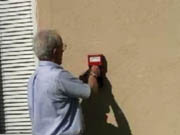
Here are some tips.
1. Always establish the base line on a wall section that has no openings, no visible signs of moisture intrusion, no surface moisture and know the composition of the wall. Tramax manufactures a non-intrusive meter (photo 1) that has a different setting for thicker EPS.
2. Know the substrate. Gypsum board may have some moisture on the surface of the board but the core is dry.
3. Check the base line setting against a probe meter test.
4. Check several locations in the same area to be sure of a good reading.
5. A dry wall can read anywhere from 5 to 12 percent and be OK.
6. All other non-intrusive readings should be compared to the base line reading.
7. Re-establish base line point every day. Do not assume.
8. The non-intrusive meters can be visualized as airport metal detectors. They read metal and give off false reading. This includes fasteners and flashing.
9. Non-intrusive meters are useless with metal lath found in cement plaster, stucco and some one-coat stucco. Stucco netting, which looks a lot like chicken wire, is also metal, and foil-faced insulation board will put readings off the chart.
10. Non-intrusive meters are very difficult to use with most EIFS drainage systems, because of the fasteners typically used. The sheathing is nailed or screwed, the moisture barrier is usually stapled and the EIFS is most commonly mechanically fastened. There is also a bit of irony involved when using any moisture meter with a drainage system. All drainage systems have a drainage plane at the substrate, which is designed in as a failsafe against moisture intrusion from a myriad of sources including failed flashing and failed sealants.
The only time it functions is when a leak occurs, thereby shielding the substrate and structural members from water by stopping moisture at the face of the drainage plane. So, if a meter reads moisture, is it on the moisture barrier, and what is the conclusion? The conclusion can be that the system is functioning as designed and the moisture barrier is shedding water back out of the drainage plane.
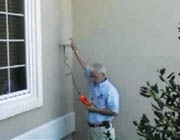
Electrical resistance meters
Electrical resistance meters are considerably more accurate than scanners, but they are intrusive and can cause moisture to penetrate the substrate if probe holes are not sealed properly. There can be other concerns, as well:1. Probes get scratched, so the reading is the highest possible for the thickness probed. For example, if the surface is damp but the sheathing is dry, the scratched probe will read the surface moisture without differentiating from the sheathing. One will end up with a false reading. A product called Plasti Dip, manufactured by Performix, was developed to insulate tool grips against electrical shock. Just dip the probes and let them dry, whenever the probes are showing any wear. Then cut the coating off the tips only and be sure readings are in the substrate where they need to be. Remember, false readings come from uninsulated probes.
2. Some resistance meters have several different settings for accuracy. The Delmhorst BD-2100 (photo 2), recommended for EIFS, has a wood setting, a comparative setting and a gypsum setting. While the conversion from wood to gypsum in most instances is linear, there are some substantive differences at higher moisture elevations. The scale for wood is 5 to 40 percent with 20 percent being the level for wood rot to exist. The scale for gypsum is .2 to 6 percent, with 1 percent considered the beginning of unacceptable moisture levels.
The conversion scale equates 1 percent on the gypsum scale to 20 percent on the wood scale. The problem occurs when the substrate reaches saturation. Wood saturation occurs between 25 and 40 percent moisture content. This means the wood cannot absorb any more moisture; so any reading above saturation is irrelevant. Gypsum, on the other hand, contains water attached to gypsum molecules that gets released during saturation, which results in destruction of the core molecular structure—and the gypsum literally falls apart.
It should be noted here that the captive water in gypsum could also be released through thermal intervention, such as a fire, effectively cooling the gypsum and retarding the transfer of BTUs through a gypsum wall assembly. The amount of time the gypsum retards the transfer of heat is directly related to the thickness of the gypsum. One-half-inch gypsum on a wall assembly is a half-hour wall, a layer on each side of the assembly is a one-hour wall, etc. The point is do not record readings on gypsum sheathing that exceed saturation since the gypsum is likely to be at or beyond the point of disintegration.
3. Meter batteries need to be checked.
4. Knowing the wall assembly is important to be able to judge probe depth. Thickness of EPS, especially around windows with EIFS picture frames, can be several inches deep.
5. Know the type of system you are inspecting. If it looks like EIFS but has metal control joints, it could be OSC, which usually contains metal and will throw off a reading.
6. Probing metal flashing will give off a false reading.
7. Probing a drainage system can lead to several problems. The probe hole must penetrate the drainage plane to get a substrate reading, which effectively puts holes where there should not be any. Use a hole saw to open a hole large enough (11⁄2-inch diameter) so one can see the drainage plane and avoid any of the fasteners. It also allows one to repair any holes made in the drainage plane with sealant, and uses the EIFS plug from the hole saw, to make a permanent repair of the hole. If the probe does not penetrate the drainage plane, then he moisture being measured is on the face of the moisture barrier, which would be inconclusive.

Not too many holes
The only time to put more than one hole in an elevation is when there is other visible evidence of water intrusion, such as interior stains. There is a bit more about EIFS drainage systems, which can affect the inspection process and equipment used. At least one major EIFS manufacturer has published a technical bulletin stating it will void its warranty if its drainage system is inspected using a meter with probes. Since the non-intrusive meters tend to give off multiple false readings due to the metal it encounters, how can an EIFS inspector determine if there is a moisture problem with the drainage system?An inspector who attempts to probe a drainage system using the conventional method of two pilot holes for the probes will have a nearly impossible task of sealing the probe penetrations, which have pierced the drainage plane membrane. The worst scenario from the manufacturer’s point of view is the inspector will follow the ERC protocol (EIFS Review Committee, North Carolina), which can require 100 to 200 probe holes, all of which will be inflicted at the most vulnerable locations, including below windows and mullions, below kickouts, and below flashing and decks.
Even though the probe holes are relatively small, they can add up. To put it into perspective, about 25 probe holes fit in a square inch, so there are 4 to 8 square inches of exposed substrate through the drainage plane membrane using the ERC protocol. What about the EIFS fasteners and staples holding the membrane in place? They both remain in the wall plugging the hole, but the fact is we really do not know what their long-term performance will be.
We also do not know what the long-term performance of the drainage system will be. The system makes sense and it incorporates a secondary drainage plane to repel moisture coming from the building envelope, which should not leak in the first place, but there is very little experience to call upon with these new systems. There are some things that can go wrong with a drainage system, which could result in moisture intrusion into the substrate, so we need a way to check for moisture in the substrate.
The drainage system works only if the drainage membrane is installed correctly. Too often, the paper or Tyvek is lapped the wrong way, flashing goes over the membrane when it should go under or under when it should go over. Roof, chimney or deck flashing can be improperly installed.
“Other” trades damage the membrane or puncture it to run utilities, fixtures, etc. There is no drainage track. The only time the drainage membrane can be inspected is when it is installed, prior to the EPS. Any time after this, it is completely concealed. If an EIFS system cannot be inspected, how can the efficiency of the system be independently verified? Inspectors need to respect the valid concerns of the manufacturers, but rescinding a warranty for moisture probing would leave destructive testing as the only means to verify the integrity of the system, and that is just to drastic a procedure for what can be a relatively simple moisture inspection.
Temperature also has an effect on readings. At 80 degrees F, a 20-percent reading converts to 19-percent moisture on the Delmhorst meters. This is the difference between a marginal reading and a reading that supports wood rot. Lower temperatures are generally adjusted upward, so a 15-percent reading at 20 degrees F converts to 20 percent.
Relative humidity should not affect probe readings. The probe is reading the electrical resistance between the two probes at the tip of the probes, not the surface of the wall. One is reading the actual moisture content with a resistance meter. Relative humidity can affect the overall readings on any given project. A long period of low RH can cause the wall system that contains high moisture readings, to dry out, thereby registering low moisture readings.
Get the wet out
Ultimately, the current non-intrusive meters are very subjective and difficult to defend in court. The resistance meters are quite reliable but still require user knowledge. There are several “radio wave” non-intrusive meters on the market, which can be useful for limited ranges, usually no more than 3/4 inch, which eliminates EIFS.When there is extended low humidity, substrate probes can be useful. One of Exterior Design Institute’s graduates invented the SRT or structural resistance tester (photo 3), which measures the amount of force required to penetrate through the substrate. The more moisture damage in the substrate, the less resistance it takes to penetrate it. One can then compare actual force to dry force and estimate substrate damage. For example, plywood sheathing has a maximum force to penetration of 42 pounds. If the actual reading is 20 pounds, then the plywood has experienced moisture/wood rot damage. It is then practical to open the wall to investigate further.
Looking for a reprint of this article?
From high-res PDFs to custom plaques, order your copy today!