Walls & Ceilings logo
search
cart
facebook twitter linkedin youtube youtube Spotify Podcasts Apple Podcasts Spotify Podcasts Apple Podcasts
  • Sign In
  • Create Account
  • Sign Out
  • My Account
Walls & Ceilings logo
  • NEWS
  • TOPICS
    • Drywall
    • Stucco/EIFS
    • Ceilings
    • Steel Framing
    • Fireproofing
    • Interior Plaster
    • Building Envelope
    • Insulation
    • Technology
    • Interior
    • Exterior
    • Women In Construction
  • COLUMNS
    • Up Front
    • All Things Gypsum
    • Art & Craft of Plastering
    • Stucco Stop
    • Steel Deal
    • Industry Voices
  • PRODUCTS
    • Buzz Guide
  • EVENTS
    • Industry Events
    • Webinars
    • BUILD Expo
  • MEDIA
    • Videos
    • Podcasts
    • Photo Galleries
    • BUILD26 Videos
    • Take our Quiz!
    • Infographics
  • EXCLUSIVE
    • Newsletters
    • Top 50 Contractors
    • Contractor of the Year
    • State of the Industry
    • W&C Store
    • Market Research
    • CEUs
    • Sponsor Insights
    • Custom Content & Marketing Services
  • DIRECTORY
  • EMAGAZINE
    • eMagazine
    • Advertise
    • Archive Issues
  • SIGN UP!
Columns

All Things Gypsum
Gypsum Board Basics
July 1, 2002
The head of the Gypsum Association's introductory column


Gypsum board is a versatile, efficient and economical building material whose application can be easy and fast. However, occasional installation questions may arise that need answers in order to maintain the quality of the job. Therefore, I thought it appropriate for my inaugural column to focus on some gypsum board installation facts that you may not know. (On behalf of the gypsum board industry, I am looking forward to bringing you helpful information in this monthly column.)

Fastener is the generic term used to refer to the nails, screws and staples with which gypsum board is generally attached to framing. (Adhesives are also used with nails and screws but are generally not considered to be fasteners.) While nails are commonly used in wood frame construction, many contractors prefer screws because they can be applied with a screw gun that speeds the installation process. In addition, screws have excellent holding power. Many contractors are uncertain about using nails and screws together in the same board. A combination of nails and screws may be used, in both fire-rated and non-rated systems; nails should be used along the edges, and screws should be used in the field. Some contractors prefer staples because they are economical and can be quickly applied with a staple gun. However, staples should only be used on the base-layer in multi-layer systems or on gypsum sheathing or gypsum lath attached to wood framing.
Control joints

Control joints may be pre-fabricated or fabricated on the job site from suitable materials. Pre-fabricated control joints are manufactured in various shapes and sizes and are used to serve a number of different stress-related functions. Control joint installation methods depend on the shape and function of the joint. Locations of control joints should be shown on the plans; they must be specified by the architect or designer where any of the following conditions exist:

o A partition, wall or ceiling traverses a construction joint (expansion, seismic or building control element) in the base building structure.

o A wall or partition runs in an uninterrupted straight plane exceeding 30 linear feet.

o A control joint is incorporated as a design accent or architectural feature.

Control joints for interior ceilings with perimeter relief should be installed so that linear dimensions between control joints do not exceed 50 feet and total area between control joints does not exceed 2,500 square feet.

Control joints for exterior ceilings and soffits, and interior ceilings without perimeter relief should be installed so that linear dimensions between control joints do not exceed 30 feet and total area between control joints does not exceed 900 square feet.

A control joint or intermediate blocking should be installed where ceiling framing members change direction.

Seek appropriate resources

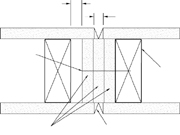
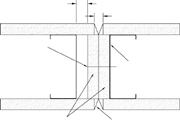
Control joints in acoustical or fire-rated systems require special treatment to maintain the ratings. Contractors should refer to appropriate technical publications for specific installation recommendations such as those detailed in the accompanying illustration which appears in the Gypsum Association's "Fire Resistance Design Manual" (GA-600-2000).

There are a few facts relating to fire-rated construction of which all contractors should be aware. For example, you may use a greater stud size (depth) in metal- or wood-stud systems than the tested size. Metal studs of heavier gauge than those tested also may be used. Remember, a stud of greater size and heavier gauge is permissible, but a stud of smaller size is not.

In floor-ceiling or roof-ceiling systems, the fire-resistance rating may be reduced by the addition or deletion of mineral or glass fiber insulation in ceiling joist spaces. You can add up to 163/4 inches of 0.5 pcf glass fiber insulation (R-40), either batt or loose-fill, to any 1- or 2-hour fire-rated floor-ceiling or roof-ceiling system that has a cavity deep enough to accept the insulation. However, if insulation is added to a system that was not tested with insulation, one additional layer of type X gypsum board, at least 1/2 inch thick, must be applied to the ceiling. This additional layer of gypsum board should be applied as described for the face layer of the tested system; the fastener length should be increased by not less than the thickness of the additional layer of gypsum board.

Metallic outlet boxes may be installed in wood and steel stud walls or partitions that have a fire-resistance rating of two hours or less. However, you should be mindful of several requirements. The surface area of individual boxes should not exceed 16 square inches; the aggregate surface area of the boxes should not exceed 100 square inches in any 100 square feet of wall or partition surface area. Boxes located on opposite sides of rated walls or partitions should be in separate stud cavities and should be separated by a minimum horizontal distance of 24 inches. Approved nonmetallic boxes may be permitted; check your local building code for specific information.

I hope these installation facts will improve your knowledge and confidence in gypsum board installation. If you have any questions about installation or other technical issues relating to gypsum board, contact me in care of the magazine or visit the Gypsum Association's Web site at www.gypsum.org. Our Web site is a useful resource and provides information about contacting our technical staff.W&C

Share This Story

Looking for a reprint of this article?
From high-res PDFs to custom plaques, order your copy today!

Recommended Content

JOIN TODAY
To unlock your recommendations.

Already have an account? Sign In

  • Abercrombie & Fitch

    EIFS in 2026: How Specialty Finishes Are Redefining Exterior Wall Systems

    As building codes, owner expectations, and design demands...
    Stucco/EIFS
    By: Regi Mendoza
  • proper air and vapor control

    From Energy Efficiency to Moisture Management: Why Air and Vapor Control Matter

    How proper air and vapor control within building...
    Building Envelope
    By: Benjamin Meyer AIA, LEED AP
  • Linear Metal Ceiling Beam Baffles

    Top 25 Ceiling Contractors of 2026

    Suspended ceilings demand precision, code compliance and...
    Ceilings
    By: John Wyatt and Tanja Kern
You must login or register in order to post a comment.

Report Abusive Comment

Manage My Account
  • eMagazine Subscription
  • Newsletters
  • Online Registration
  • Manage My Preferences
  • Subscription Customer Service

More Videos

Sponsored Content

Sponsored Content is a special paid section where industry companies provide high quality, objective, non-commercial content around topics of interest to the Walls & Ceilings audience. All Sponsored Content is supplied by the advertising company and any opinions expressed in this article are those of the author and not necessarily reflect the views of Walls & Ceilings or its parent company, BNP Media. Interested in participating in our Sponsored Content section? Contact your local rep!

close
  • medical professionals moving a patient on a stretcher through the halls of a medical building
    Sponsored byNational Gypsum Company

    What Does High Performance Mean When It Comes To Gypsum Boards?

Popular Stories

Linear Metal Ceiling Beam Baffles

Top 25 Ceiling Contractors of 2026

Wichita Biomedical Campus

Wichita Drywall Worker Dies After Scaffolding Fall

QXO Just Changed the Game-Here's What Contractors Are Asking

QXO Just Changed the Game-Here's What Contractors Are Asking

Construction workers in safety vests install drywall

Gypsum Sales Hold Amid Market Shifts in the U.S.

Events

June 24, 2026

The Bright Side & Benefits of Designing with Integrated Lighting

Credits 1 AIA LU/HSW; 0.1 ICC CEU

This course will explore the pivotal role architects and lighting design play in creating safer, more sustainable spaces. Learn how to avoid common lighting mistakes and make informed decisions that create the best visual environment for occupants. 

January 1, 2030

Webinar Sponsorship Information

For webinar sponsorship information, visit www.bnpevents.com/webinars or email webinars@bnpmedia.com.

See our full library of webinars

View All Submit An Event

Products

2026 National Painting Cost Estimator

2026 National Painting Cost Estimator

See More Products

Related Articles

  • All Things Gypsum
    Gypsum Board Vocabulary Builder

    See More
  • All Things Gypsum
    Gypsum Board Townhouse Separation Wall Systems

    See More
  • All Things Gypsum
    Gypsum Industry and Standards: The Creation Process

    See More

Related Products

See More Products
  • Builder's Guide to Stucco, Lath & Plaster

  • 2021 ibc.jpeg

    2021 International Building Code® Illustrated Handbook

See More Products

Events

View AllSubmit An Event
  • NFCA

    NFCA's Board of Directors and Leadership continue to discuss the possibilities for NFCA Educational Events in 2021.
View AllSubmit An Event

Related Directories

  • PABCO Gypsum

    Family owned and operated, PABCO Gypsum has been providing top quality gypsum wallboard products and superior customer service throughout North America for nearly 50 years. The company produces a broad range of gypsum drywall products for residential and commercial applications including mold, fire, sound and impact-resistant boards. This includes QuietRock, the first and most technically advanced sound reducing drywall panel in the industry. PABCO Gypsum, along with PABCO Paper and Roofing Products are divisions of PABCO Building Products LLC that services the building industry in the United States and Canada.
  • Gypsum Association

    Established in 1930, the Gypsum Association is the technical center for the application, finishing, and overall use of gypsum panel products. In addition to responding to technical inquiries, the Association maintains a library of technical publications, most of which are free to architects, specifiers, builders, contractors and code officials.
×

Connect with the industry’s leading resource for unparalleled insights and education.

Join thousands of industry professionals today. Shouldn’t you know what they know?

JOIN NOW
  • RESOURCES
    • Advertise
    • Contact Us
    • Directories
    • Store
    • Want More
  • SIGN UP TODAY
    • Create Account
    • eMagazine
    • Newsletters
    • Customer Service
    • Manage Preferences
  • SERVICES
    • Marketing Services
    • Reprints
    • Market Research
    • List Rental
    • Survey/Respondent Access
  • STAY CONNECTED
    • LinkedIn
    • Facebook
    • Instagram
    • YouTube
    • X
  • PRIVACY
    • PRIVACY POLICY
    • TERMS & CONDITIONS
    • DO NOT SELL MY PERSONAL INFORMATION
    • PRIVACY REQUEST
    • ACCESSIBILITY

Copyright ©2026. All Rights Reserved BNP Media, Inc. and BNP Media II, LLC.

Design, CMS, Hosting & Web Development :: ePublishing
