Germantown's Sacred House
One of my former students called to ask if I wanted to look at a job that was more extensive than she could handle. The next day, the designer called with the address and some information about the job. When he said it was the former home of the Pennsylvania state capitol architect Joseph Huston, this immediately caught my attention.
In 1883, he entered the famous Philadelphia architectural firm of Furness and Evans, where he stayed for five years. In his free time, Huston studied Latin, Greek and mathematics with a tutor, enabling him to enter Princeton in 1888. At Princeton, his closest friends included architect Frank Hays, painter Edward Redfield, and sculptor Alexander Stirling Calder. Undoubtedly, it was this circle of artistic friends that helped develop Huston's architectural and artistic sensibilities evident in the Pennsylvania state capitol, and the Oaks Cloister.
Great art
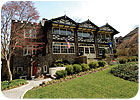
Artistic works by a variety of people who worked in the state capitol are found in the Oaks Cloister. The home contains pieces by Edwin Austin Abbey, Henry Mercer, George Gray Barnard, Violet Oakley and William Brantley Van Ingen. The Oaks Cloister is a magnificent 20-room turn-of-the-century mansion, which retains the original grandeur it possessed during Huston's occupancy. Located in historic Germantown (neighborhood in Philadelphia), the Oaks Cloister is an eclectic blend of English Tutor and Craftsmen influences. Using his architectural imagination and expertise Huston designed his Oaks Cloister to serve as both a functional home and elegant showplace for his ever-growing collection of art. Traces of his grand scheme for the state capitol can be found throughout the home.We asked one of the owners what exactly he was looking to do. He wanted to make it livable by updating the kitchen to include modern appliances and a master suite on the third floor, while keeping as much of the original artwork and features the house had.
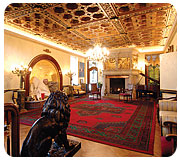
We started our walk-through in the sitting room. The gilded ornament, ceiling strap work, egg and dart crown, the same as was used in the state capitol, had been painted over by the previous owners. A carved boar hunt fireplace cast by Alexander Sterling Calder adorned the room. The original one was carved for the Mercersburg Academy, in Pennsylvania. The doors and trim were beautifully wood grained.
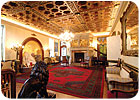
After our walk-thru of the three floors in the main section of the house, we started to make our way down the curved staircase into the ballroom. This room was eye candy for any decorative painter. At the far end of the ballroom was a 15th century carved caen stone fireplace with four gilded panels. The fireplace is a copy of the "Chimnee de Couleur," originally made for King Francis I and displayed in the Cluny Museum in Paris. In the fireplace set four gold leaf panels representing the story of the "Sacra Casa," the legendary house of the Virgin Mary that was carried by angels across the Adriatic Sea to Loretto, Italy, where it supposedly remains today.
One hundred years of solitude
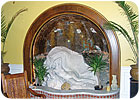
The ceiling was a gilded and polychrome-coffered ceiling. To the left was a niche that held the statue "Venus in the Waves," by George Gray Barnard. Huston commissioned Barnard to create other sculptures located outside of the state capitol building. The niche was covered with 1/2-inch-by-1/2-inch amber glass tiles gilded with silver leaf on the back. Huston made the niche into a grotto. Of course the grotto, as well as the rest of the room, hadn't really been touched in a hundred years. Therefore, everything was in poor condition.The ceiling was covered with a lot of soot and dirt, the grotto was leaking and the entire tile finish was damaged. The fireplace and gilded panels were also dirty. We suggested that it might be cheaper to redo the ceiling rather than restore the existing work.
The first thing that had to be done was to analyze what exactly the existing colors were and to what extent the gilding was damaged. As for the fireplace, we cleaned it thoroughly, and the damaged portions could be replaced and regilded. For the grotto, we removed all the tiles. We would replaster the damaged areas to make it watertight and then replace all the glass tiles.
Once we did the analytical work, we put together a budget for the project. Once approved, we did a mock up of one of the coffered ceiling sections. The owner wanted to know if it would be possible to get the ceiling done in 30 days. Therefore, the first phase of our work was to clean the soot from the ceiling. Then we repainted the ceiling with the new colors. The background field on the ceiling was a royal ultramarine blue color.
We decided to spray the background color, as this would save us the most time. Inside each of the coffers were alternating colors of blue and red. The outside field was painted an old-gold color and of course, all the ornament was gilded. Once all of the background colors were finished, we began the process of gilding to cover the ornament. The first process of gilding was to apply the size for the ceiling ornament. We used a 12-hour size and once this reached tack, we applied the gold leaf. We applied 25,000 sheets of gold leaf, burnished and sealed them, and then toned all of the gilded ornament.
We used a Vulpex solution for the 15th century fireplace. We cleaned the gilded panels and hand carved the missing heads and regilded them. Then we used a poultice to pull the dirt out of the stone.
The first order of business on the grotto was to get the outside sealed to prevent it from leaking. We patched the cracks and covered it with a rubberized roofing material. We scraped the tile off the domed area and removed all the stonework from the inside. At this point, we cleaned the statue of "Venus in the Waves" then covered it to protect it. We found a stain glass manufacturer in Germany that carried the amber-colored glass that was used inside the grotto.
In the studio, we gilded all the glass with silver leaf using a gelatin size. As the glass panels were finished, we sealed the backside with the decor enamel and packed the glass up to take to the job site. Once the glass was unpacked on the job site, we began cutting it into 1/2-inch-by-1/2-inch squares and began the process of applying the glass tiles to the dome. Once we finished the job of applying the 11,500 glass tiles, we had to re-lay all the stone inside the grotto behind the statue. For additional lighting to the dome, we built a light trough in the stonework. It looked stunning once completed.
Faux play
While working in the ballroom, we found some original silk damask on the walls behind the bookcase. We told the owner we could reproduce it in a faux finish. We suggested that the white wainscot be marbled and gilded, and that we apply a caen stone finish on the light trough around the ceiling area. To finish off the area, we suggested we use the literary inscriptions and themes from the ceiling and paint them in trompe l'oeil style to make them seem like they were cut into the stone. He agreed that it would tie the room all together.We covered the yellow walls with a pearl glaze and then stenciled the damask pattern on top of it with flat latex. We marbleized the wainscot with green vert marble and sienna panel inserts and gilded the highlights on selected areas of the trim. The light trough around the ceiling was stippled with glazes to imitate the caen stone of the fireplace. Once this was completed, we took the Latin bookmarks and painted them into the area above the light trough in the ceiling to finish off the area.
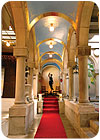
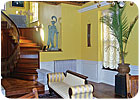
We needed a design for the stairway that would flow into the ballroom. The stairway was basecoated the same color as the walls in the ballroom. We wanted to use the same colors but we felt that the damask might be a little overpowering in the stairway because of the height. We chose to do a silk stripe pattern with the same techniques as we used for the damask.
Here we covered the yellow walls with a pearl glaze again and we used lasers to strike out the walls with masking tape. Once the area was masked off, we applied our light yellow flat acrylic latex and when finished, we removed the tape. To really make this area standout, we decided to gild pinstripes between each of the stripes. We then carried the yellow out onto the white ceiling and applied a Victorian stencil to the frieze and ceiling. Then on the head wall of the staircase we reproduced a section of "The Unity Mural," painted by Violet Oakley, which is at the Pennsylvania state capitol. In the studio, we cast a centerpiece for the chandelier and installed it on the ceiling. To make the job look complete, we gilded the spindles in the staircase.
The job began in October and wrapped in November, just in time for the homeowners big party they wanted to hold and for the holiday season. It was a lot of work and demanded great attention to detail but we're pleased with this and so are the homeowners. When in Philly, take a stroll around Germantown and look for the home. When doing high-profile projects and/or historic homes, research the history of the house and brush up on your knowledge of restoration. This information goes a long way.
Looking for a reprint of this article?
From high-res PDFs to custom plaques, order your copy today!


