The Finish Line: Terminations and Wrapping

Probably the most common question I get asked about EIFS is “How come they leak?” Well, actually, the EIFS itself does not leak. When there is a leak, almost always the water is getting around the edge of the system, where it terminates.
Every wall cladding stops and starts somewhere, including EIFS. How the design and construction of terminations of any wall cladding are handled is critical, and with EIFS this involves some way of “wrapping” the EIFS around its edge. The wrapping can take the form of the EIFS itself (the coatings), or some type of accessory, such as flashing. There are a number of wrapping techniques–more than you probably realize–and in this month’s column I’ll show some examples of termination and wrapping conditions, and what to do, and not do. If you are working with A/E’s, you may find this primer helpful for explaining the various termination techniques.
First things first: The edge of an EIFS is virtually never terminated by simply hacking off the edge and leaving exposed raw foam. This frequent cost-cutting trick is a recipe for degraded foam, leaks, and bugs getting in. The key point is that some form of “wrapping” is needed.
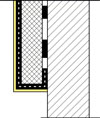
Illustration 1
Backwrapping
A traditional backwrap is shown in Illustration 1, in the form of the base of a solid wall. The black is the base coat or the attachment adhesive, and the dotted white line is the mesh. The finish is in yellow. The drawings are not to scale, but are emphasized for clarity purposes. This common way of showing the condition can be misleading, as it doesn’t really show what’s going on and how it is constructed.There are several ways of creating a backwrap.
Version A1. A common way of building this detail is to somehow affix a strip of mesh to the substrate. One way is to staple a narrow strip of mesh to a substrate (like wood), without adhesive, and let the mesh hang loose. Then the backside of the foam is spread with adhesive, and the foam is applied to the substrate.
Version A2. A variation of the above method is to use adhesive to hold the mesh in place (works on hard substrates like masonry) and then apply the foam boards.
In both cases, the end of the insulation board and a portion of the face have adhesive applied to them, and the dangling mesh is brought around and embedded in the adhesive.
A proper backwrap pretty much seals the edge of the system, so if water gets between the foam and the substrate, it has a hard time getting out. Therefore this technique is bad for the bottom horizontal edge of EIFS with Drainage; see Illustration 2.
Version B. This is sometimes called prewrapping. It involves wrapping the mesh onto the back side of the foam before the foam piece is installed. The semi-completed piece is then taken to the substrate and attached. This technique can be handy when access to the edge of the foam is blocked from trowel access. By using this technique, foam pieces can be fitted into inaccessible, tight spaces. Sometimes contractors prewrap boards at the warehouse and let them cure. They then take them as ready-to-install pieces and attach them to the substrate. This is a good rainy day activity when working at the job site is not possible.
Backwrapping has a problem with sheathing/stud substrates, where the edge of the sheathing is exposed and could be affected by water leaks in the vicinity.
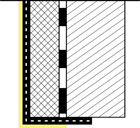
Illustration 2
Edge Wrapping
An edgewrap is shown in Illustration 2, in the form of what might be a door head on a solid wall. This method is fast and easy, but also has its issues.For one, you need access to the edge of the substrate opening. If the windows are already in place, there’s no way to get to the substrate. This condition occurs frequently with retrofit EIFS applications, when the windows stay in place. It doesn’t work with nail flange windows either.
This method works great on prefab panels, as it really locks the EIFS to the substrate and the panel frame, and is easy and fast.
This method really seals the edge of the EIFS, so it’s not used at the bottom horizontal edges of EIFS with Drainage.

Illustration 3
EIFS with Drainage
EIFS with Drainage has to create the full drainage path for the water at the edge of the EIFS. Providing this weeping capability requires leaving the bottom horizontal edge of the EIFS open in some manner. There are a number of ways to do this, but keep in mind that the drainage cavity itself needs to be open at the bottom too, so Version A1 and A2 don’t work. Instead, Version B is used, and the prewrapped foam piece is then mounted on the substrate over the water resistive barrier, thus taking into account that the cavity needs to be kept open. This method works well when a plastic mesh spacer is used to create the drainage cavity; see Illustration 3. It doesn’t work well when foam with vertical slots on the back (to create the drainage path) is employed.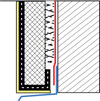
Illustration 4
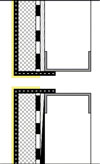
Prefabricated Panels
EIFS with Drainage is used mostly on wood framed residential structures, and prefab panels are used mostly on large commercial jobs. Using some sort of drainable edge on prefab panels is complicated to design and build. Look at Illustration 5, which shows a typical prefab panel horizontal joint. How you would add drainage, or would you even incorporate flashing in traditional barrier EIFS prefab panels? Panels are almost always edgewrapped, although once in a while backwrapping is used to allow incorporation of factory-installed flashings.In Europe, the use of trim, embedded into the edge of the EIFS, is much more common than in North America. In Europe they use much thicker base coats and thus have a lot of “meat” in the coatings to keep the trim in place.
Since the edge of the EIFS is so critical in providing viable weatherproofing, this subject of easier, more effective termination techniques strikes me as a worthy research project. I’ve often toyed with the idea of creating a group or institute that does this sort of research on EIFS issues, like other established products have–such as PCA for concrete–and so on. This area of technical research would be one of my first projects, or perhaps an individual could develop some clever edge treatment that does the job, and make a buck at it.
Looking for a reprint of this article?
From high-res PDFs to custom plaques, order your copy today!




