London Calling
The Natural History Museum in London will be turning heads with a massive Cocoon.
Ironically, the Darwin Centre Phase Two project is more of a tale of creation than evolution. The Natural History Museum’s Phase 2 in London features one of the city’s most architecturally radical sights-a functioning Cocoon. The design fits with science themes by the building’s namesake-Charles Darwin. One of the oldest of London’s most treasured buildings, the £75 million ($114 million) extension is the largest since the structure located to its South Kensington site in 1881. It also showcases a new architectural icon that is unique in its technical and creative endeavors.
 This new design, a free-standing structure, is a Cocoon housed within a glass atrium. This holds the world’s largest collection of plant and insect specimens, a unique anthology of 17 million insects and three million plants collected over the last 300 years by such scientists as Charles Darwin, Alfred Russel Wallace and Sir Hans Sloane. The structure also houses state-of-the-art laboratories for 250 international scientists and an interactive visitor exhibition.
For the Cocoon, Danish architect C. F. Møller approached the design literally by creating a silk bubble with a series of ivory-colored threads with a subtle sheen that criss-cross on the surface. To start the process a 65 meter long (213 feet), eight-story high structure was built by sprayed concrete specialist Shotcrete. Expanded metal mesh was fitted to a skeletal steel rebar framework and a 250 millimeter (9.8 inches) thick layer of concrete spray applied to create a 3,500 square meter (37,670 square feet) raw concrete surface.
 “The
skeletal frame of the Cocoon is the rebar, bent and built-up around the
scaffolding with fixed points and worked (shaped) on site in accordance with
the 3-D model by extracting the coordinates in a similar way ... to when we set
out our control joints,” says Vincent O’Brien, UK contracts director for
Armourcoat.
“The
skeletal frame of the Cocoon is the rebar, bent and built-up around the
scaffolding with fixed points and worked (shaped) on site in accordance with
the 3-D model by extracting the coordinates in a similar way ... to when we set
out our control joints,” says Vincent O’Brien, UK contracts director for
Armourcoat.
The Cocoon also performs a genuinely protective job. The concrete structure itself provides thermal mass to inhibit any fluctuations to the inside temperature of the unit. The outer surface was insulated with EPS as well to shield the concrete as much as possible from external temperature variations. With the outer layer exposed to the sun on one side through the glass façade, movement of the surface was a worry.
“From our point of view, we wanted a single point of responsibility for the insulation and polished plaster package,” says Alan Grant of HBG Construction. “Only specialist contractor Armourcoat was capable of taking this on.”
“Alan Grant of BAM (formerly HBG) Construction employed our product knowledge to ascertain sequence of work, program constraints and design capabilities all at one time under the direction of the Architect CF Møller,” says O’Brien. “This was the first time anything like this had been created so most of the hard work was in the build-up/preparation and key discussion stages.”
 While
Shotcrete achieved an excellent overall shape to the Cocoon structure with the
spray concrete, there were still localized variations to the surface of up to
plus/minus 30 millimeters (1.1 inch). Before the polystyrene insulation layer
could be fixed to the surface, it was necessary to dub out almost the entire
surface of the Cocoon with a resin modified render. The render was applied to
fill out any hollow areas of the surface and was ruled off freehand using 2.4
meter (7.8 feet) lengths of plywood that could be flexed to the localized shape
of the surface. A 50 millimeter (1.9 inch) polystyrene layer was then fixed by
Armourcoat specialists to the concrete surface using Dryvit Genesis adhesive
and more than 16,000 Hilti insulation fasteners. Any slight lips or ridges in
the polystyrene were then rasped off and the entire surface of the Cocoon was
coated with a layer of reinforcing mesh bedded into two layers of Dryvit
Genesis basecoat.
While
Shotcrete achieved an excellent overall shape to the Cocoon structure with the
spray concrete, there were still localized variations to the surface of up to
plus/minus 30 millimeters (1.1 inch). Before the polystyrene insulation layer
could be fixed to the surface, it was necessary to dub out almost the entire
surface of the Cocoon with a resin modified render. The render was applied to
fill out any hollow areas of the surface and was ruled off freehand using 2.4
meter (7.8 feet) lengths of plywood that could be flexed to the localized shape
of the surface. A 50 millimeter (1.9 inch) polystyrene layer was then fixed by
Armourcoat specialists to the concrete surface using Dryvit Genesis adhesive
and more than 16,000 Hilti insulation fasteners. Any slight lips or ridges in
the polystyrene were then rasped off and the entire surface of the Cocoon was
coated with a layer of reinforcing mesh bedded into two layers of Dryvit
Genesis basecoat.
As it emulates a natural object, the Cocoon is totally free-form and proved difficult to define mathematically. A specialist surveying company was employed to survey the actual shape of the Cocoon and enable accurate comparisons with the 3-D model design. The next step was to extract all the data from the design model to establish the position of all the control joint lines and to then plot these onto the actual surface of the Cocoon. The control joints, or reveals, were aesthetic, in giving the cocoon a spun web look, as well as functional to allow some expansion and contraction. With a total of 2.8 kilometers (more than a mile and half) of both straight and curved control joints, each and every line had to be plotted at 0.5 meter intervals onto the surface of the Cocoon.
 The
next part of the process was to cut a 28 millimeter (1 inch) wide chase along
the line of each control joint. Bright mild steel bars measuring between 3 to 6
meters (9.8 to 19½ feet) were flexed and fixed onto the surface of the Cocoon
to follow the plotted points for each of the lines. Based on a Makita
twin-wheel cutter, the Armourcoat technical team then designed and built a
special cutting device that could be locked onto the 12 millimeter (1/3 inch)
bars and would move back and forward freely on two rollerblade wheels. In the
center of this machine were two cutting discs located on a common axle which
could cut an accurate slot in the surface of the Cocoon.
The
next part of the process was to cut a 28 millimeter (1 inch) wide chase along
the line of each control joint. Bright mild steel bars measuring between 3 to 6
meters (9.8 to 19½ feet) were flexed and fixed onto the surface of the Cocoon
to follow the plotted points for each of the lines. Based on a Makita
twin-wheel cutter, the Armourcoat technical team then designed and built a
special cutting device that could be locked onto the 12 millimeter (1/3 inch)
bars and would move back and forward freely on two rollerblade wheels. In the
center of this machine were two cutting discs located on a common axle which
could cut an accurate slot in the surface of the Cocoon.
Once all the intersecting lines had been chased into the surface each of the 340 panels could have special beads applied to the edges. Armourcoat designed, developed and prototyped a special bead/shadow gap design that could achieve the required design aesthetic onto a double curved surface.
 A
total of 5.6 kilometers (more than 3 miles) of edge bead was applied to the
islands and then 1.7 miles of the “M” section insert was clipped into position
to locate between the two edge beads. Every junction had to be accurately hand
mitered with some of the lines crossing over each other at acute angles of as
little as 15 degrees. This patented design not only achieved the correct design
and shadow gap detail, but can also accommodate for thermal expansion and
movement between the panels.
A
total of 5.6 kilometers (more than 3 miles) of edge bead was applied to the
islands and then 1.7 miles of the “M” section insert was clipped into position
to locate between the two edge beads. Every junction had to be accurately hand
mitered with some of the lines crossing over each other at acute angles of as
little as 15 degrees. This patented design not only achieved the correct design
and shadow gap detail, but can also accommodate for thermal expansion and
movement between the panels.
Armourcoat’s AntiCrack substrate preparation system was then applied. AntiCrack is a cost effective polymer and fiber-modified gypsum skim-coat plaster and provides a substrate that will keep the top layer in fine condition for many years without fear of shrinkage or cracking. Once the AntiCrack had cured and dried out, two layers of the company’s Keycoat were applied prior to the application of the final finish. The final finished effect of a giant silk Cocoon was achieved using ivory colored Armuralia polished plaster, also provided by Armourcoat. Armuralia provided a silky smooth finish with subtle tonal variations.
The finished Cocoon project is a milestone achievement, a strong design and technical solution befitting the historic and social reference of the Natural History Museum. Our thesis is that Darwin would’ve been proud.
Specialist Contractor: Armourcoat Ltd.
Client: Natural History Museum
Architect: C. F. Møller, Denmark
Main Contractor: HBG Construction
Rhino
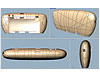
modeling software details the intricate “silk thread.”
Ironically, the Darwin Centre Phase Two project is more of a tale of creation than evolution. The Natural History Museum’s Phase 2 in London features one of the city’s most architecturally radical sights-a functioning Cocoon. The design fits with science themes by the building’s namesake-Charles Darwin. One of the oldest of London’s most treasured buildings, the £75 million ($114 million) extension is the largest since the structure located to its South Kensington site in 1881. It also showcases a new architectural icon that is unique in its technical and creative endeavors.
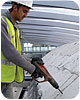
Fixing
the EPS insulation layer with Hilti fasteners.
For the Cocoon, Danish architect C. F. Møller approached the design literally by creating a silk bubble with a series of ivory-colored threads with a subtle sheen that criss-cross on the surface. To start the process a 65 meter long (213 feet), eight-story high structure was built by sprayed concrete specialist Shotcrete. Expanded metal mesh was fitted to a skeletal steel rebar framework and a 250 millimeter (9.8 inches) thick layer of concrete spray applied to create a 3,500 square meter (37,670 square feet) raw concrete surface.
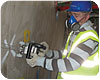
Cutting
the control joints with a modified Makita twin-wheel cutter.
The Cocoon also performs a genuinely protective job. The concrete structure itself provides thermal mass to inhibit any fluctuations to the inside temperature of the unit. The outer surface was insulated with EPS as well to shield the concrete as much as possible from external temperature variations. With the outer layer exposed to the sun on one side through the glass façade, movement of the surface was a worry.
“From our point of view, we wanted a single point of responsibility for the insulation and polished plaster package,” says Alan Grant of HBG Construction. “Only specialist contractor Armourcoat was capable of taking this on.”
The
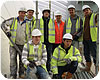
plastering team with Armourcoat CEO Guy Whitehead (center with orange vest).
A GOOD YEAR
Armourcoat became involved as a specialist at the design stage a year in advance of construction commencing, says O’Brien. Members of the company attended various design meetings to interface with other specialists, such as Shotcrete Ltd. and Brogan Scaffolding.“Alan Grant of BAM (formerly HBG) Construction employed our product knowledge to ascertain sequence of work, program constraints and design capabilities all at one time under the direction of the Architect CF Møller,” says O’Brien. “This was the first time anything like this had been created so most of the hard work was in the build-up/preparation and key discussion stages.”
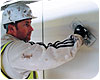
Applying
the Armuralia plaster finish.
As it emulates a natural object, the Cocoon is totally free-form and proved difficult to define mathematically. A specialist surveying company was employed to survey the actual shape of the Cocoon and enable accurate comparisons with the 3-D model design. The next step was to extract all the data from the design model to establish the position of all the control joint lines and to then plot these onto the actual surface of the Cocoon. The control joints, or reveals, were aesthetic, in giving the cocoon a spun web look, as well as functional to allow some expansion and contraction. With a total of 2.8 kilometers (more than a mile and half) of both straight and curved control joints, each and every line had to be plotted at 0.5 meter intervals onto the surface of the Cocoon.
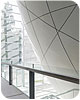
Visitors
view of the cocoon from the museum.
Once all the intersecting lines had been chased into the surface each of the 340 panels could have special beads applied to the edges. Armourcoat designed, developed and prototyped a special bead/shadow gap design that could achieve the required design aesthetic onto a double curved surface.
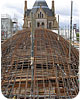
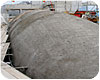
Expanded
metal mesh was fitted to the steel rebar framework, to produce the first above
ground sprayed concrete structural element in the world.
Armourcoat’s AntiCrack substrate preparation system was then applied. AntiCrack is a cost effective polymer and fiber-modified gypsum skim-coat plaster and provides a substrate that will keep the top layer in fine condition for many years without fear of shrinkage or cracking. Once the AntiCrack had cured and dried out, two layers of the company’s Keycoat were applied prior to the application of the final finish. The final finished effect of a giant silk Cocoon was achieved using ivory colored Armuralia polished plaster, also provided by Armourcoat. Armuralia provided a silky smooth finish with subtle tonal variations.
The finished Cocoon project is a milestone achievement, a strong design and technical solution befitting the historic and social reference of the Natural History Museum. Our thesis is that Darwin would’ve been proud.
Sidebar: Team Players
Project: Darwin Centre Phase Two-“The Cocoon,” Natural History Museum, LondonSpecialist Contractor: Armourcoat Ltd.
Client: Natural History Museum
Architect: C. F. Møller, Denmark
Main Contractor: HBG Construction
Looking for a reprint of this article?
From high-res PDFs to custom plaques, order your copy today!