The Finish Line: Firestopping
Firestopping
is an especially important topic for EIFS, due to the system’s unique
multi-layered form of cladding construction.

Firestopping is an especially important topic for EIFS, due to the system’s unique multi-layered form of cladding construction. If you are like a lot of contractors that read W&C magazine and are doing not just the EIFS but also the sheathing, studs and drywall, you need to be especially aware of this. It’s a safety matter.
In the early day of EIFS in North America, EIFS was used mostly on stud walls (metal or wood studs). This is contrary in Europe-from which EIFS came-where solid load bearing masonry walls, spanning several floors are the mainstay. In North America, stud wall construction is the most common substrate system, and the stud cavity often bypasses the edge of the floor-the studs are continuous vertically for several floors. Therein lies the problem.
The concern regarding safety exists because EIFS is essentially a hollow, laminated composite cladding. By “hollow” I am referring to the low density EPS core used in most EIFS, which is 95 percent air. In other words, the EIFS’s EPS core is essentially hollow. And EPS melts at temperatures far below that of flames, and when it does, it reverts back a hard, solid resin, to less than 5 percent of its original density, thereby creating a hollow cavity between the EIFS exterior coatings and the sheathing substrate.
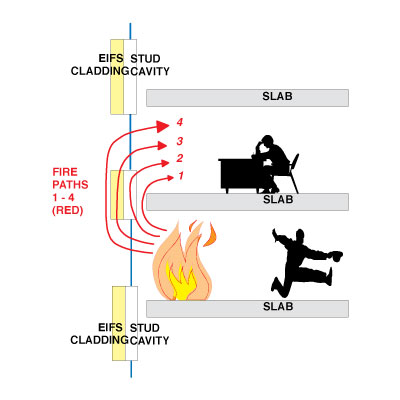
There are several possible routes for the flame to travel from floor to floor:
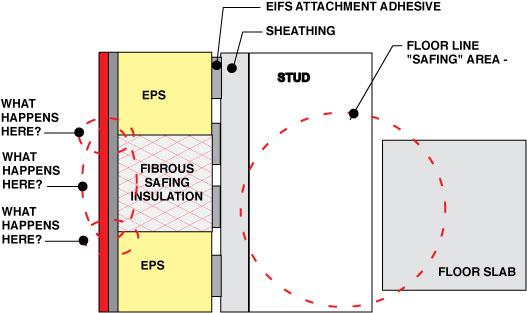
Some jurisdictions, mostly not in the U.S., require firestopping within the EIFS insulation core. This is done by replacing the EPS foam at the floor line with a continuous horizontal strip of noncombustible insulation, such as rock wool. One can imagine all sorts of problems with foam and fibrous materials being next to each other-such as being able to see where the strip is (color change), and cracking. Diagram 2 is an example of what I mean.
Another solution is to require full through-the-EIFS sealant-type joints at every floor line. This can dramatically change the popular seamless look of an EIFS façade, as well as add to initial construction cost and maintenance costs.
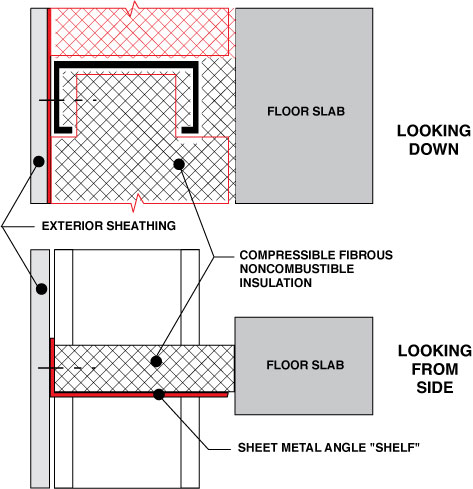
Diagram 3 shows a way of doing this with a sheet metal shelf that supports the insulation. Note that the shelf is installed from the outside as the studs are installed, and allowances are made for the width of the gap between the inside face of the studs and the edge of the slab. Thus, the insulation is compressed to form a tight fit. This type of safing support can be pre-made off-site in stud-spacing-size pieces (for one per stud spacing) or made in strips. They can be trimmed using hand shears to fit corners and other odd stud spacing conditions. This sort of safing detail is usable for stucco or tile or brick veneer panels; it is not EIFS specific, as it is independent of the cladding.
Here’s an important case in point about firestopping: sometimes, the interior drywall does not extend past the ceiling line at the exterior walls. This can occur if the exterior walls are not required to have a fire resistance rating (i.e., “zero hours” is OK, in lieu of a 1 or 2 hour ratings). This can result in the stud cavity being wide open above the ceiling line, allowing the fire to get at the edge of the floor slab if it gets past the ceiling and into the air space between the ceiling and the slab. With no drywall at this location, the fire resistance of the (missing) drywall, and the retarding force it provides against fire heat flow, is not present. Thus the use of fire safing is extra important.
Also, think about the sequence of construction in terms of installing the firestopping material. For instance, there may be structural brackets or embedded steel at the edge of the slab, which gets in the way of installing the safing from the outside.
Firestopping is an especially important topic for EIFS, due to the system’s unique multi-layered form of cladding construction. If you are like a lot of contractors that read W&C magazine and are doing not just the EIFS but also the sheathing, studs and drywall, you need to be especially aware of this. It’s a safety matter.
In the early day of EIFS in North America, EIFS was used mostly on stud walls (metal or wood studs). This is contrary in Europe-from which EIFS came-where solid load bearing masonry walls, spanning several floors are the mainstay. In North America, stud wall construction is the most common substrate system, and the stud cavity often bypasses the edge of the floor-the studs are continuous vertically for several floors. Therein lies the problem.
EIFS Walls at the Floor Slab Area
Sometimes, the studs stop and start at the underside and top of the floor slab. In this case there is no problem-or is there? And then sometimes the studs are outside the floor slab and go right past the edge of the slab. Where is the EIFS cladding itself, in the midst of all of this? The answer: it is outboard, hence EIFS’s basic name: exterior insulation and finish system. This is what makes EIFS unique.The concern regarding safety exists because EIFS is essentially a hollow, laminated composite cladding. By “hollow” I am referring to the low density EPS core used in most EIFS, which is 95 percent air. In other words, the EIFS’s EPS core is essentially hollow. And EPS melts at temperatures far below that of flames, and when it does, it reverts back a hard, solid resin, to less than 5 percent of its original density, thereby creating a hollow cavity between the EIFS exterior coatings and the sheathing substrate.
Diagram
1: Floor-to-floor fire paths. Paths 1 and 2 are not EIFS issues: they apply to any type of wall construction
that supports a cladding-it could be tile or stucco or brick veneer,
too. Path 3 is a definite EIFS issue. Path 4 could be an EIFS issue if the EIFS coatings catch on fire, or if the
flame plume is big enough to extend far up the outside of the wall on its own.
Fire Paths
The issue of fire traveling vertically from floor to floor is often called firestopping and usually involves fire originating from inside the building. In particular, it is about the floor-to-floor spread of fire, mostly in commercial buildings, wherein the wall and floor structure is noncombustible. But the walls might have some combustible materials in them, such as the EPS foam core in EIFS. Hence, one can envision several routes by which flames from a fire might find their way around the edge of the floor slab and get to the next floor-clearly something to be avoided.There are several possible routes for the flame to travel from floor to floor:
- Between the edge of the floor slab and the wall structure (assuming a gap exists between the two);
- Within the stud cavity, if the stud cavity bypasses the edge of the slab continuously;
- Within the core of the EIFS (through the EPS insulation);
- By traveling up the outside face of the EIFS via the coatings burning or by the flame plume coming out a window and going upward against the outside of the façade.
Diagram 2
Codes
The codes normally do not permit combustible materials in the walls of noncombustible types of construction, i.e., commercial buildings (not wood frame low rise buildings). EIFS was granted an exemption into the building codes in the 1980s when large-scale testing showed that the fire neither moves upward within the EIFS EPS core, nor do the EIFS coatings propagate flame. This exemption is now a part of the International Building Code.Some jurisdictions, mostly not in the U.S., require firestopping within the EIFS insulation core. This is done by replacing the EPS foam at the floor line with a continuous horizontal strip of noncombustible insulation, such as rock wool. One can imagine all sorts of problems with foam and fibrous materials being next to each other-such as being able to see where the strip is (color change), and cracking. Diagram 2 is an example of what I mean.
Another solution is to require full through-the-EIFS sealant-type joints at every floor line. This can dramatically change the popular seamless look of an EIFS façade, as well as add to initial construction cost and maintenance costs.
Diagram 3
Construction Details
In paths 1 and 2, the way the fire is prevented from moving vertical from floor to floor is by putting a fire resistant material at the floor line. This is normally done by using some sort of noncombustible compressible fibrous insulation material or pourable material that is supported in a way that prevents it from falling away if subjected to fire. This material is usually called fire safing, and is often some type of mineral wool material.Diagram 3 shows a way of doing this with a sheet metal shelf that supports the insulation. Note that the shelf is installed from the outside as the studs are installed, and allowances are made for the width of the gap between the inside face of the studs and the edge of the slab. Thus, the insulation is compressed to form a tight fit. This type of safing support can be pre-made off-site in stud-spacing-size pieces (for one per stud spacing) or made in strips. They can be trimmed using hand shears to fit corners and other odd stud spacing conditions. This sort of safing detail is usable for stucco or tile or brick veneer panels; it is not EIFS specific, as it is independent of the cladding.
Here’s an important case in point about firestopping: sometimes, the interior drywall does not extend past the ceiling line at the exterior walls. This can occur if the exterior walls are not required to have a fire resistance rating (i.e., “zero hours” is OK, in lieu of a 1 or 2 hour ratings). This can result in the stud cavity being wide open above the ceiling line, allowing the fire to get at the edge of the floor slab if it gets past the ceiling and into the air space between the ceiling and the slab. With no drywall at this location, the fire resistance of the (missing) drywall, and the retarding force it provides against fire heat flow, is not present. Thus the use of fire safing is extra important.
What to Look For
When reviewing the architect’s drawings, check the details at the floor lines to see if the firestopping is present. Simply passing the cavity insulation through the stud cavity at the floor line is not firestopping. Something more durable is needed, as noted earlier.Also, think about the sequence of construction in terms of installing the firestopping material. For instance, there may be structural brackets or embedded steel at the edge of the slab, which gets in the way of installing the safing from the outside.
Looking for a reprint of this article?
From high-res PDFs to custom plaques, order your copy today!




