Soundproofing's Speedy Evolution

Many argue that sound, reverberation and echo control began in ancient Greece. It was there, they say, that construction projects such as the Theater of Epidaurus achieved acoustics that allowed 14,000 spectators to hear sounds as minute as coins dropping on the performance space.
These claims suggest humans have been enhancing sound for thousands of years but in 1922 an American physicist named Floyd Rowe Watson claimed that blocking sound is a far newer endeavor.
“Before 1915 little was known definitely about [soundproofing] and cut-and-try methods were used when soundproofing was desired,” Watson wrote in “Sound Proof Partitions,” a book published in 1922. “These cases were usually isolated and few published accounts are available, so that little progress was made.”
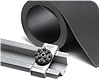
A vinyl sound barrier behind a resilient isolation clip connected to the proper bushing.
The Current Evolution
Watson began to study and record the effects of various plasters, metals and outing flannel on sound, and by the ’50s and ’60s, materials and techniques as diverse as wooden studs, lead, furring strips, plaster, rag-filled cinderblocks and concrete were being used.“Another old approach to blocking noise was the ‘room within a room,’” says David Ingersoll, national sales manager at Acoustical Solutions Inc. “Entire walls were being built with space between them and the original walls.”
While this method worked relatively well, it was far from ideal.
“You would lose so much space and paying for labor, new studs and other materials, it just wasn’t cost-effective in many situations,” Ingersoll says.
One of the next steps in blocking sound transfer arrived when, Ingersoll says, soundproofing condensed into a single wall and was achieved either through a “mass game” or resilient channels.
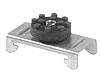
A resilient isolation clip.
Mass stops sound transfer, so the mass game did work but there comes a time when adding additional vinyl or layers of drywall is no longer an option.
The answer to running out of places to add mass came in the form of resilient channels. Resilient channels decouple wall and ceiling surfaces from studs via metal bushings that create space. The small metal strips decrease the amount of surface area at the points of connection through which sound waves are able to travel, and because sound travels faster through solids, this was a very effective soundproofing tool.
“The first resilient channels still weren’t perfect though,” Ingersoll says. “There was still metal directly attached to wood or metal studs, so some sound would still travel right through.”
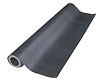
A mass-loaded vinyl sound barrier
Small But Strong
As the rapid evolution in soundproofing continued, a small clip made the next big splash. Designed to attach to the metal bushings that create resilient channels, these clips employ small neoprene pads at the point of contact/transfer between the studs and bushings.The neoprene pads absorb the vibrations that once traveled through the walls.
“Now that we had isolated the drywall from the studs and added mass inside the wall our attention turned to sealing joints and penetrations,” Ingersoll explains. “Corners, outlets, cable chases, we began to make sure every single crack was properly sealed with acoustical caulk or putty.”
These small openings and joints are important because of what is known as the one percent rule. This rule states that a 1-percent opening will allow up to 50 percent of sound to pass through.
The most recent step in the soundproofing evolution was the introduction of products like Green Glue and QuietGlue. These products were the first sound-damping compounds to be applied between sheets of drywall. Ideal for the retrofitting and enhancing sound mitigation capabilities of existing walls, these products are spread on the back of a piece of drywall that is then placed on the existing drywall.
They work by distributing into various directions the sound that hits the first layer of drywall until that sound energy becomes heat energy and dissipates.
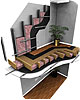
Wall and floor/ceiling acoustical treatment (resilient channels, mass-loaded vinyl and floor underlayment).
Moving Forward
Wesley Wollin, an architect and building acoustics instructor at British Columbia Institute of Technology believes “the acoustic industry needs to move from its traditional place inside a building to dealing with the exterior environment, and its impact through the building envelope with the user-occupied zones, be that either interior spaces, or exterior social zones such as balconies, terraces and patios.”Additionally, he says, “I am very interested in seeing psychological/sociological testing on whether there is a certain spectrum of sounds that are pleasant, and should be maintained for masking purposes, while frequencies of sound such as truck rumbling, or mechanical hissing could be isolated to create a more pleasant soundscape.”
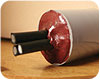
Fire-stop putty that is used to create acoustical seals around wires, electrical box outlets, etc.
He adds that using floor underlayment and adding mass to floors/ceilings has been around for years, but only now does he see an influx in the amount of people and businesses interested in making it a part of their construction projects.
“My guess is that it has to do with the fact that fewer rooms have wall-to-wall carpeting now. Many people are moving back to hard wood and tile floors,” says Ingersoll. A far more obvious and prevalent trend, he says, is the movement toward environmentally friendly ways of blocking sound. “We’ve added as much mass and decoupling as we can, so the next step is about making it as environmentally friendly as possible. People either want to obtain LEED certification or just feel good about what they have in their homes and buildings.”

Quiet Glue Pro is applied between two pieces of drywall to block noise.
Where has this evolution taken us?
As new soundproofing products and techniques appear, they don’t discredit those that have been used previously. For example, the “room-within-a-room” technique is still used in many recording studios. Instead of discrediting, these new products and techniques add to the potential effectiveness and ability to create more complete acoustical treatments.
“It’s amazing how things have changed in just 10 years,” Ingersoll says. “Before, people just hoped to have a better sound blocking wall or ceiling, but now there are so many options, and people can choose different levels of treatment-good, better or best.”
Looking for a reprint of this article?
From high-res PDFs to custom plaques, order your copy today!