Barrier Requirements for SPF
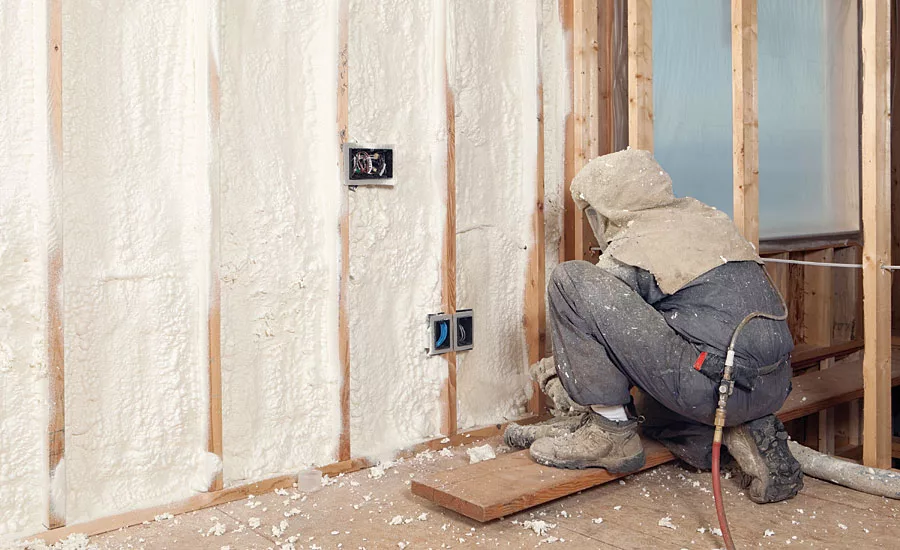
A construction worker is spraying expandable foam insulation between wall studs, near a protected window, at a new home construction project.
The use of spray polyurethane foam continues to grow among builders, contractors and architects who understand its superb ability to seal the building envelope. Acting as a single-source solution, SPF accomplishes what would normally require multiple products. However, like most organic materials, SPF is combustible and, when unprotected, may ignite and cause flash fire. Thus it is necessary to also utilize thermal and/or ignition barriers to ensure safety in the use of SPF.
The Benefits of Spray Polyurethane Foam in Walls and Ceilings
Unlike other insulation solutions, SPF possesses the unique ability to insulate, seal against air and water and air leakage, as well as control moisture throughout the structure. Considered a “single-source solution,” SPF reduces the need for the use of multiple products. This sealing capability of SPF in the building envelope also directly enables the material’s superb energy efficiency in the structure.
The quality of the building enclosure directly impacts the energy efficiency of the structure. The materials and the methods of construction utilized will determine whether air leakage occurs at any number of points in the walls, ceiling and roof. When air leakage occurs, energy loss follows and energy efficiency is compromised. Thus air sealing is of paramount importance when trying to achieve energy efficiency.
Thermal insulation is also a major contributor to energy efficiency. Because SPF forms in place and fully adheres, the material almost completely eliminates the cracks and gaps that allow the escape of conditioned air. It may also be installed in a continuous layer, eliminating many thermal bypasses typically found with cavity insulations. Additionally, SPF boasts one of the highest R-values per inch of all available insulation options, demonstrating exceptional thermal performance.
The effectiveness of insulation is measured through a combination of factors including moisture control, air leakage, health, safety, durability, and comfort and energy efficiency—with SPF scoring exceptional marks in all categories.
15 Minute Thermal Barrier Requirements for SPF
As mentioned, SPF is combustible, like other organic substances. The material is formulated with flame retardants that decrease the flame spread (as measured by ASTM E-84, the Test for Surface Burning Characteristics for Building Materials). These numerical flame spread indices are solely utilized to measure and describe properties of products in response to heat and flame under controlled laboratory conditions thus do not reflect hazards of SPF (or other products) under actual fire conditions.
SPF, when unprotected, may ignite and cause flash fire when exposed to fire sources such as trash fires, welding arcs, cutting torches or red-hot metal. Burning SPF forms a surface layer of less flammable char, however initial burning may produce combustible gases and black smoke, which in confined interiors may accumulate and ignite into a flashover—a dangerous fire condition. Flashover may also result in additional foam or combustibles being drawn into the fire, resulting in further combustible gases and a “feeding of the fire.”
Because of these potential hazards, it is imperative that SPF and other foam plastic insulations be covered by 15 minute thermal barriers, ignition barriers, or have the SPF assemblies meet the criteria of large-scale fire tests.
Thermal barriers are applied between foam plastics (including SPF) and interior spaces and delay the temperature rise of foam during an incidence of fire, as well as delay or prevent the foam’s ultimate involvement in a fire.
Where Thermal Barriers are Required
All model building codes, with some exceptions, require that SPF be separate from interior living spaces by an approved thermal barrier. Exceptions to the requirement that all interior SPF applications be covered by a thermal barrier or an equivalent thermal barrier, or be part of a tested alternative assembly are:
- Certain masonry or concrete constructions.
- Certain attics and crawlspaces.
- Sill plates and headers (limited to certain SPFs in
- Type V construction.
- Exterior applications as part of certain tested and classified roof assemblies.
- Others as provided by the building model codes.
Selecting a Thermal Barrier
SPF installers generally have three thermal barrier options:
- Prescriptive Thermal Barriers—1/2-inch gypsum wallboard is approved by the IBC and IRC.
- Equivalent Thermal Barriers—Materials equivalent to 1/2-inch gypsum wallboard may be used if they have been tested in accordance with the IBC and IRC to limit temperature rise and remain in place for 15 minutes, per NFPA 275.
Typical options include:
- Spray-applied cementitious materials
- Spray-applied cellulose materials
- Portland cement plaster
- Intumescent coatings
- Other proprietary materials
Alternative Assemblies—SPF may be covered with other materials or left exposed provided the assembly has been approved on the basis of large-scale fire testing representing the actual end-user configuration.
Generally accepted tests include:
- NFPA 286 Standard Methods of Fire Tests for Evaluating Contribution of Wall and Ceiling InteriorFinish to Room Fire Growth (with specific acceptance criteria defined by the IBC and IRC)
- UL 1715 Fire Test of Interior Finish Material
- UL 1040 Insulated Wall Construction
- FM 4880 Building Corner Fire Test
Ignition Barrier Requirements for SPF
The IBC and IRC permit the use of an ignition barrier in lieu of a thermal barrier in attics and crawlspaces where entry is made only for repairs and maintenance, or for the service of utilities. Sometimes these rules are misinterpreted, but as a general rule of thumb, the following conditions would determine that the space in question is entered only for repairs, maintenance or service of utilities:
- Limited access (hatch, small door, etc.).
- Utilities within the space including, but not limited to, HVAC equipment, ductwork, electrical lines, plumbing, wiring (telephone, Internet, cable, security, etc.), radiant heating, etc.
- Possibility that any utility as described above may be installed in the future.
Note the ultimate decision on whether an ignition barrier may be utilized instead of the thermal barrier is the sole discretion of the local code authority.
Selecting an Ignition Barrier
There are three ignition barrier choices to select from:
-
Prescriptive Ignition Barriers—Named in the IBC and IRC, these include:
- 1½-inch-thick (38mm) mineral fiber insulation.
- 1/4-inch-thick (6.4mm) wood structural panels.
- 3/8-inch (9.5mm) particleboard (1/4-inch-thick under IBC).
- 1/4-inch (6.4mm) hardboard.
- 3/8-inch (9.5mm) gypsum board).
- Corrosion-resistant steel having a base metal thickness of 0.016-inch (0.406mm).
- 1½-inch-thick cellulose insulation (per 2012 IRC).
- Alternative Materials—Alternate coatings or coverings that may be approved by code authorities having jurisdiction.
- Alternative Assemblies—Leaving SPF exposed in an attic or crawlspace may be permitted provided the material has been tested and passed in accordance with AC 377, Appendix X or ASTM E 970.
Importance of Professional Certification in SPF Installation
Understanding thermal and ignition barrier requirements is of paramount importance in the installation of SPF. Additional information is available as a resource of the Spray Polyurethane Foam Alliance. The alliance also encourages that all individuals and companies involved in the installation of SPF complete the Professional Certification Program, which ensures best practices and safety in the application of the product.
Looking for a reprint of this article?
From high-res PDFs to custom plaques, order your copy today!