Walls & Ceilings logo
search
cart
facebook twitter linkedin youtube youtube Spotify Podcasts Apple Podcasts Spotify Podcasts Apple Podcasts
  • Sign In
  • Create Account
  • Sign Out
  • My Account
Walls & Ceilings logo
  • NEWS
  • TOPICS
    • Drywall
    • Stucco/EIFS
    • Ceilings
    • Steel Framing
    • Fireproofing
    • Interior Plaster
    • Building Envelope
    • Insulation
    • Technology
    • Interior
    • Exterior
    • Women In Construction
  • COLUMNS
    • Up Front
    • All Things Gypsum
    • Art & Craft of Plastering
    • Stucco Stop
    • Steel Deal
    • Industry Voices
  • PRODUCTS
    • Buzz Guide
  • EVENTS
    • Industry Events
    • Webinars
    • BUILD Expo
  • MEDIA
    • Videos
    • Podcasts
    • Photo Galleries
    • BUILD26 Videos
    • Take our Quiz!
    • Infographics
  • EXCLUSIVE
    • Newsletters
    • Top 50 Contractors
    • Contractor of the Year
    • State of the Industry
    • W&C Store
    • Market Research
    • CEUs
    • Sponsor Insights
    • Custom Content & Marketing Services
  • DIRECTORY
  • EMAGAZINE
    • eMagazine
    • Advertise
    • Archive Issues
  • SIGN UP!
Fireproofing

Fire Protection with I-Joists and Stone Wool in Residential Construction
By Thomas Hackett
fire protection
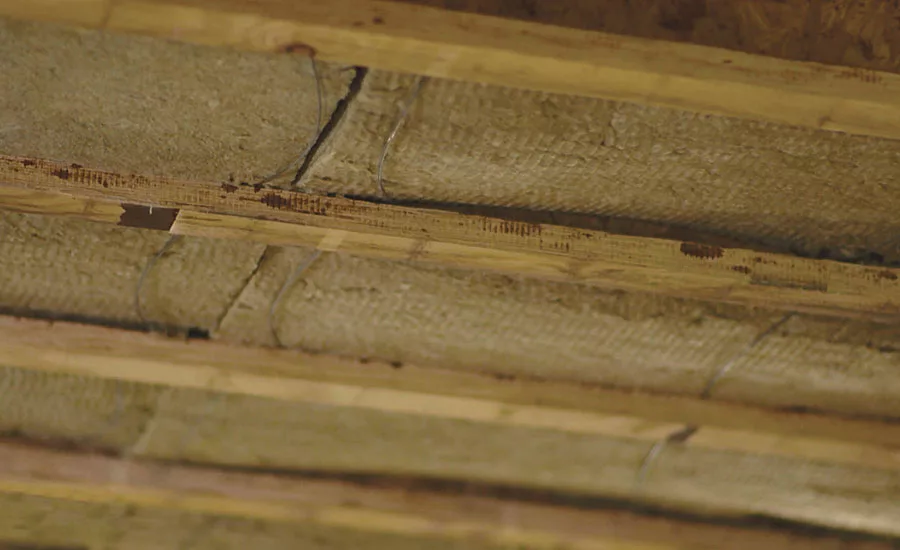
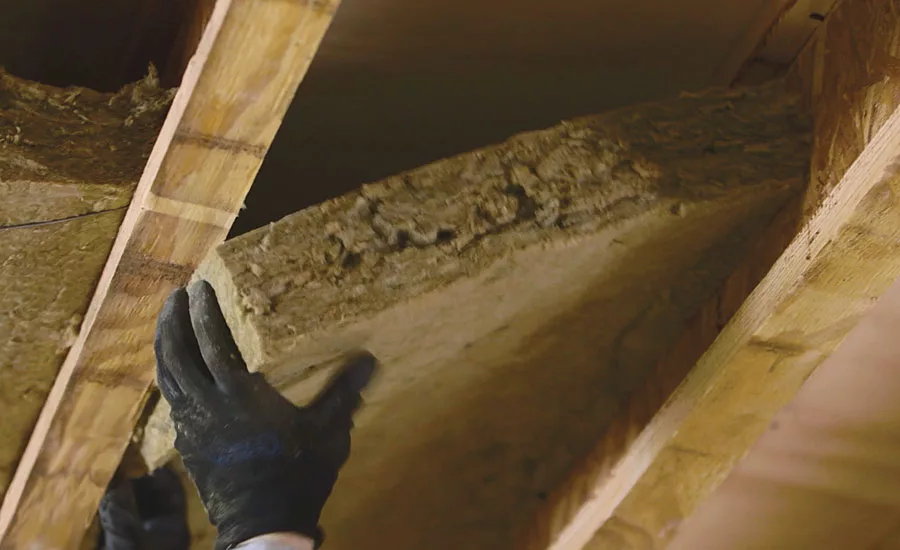
Batts inserted between joists, on top of bottom flange.
Hackett
Hackett
Hackett
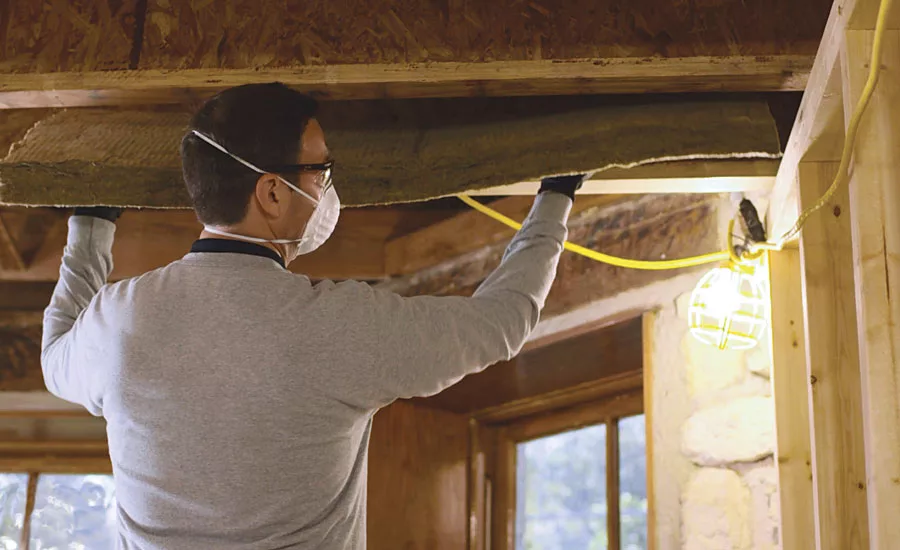
Stone wool batts installed in I-joists.
fire protection
Hackett
Hackett
Hackett
August 1, 2016

As the use of the new applications grows, we learn about the benefits and drawbacks with each approach and ultimately, with our increased understanding and knowledge, code requirements change to reflect the safest ways to build and remodel homes.

I-joists are a perfect example of an application that has dramatically changed the building industry and in turn, has driven changes to the building code requirements. Invented in 1969, I-joists are engineered wood joists that offer many benefits while eliminating many problems that regularly arise with conventional wood joists. For example, I-joists are capable of supporting heavy loads with substantially less lumber than solid wood joists. In addition, they are far less prone to bow, crown, twist, cup or split than traditional lumber joists. Problems with squeaky floors are far less prevalent with I-joists because of their overall dimensional stability.

A Solution that Meets Requirements

Because of the benefits of I-joists, their use and application have grown dramatically. In the Fundamentals of Building Construction, Volume 4, authors Iano and Allen state that approximately 50 percent of all wood light framed floors used I-joists. However, one of the drawbacks that have become evident is that I-joists are prone to fail sooner in fires than conventional joists. In response, the 2012 IRC Section R 501.3 code requirements were changed to address the issues related to fire safety.

As of February 2016, local jurisdictions in Arkansas, California, D.C., Florida, Georgia, Idaho, Kentucky, Louisiana, Minnesota, Montana, Rhode Island, South Carolina, Utah, Virginia and Washington have officially adopted the 2012 edition of the more stringent fire protection of I-Joist code. Research firm Forest Economic Advisor projects about 60 percent of jurisdictions will do so by 2017.

There are a variety of options available for home builders and remodelers to use to meet the new code requirements when building with I-joists. For example, basement ceilings can be finished with drywall, or a sprinkler system can be installed. However, both of these options come with substantial budget implications for the homeowners and, in the case of sprinkler systems, home builders are obligated to change their traditional methods of construction. Fortunately, stone wool insulation batts provide a solution that meets the requirements of the code.

Stone wool is simply a type of insulation that is comprised of basalt rock and steel slag, which is a recycled by-product of the steel industry. To manufacture stone wool, these raw materials are melted down into lava and then spun into fibers which then form the insulation. Stone wool resists temperatures up to approximately 2,150 degrees Fahrenheit. While traditional, combustible insulation can fuel a fire and, if exposed, assist in the spread of fire. Stone wool insulation actually impedes the spread of fire and provides valuable extra minutes to save people and property, as well as the resultant environmental damage.

Installing Stone Wool

Installing stone wool batts between I-joists is fast and easy. Using stone wool batts falls easily within the traditional methods of construction that builders and remodelers use, resulting in no changes to the processes typically used by these professionals.

The following assembly was tested and approved to provide alternate fire resistance per the 2012 IRC, section R 501.3, exception 4. The system was tested per ICC Acceptance Criteria AC-14 section 4.4, following ASTM E119.

Installation Instructions:

  • Follow instructions on personal protection equipment as outlined on the packaging of the product.
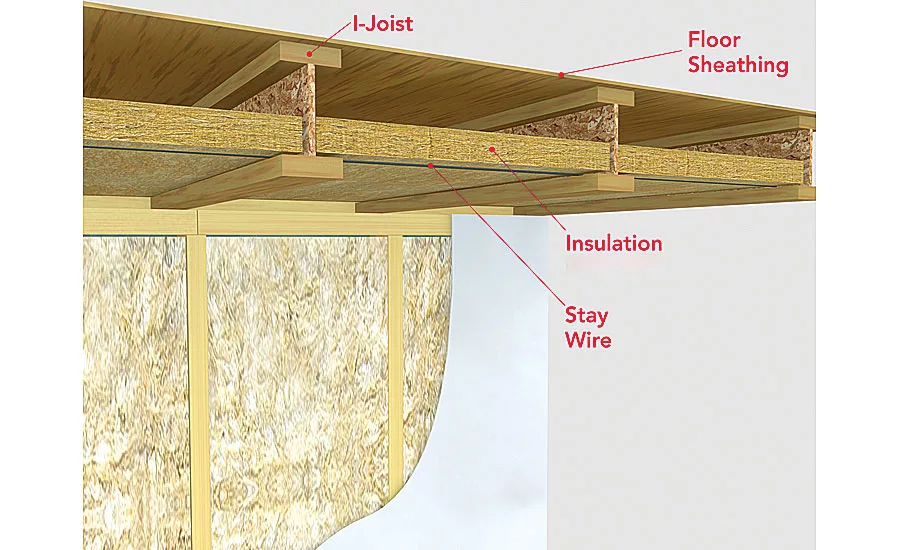
  • Install batts between joist webs, on top of the bottom flanges. Use batt widths that correspond to joist spacing. Use minimum 15.25-, 18.5- and 23-inch widths, when I-Joist spacing is 16-, 19.2- and 24-inches on center, respectively.
  • Install batts snug around any pipes located in the cavity. Stone wool batts are designed to friction fit to normal I-joist spacing. The batts cut easily with serrated blades. No special training is required to install stone wool.
  • Use rigid stay wires between bottom flanges, 24-inches on center and no more than 4-inches from ends of batts.

Other Benefits of Stone Wool

In addition to the benefit of meeting the fire protection code requirements for basement ceilings, stone wool insulation offers many other benefits to homeowners. For example, the unique non-directional structure of stone wool will provide effective sound absorption, thus reducing the sound transfer between floors.

Because stone wool is made from natural and recycled products, the insulation provides an environmentally sustainable solution that the homeowner can feel comfortable using. In addition, the inorganic characteristics of stone wool resist water, and will not promote the growth of mold or mildew, enhancing the desired healthy features of a home.

The use of I-joists in residential applications continues to grow. Combining stone wool insulation with I-joists provides the highest level of construction standards along with fire safety and many other benefits to both the homeowner and the construction contractor. 

KEYWORDS: firestopping insulation ROCKWOOL steel

Share This Story

Looking for a reprint of this article?
From high-res PDFs to custom plaques, order your copy today!

Wc0816 ft4 fire protection p5 headshot
Thomas Hackett manages the Technical Support Center at ROXUL Insulation. He is responsible for overseeing the technical support function for ROXUL products in various applications throughout North America.

Recommended Content

JOIN TODAY
To unlock your recommendations.

Already have an account? Sign In

  • Abercrombie & Fitch

    EIFS in 2026: How Specialty Finishes Are Redefining Exterior Wall Systems

    As building codes, owner expectations, and design demands...
    Stucco/EIFS
    By: Regi Mendoza
  • proper air and vapor control

    From Energy Efficiency to Moisture Management: Why Air and Vapor Control Matter

    How proper air and vapor control within building...
    Building Envelope
    By: Benjamin Meyer AIA, LEED AP
  • Linear Metal Ceiling Beam Baffles

    Top 25 Ceiling Contractors of 2026

    Suspended ceilings demand precision, code compliance and...
    Ceilings
    By: John Wyatt and Tanja Kern
You must login or register in order to post a comment.

Report Abusive Comment

Manage My Account
  • eMagazine Subscription
  • Newsletters
  • Online Registration
  • Manage My Preferences
  • Subscription Customer Service

More Videos

Sponsored Content

Sponsored Content is a special paid section where industry companies provide high quality, objective, non-commercial content around topics of interest to the Walls & Ceilings audience. All Sponsored Content is supplied by the advertising company and any opinions expressed in this article are those of the author and not necessarily reflect the views of Walls & Ceilings or its parent company, BNP Media. Interested in participating in our Sponsored Content section? Contact your local rep!

close
  • medical professionals moving a patient on a stretcher through the halls of a medical building
    Sponsored byNational Gypsum Company

    What Does High Performance Mean When It Comes To Gypsum Boards?

Popular Stories

drywall contractor sanding ceiling

D.C. Drywall Contractors to Pay $302K in Worker Case

Wichita Biomedical Campus

Wichita Drywall Worker Dies After Scaffolding Fall

Okan Tower in Miami, Florida

OSHA Opens Investigation Into Fatal Okan Tower Column Collapse

Construction workers in safety vests install drywall

Gypsum Sales Hold Amid Market Shifts in the U.S.

Events

June 24, 2026

The Bright Side & Benefits of Designing with Integrated Lighting

Credits 1 AIA LU/HSW; 0.1 ICC CEU

This course will explore the pivotal role architects and lighting design play in creating safer, more sustainable spaces. Learn how to avoid common lighting mistakes and make informed decisions that create the best visual environment for occupants. 

January 1, 2030

Webinar Sponsorship Information

For webinar sponsorship information, visit www.bnpevents.com/webinars or email webinars@bnpmedia.com.

See our full library of webinars

View All Submit An Event

Products

2026 National Painting Cost Estimator

2026 National Painting Cost Estimator

See More Products

Related Articles

  • Using Expansion Beads in Residential Construction

    Using Expansion Beads in Residential Construction

    See More
  • Susan Hines and Michael Schmeida

    Glass Mat Gypsum Sheathing in Residential Construction: A High-Performance, Code-Compliant Alternative to Traditional Materials

    See More
  • Efficiency in Residential Construction

    See More

Related Products

See More Products
  • business.png

    How to Succeed With Your Own Construction Business

  • Construction Spanish to English Dictionary

  • barrys.jpg

    Barry's Advanced Construction of Buildings, 4th Edition

See More Products

Related Directories

  • National Fire Protection Assn. (NFPA)

    Known as the trusted source of safety knowledge, the National Fire Protection Association (NFPA) has been helping to solve some of the planet’s toughest safety problems for more than 125 years. To remain relevant for over a century as a knowledge and information organization, we’ve continually evolved our scope of expertise—from fire prevention, wildfire preparedness, and electrical safety to hazardous materials, community risk reduction, and public safety.
  • Rockfon

    Rockfon North America provides a complete ceiling system offering, combining stone wool and specialty metal ceiling panels with metal suspension systems. Easy to install and durable, Rockfon’s stone wool material and product range helps protect people from noise and the spread of fire, while contributing toward a sustainable future.
×

Connect with the industry’s leading resource for unparalleled insights and education.

Join thousands of industry professionals today. Shouldn’t you know what they know?

JOIN NOW
  • RESOURCES
    • Advertise
    • Contact Us
    • Directories
    • Store
    • Want More
  • SIGN UP TODAY
    • Create Account
    • eMagazine
    • Newsletters
    • Customer Service
    • Manage Preferences
  • SERVICES
    • Marketing Services
    • Reprints
    • Market Research
    • List Rental
    • Survey/Respondent Access
  • STAY CONNECTED
    • LinkedIn
    • Facebook
    • Instagram
    • YouTube
    • X
  • PRIVACY
    • PRIVACY POLICY
    • TERMS & CONDITIONS
    • DO NOT SELL MY PERSONAL INFORMATION
    • PRIVACY REQUEST
    • ACCESSIBILITY

Copyright ©2026. All Rights Reserved BNP Media, Inc. and BNP Media II, LLC.

Design, CMS, Hosting & Web Development :: ePublishing