Acoustics Can be Hard
Think of a memorable visit to a concrete, block or stone finished project and it’s highly probable that the structure’s poor acoustics is the focal point of the experience that is etched in your memory. Concrete block walled gymnasiums, for example, are notoriously reverberant making graduation loudspeaker announcements memorable for being unintelligible. Despite those unfortunate memories, every building material can be acoustical, and with proper selection and planning, you can achieve the project’s acoustic goals for noise isolation and architectural acoustics, even if your materials are hard.
Noise Isolation
The most intuitively obvious acoustical attribute of concrete, block and stone is the brute force ability of their dense mass to block sound. Unlike many other common sense notions about acoustic design, this one is absolutely correct. In fact, the sound transmission loss of simple, single component walls and ceilings can be accurately predicted by the so-called “mass law equation.” According to that equation, sound isolation increases 6 dB for every doubling of sound frequency, and another 6 dB for every doubling of the wall’s surface density (i.e., density by thickness of the wall). Brute force improvements in noise isolation can be made by choosing a more dense building material, by increasing the structure thickness, or by doing both.
Before selecting an appropriate specification for a noise barrier, both the level and the type of noise for which the barrier is intended need to be determined. Noise level is relatively easy to determine from sound level measurements, and the type of noise generally can be classified as speech, mechanical, or shock.
When designing for mechanical noise, the wall should be specified by its octave band transmission loss values, usually given for 10 sound frequency bands of 31, 62, 125, 250, 500, 1000, 2000, 4000, 8000 and 16,000 Hz. The minimum acceptable TL for any building component is found simply by subtracting the acceptable background noise level in the receiving space from the noise level generated at the source. There are a few other details, but that’s basically it.
When designing for speech isolation, the wall can be specified by its sound transmission class, which is a simplified, single-number rating system specifically targeted for human speech frequencies and levels. In general, walls rated at STC50 or above are “speech proof,” STC40 walls result in hearing muffled speech from the adjacent room, and STC30 walls allow intelligible conversation between the two rooms.
A third type of noise is characterized by shockwaves, where specifying the sound transmission class of the wall is still necessary but not sufficient for maintaining isolation. As an example, indoor gun ranges make extensive use of concrete and block construction. Here, maximum surface density serves to stop both airborne sound as well as stray bullets. In addition, the surfaces are washable to allow the control of lead levels in the range. Use of high-velocity ammunition produces supersonic shock waves which expand as they travel downrange with the bullet. When these shock waves hit the side walls, ceiling and floor of the range, the effect is more similar to that of a hammer blow than a sound wave. Because of this, the ability of the wall, ceiling or floor to block shockwaves is specified by its impact insulation class (IIC). In addition, bullet shields and lighting fixtures, if suspended from the ceiling, must be hung using vibration isolators. Surface treatments on walls and overhead bullet shields are designed primarily to intercept shock waves, and absorb airborne sound as a secondary function. All surface treatments should be washable and not act to collect lead dust.
Once the required transmission loss, sound transmission class and/or impact insulation class ratings have been specified, the wall, ceiling or floor construction can be selected from manufacturer’s assemblies that have been lab tested to meet those ratings. In the absence of test data, the mass law equation can be used to determine the required thickness for solid, concrete walls and slabs to obtain TL and STC requirements. The lab-certified performance of more complicated constructions can be found on the web sites of manufacturers of building systems such as Nuform Building Technologies, professional organizations such as American Concrete Institute, American Society for Testing Materials, Portland Cement Association, National Concrete Masonry Institute, and government sites such as National Research Council Canada. Complete, certified lab tests bearing the test engineer’s signature are preferable to marketing pamphlet information.
Architectural Acoustics (Absorption and Diffusion)
If the most intuitively obvious acoustical attribute is the ability to block sound, the least obvious is the ability of hard surfaces to absorb sound. In general, sound absorption increases with the porosity of the hard surface finish. For example, smooth painted concrete has an average sound absorption coefficient of 0.015 while a rough, unfinished concrete surface measures 0.033. The contrast between a smooth painted surface and a rough finish is more dramatic for concrete masonry units, where the high frequency absorption coefficient of .20 for the unfinished porous block is reduced to a mere 0.02 when it is painted, typically causing a significant and unwanted rise in the reverberation of a room. Achieving sound absorption coefficients above 0.2 in hard finishes can be done using specialty masonry units, such as RPG’s Diffusorblox or specialty finishes such as Sonakrete, Acoustement or Phonstop.
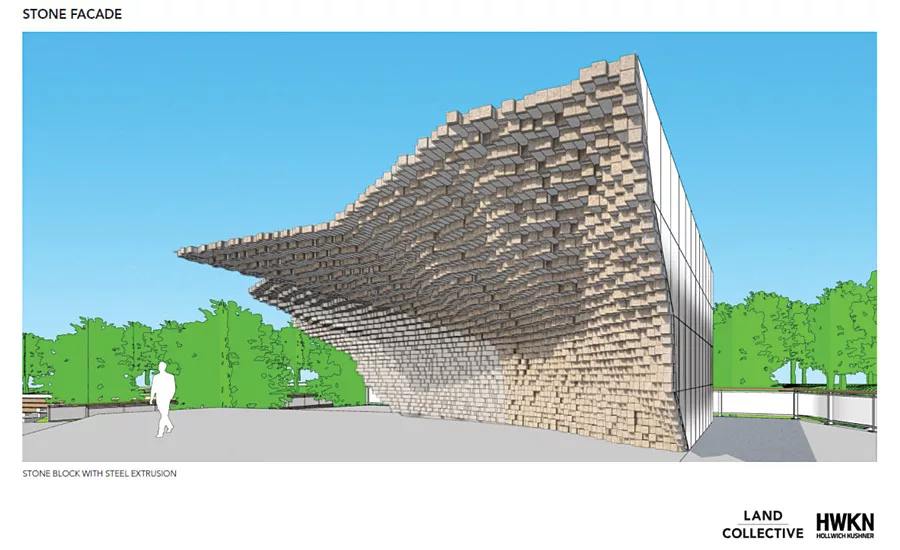
The Stage Pavilion in Westfield, Ind., is a good example of a performance acoustics project being designed with stone surfaces. The pavilion will be one of four cornerstones for and serve as the concert stage overlooking the great lawn of the Grand Junction Park & Plaza urban complex. With the Indianapolis Symphony Orchestra in mind, getting the acoustics right is a must.
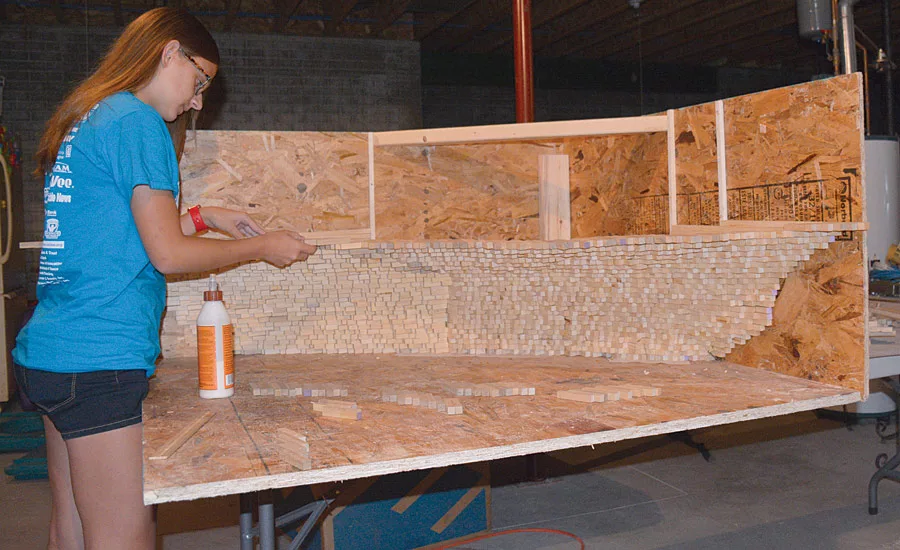
The stage façade comprises an array of 6-by-6-inch stone caps on square aluminum tubing. The complicated surface provides diffusion, reflection and absorption (through perforations) and—if done correctly—will add presence to the orchestra’s sound. Because of the sheer number and relatively small size of the surfaces, computer modeling of the pavilion’s acoustics was felt to be unreliable, so a 1/12-scale physical model was built for actual acoustic testing of the design.
Using this technique, music is played at 12x normal speed through miniature speakers on the scale model stage and simultaneously recorded on the model lawn. Listening to that recording at normal speed then allows you to hear how the façade shape has modified the music (the façade’s impulse response); design changes then can be planned. The infinite variability of the design allows minute changes to be explored.
Contrary to popular belief, the world of acoustical materials doesn’t just comprise acoustic ceilings, acoustic panels and acoustic insulation. Every material blocks, reflects, absorbs and diffuses sound. Every material is acoustical—even the hard ones.
Looking for a reprint of this article?
From high-res PDFs to custom plaques, order your copy today!