Three R’s and a Small Bite
It’s no secret that global temperature has been increasing and increasing, and EIFS and stucco claddings are inherent to solving this problem.

You may have received one from your energy provider this past summer. A plea to your conservative side, a participation plea to perform a single action to help the greater good, and it sounds like this: "Please reduce your energy usage between the hours of 3:00 p.m. and 10:00 p.m."
Whether you believe the environmentalists or not, we are all witness to the ever-increasing global temperatures. Having been an enthusiastic LEED professional, I learned about many of the factors causing increasing temperatures. The Heat Island Effect, the buildup of CO² emissions from the burning of fossil fuels and deforestation to name a few. (I am still on the fence regarding cows and their CO² contributing flatulence.) More people, more buildings, more cars, more expansion, more pollution and it goes on and on. So, what are we to do? I adopted a credo learned from my green years and make every effort to Think Globally and Act Locally.
Like the old idiomatic inquiry, “How do you eat an elephant?” we tackle the daunting, overwhelming and seemingly impossible global issue, gradually, just a little at a time.
Building performance, that which measures and regulates the usage of energy consumption, is ever increasing in its importance. The criteria to use less energy is becoming more stringent so much so that a goal of net zero is on the horizon. Now where am I going with all of this? I want to highlight the fact that EIFS and stucco claddings are an inherent component to not only use less energy, but to efficient building performance and a simple, no-nonsense global “bite of the elephant.”
According to the environmental sustainability community, many considerations go into valuating energy efficiency and performance of a cladding. Two main considerations that pretty much reflect the built environment are the Embodied Energy and Life Cycle approach.
Embodied Energy
This is the metric that looks at all of the energy used by all of the processes associated with a building product. From raw earth mining to processing of those natural resources, to transportation, packaging, and delivery of the products. One may look at this as the up-front assessment of the energy it takes to make a given product or series of products. This is where we (as cladding and construction professionals) would evaluate the items used to build the building in order to reduce energy usage.
Stucco
The making of cement takes a lot of energy. You’ll need to mine the ingredients together, crush them in big machines, haul them to the furnaces (which use energy themselves), bag the cement, palletize it and then ship it to the supply house. Then it’ll need to be unloaded and stocked in that location until a sale is made after which it is again loaded and trucked to the jobsite, mixed in machines, and placed on the building. Then there is the wire or non-metallic lath which has its own energy cost to make and ship, the lime (similar to cement) and the massive piles of sand that are mined, washed, and trucked to the jobsite. All contributing to a bigger than expected embodied energy price tag. And you can’t forget the finish.
Depending on which type you use, cement or acrylic, there’s a smaller EE upcharge. All combined, you have a bigger EE footprint than other products but a long-lasting product, really long. Properly prepared and applied stucco can last decades and in some instances, centuries.
EIFS
Compared to its stucco counterpart, EIFS has a smaller EE footprint. The base coats use cement and the polymer components, derived from petroleum products, do not take a whole lot of energy to convert them into acrylic finishes and base coats. The polymers turned to acrylics do not fare well in the biodegradable realm but they do considerably well in staying the way they are as an EIF system. The EPS foam is also a big petroleum laden component in its formed pellets. These pellets are then placed into a giant form and infused with steam to expand into a billet. The final sheets are cut from said billet with a hot wire. Shipping these components is less impactful in that there is a 6-to-1 full-delivery-truck difference with stucco being the heavy.
With the exception of the trucking of these products to the jobsite for installation, they are pretty close in their embodied energy ratings.
Life Cycle
Life Cycle Analysis is the evaluation method used to address the environmental impact a product or an assembly of products has. An early view of this was termed as a cradle-to-grave analysis, the impact of a product from the beginning to the end of its useful life and ultimately, to its disposal. Today, we have what is termed cradle-to-cradle, which includes the repurpose, reuse and rebirth of a given structure. The EE analysis is always a component of the LC or cradle-to-cradle whole building analysis view. Measurable accomplishments would include the reusing and recycling of building components.
Stucco
This has a little bit of insulation value, a little bit, and in cold climates it can absorb some solar heat and put it back into the house, some. So, it can offer some insulation and thermal mass performance characteristics during its life cycle. It stays on the wall for a long time and is a good fire deterrent. Also, if it ever needs to go into the waste stream, it will biodegrade over time but as I mentioned before, stucco lasts a really long time if properly applied. If a stucco cladding is in need, it can be refinished.
I have seen applications where an entire lath layer was added and a whole new stucco base coat and finish was applied to the lath. (This is rarely used because it is almost impossible to attach lath over stucco and hit the studs, nevertheless done anyway.) Some redo applications utilize an acrylic basecoat and fiberglass mesh layer with an acrylic finish. Other methods are a reapplication of a cementitious finish commonly referred to as a rescrub. Then there is the application of an acrylic finish right over the existing stucco. And then there is the application of a stucco cladding over another existing cladding like wood, tile, pour in place cement, CMU structures, vinyl claddings, etc. If there is an Achilles’ heel to new application of and reapplication of stucco, it is the propensity for stucco to crack. Sometimes when a new layer is applied and a crack happens, there may be instances of efflorescence or even slight blistering of the new finish/layer. But that rarely happens.
EIFS
Right out of the gate, EIFS provides an insulation value to the wall assembly. There is approximately an R-4 insulation value per inch of foam thickness and EIF systems now-a-days can use up to twelve inches in thickness. The performance characteristic of installing EIFS on the outboard side of the wall assembly is absolute. It is proven to be the most efficient location for insulation on a wall assembly. (Side note: to make a building super-insulated, consideration should be given to making the insulation continuous through the roof and floor layers as well.)
An additional value is that EIFS hits the ring at about one pound per cubic foot in weight. This lightweight characteristic can allow for less framing members or lighter gauge metal studs. Some EIFS performance bolsters can include an air/moisture barrier, incidental moisture drainage, pressure equalization and acrylic adhesives to allow it to be applied to virtually any wall surface besides glass. All of these considerations are included within the EIF system. And, because the insulation layer is adhesively attached there is no thermal transference through fasteners. But what really makes EIFS unique is its ability to be applied to existing surfaces. It can transform a thermally deficient cladding into a thermal superstar without tearing anything off or any heavy modifications. If EIFS has an Achilles’ heel it is in the application. Because it is a “system,” applicators must follow manufacturers’ recommendations and cannot use a lick-it-and-go installation. For EIFS to optimally perform worry-free, it needs to be installed optimally, preferably by a professional.
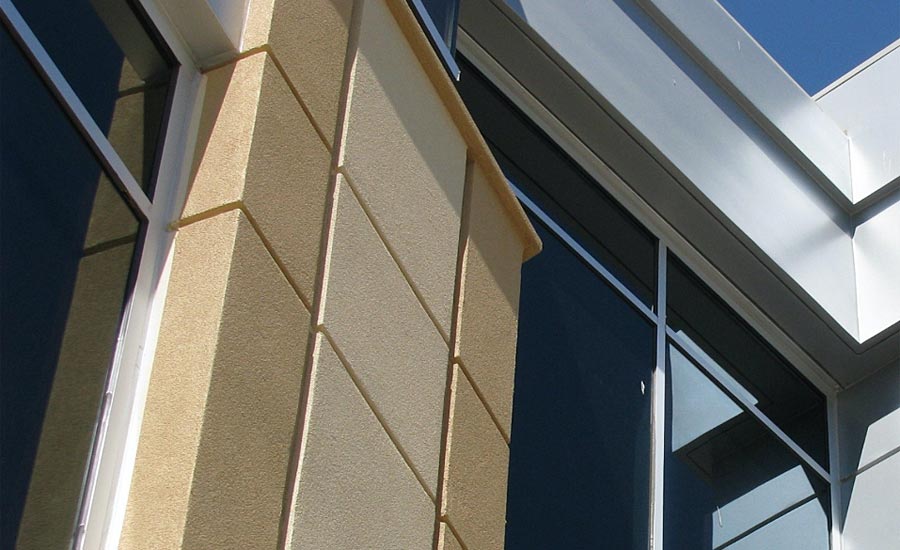 Building Image courtesy of Dryvit.
Conclusion
Compared to any other claddings we know of today, Stucco and EIFS have the best cost to benefit ratio. Both are proven performers and are flexible in their ability to look like anything you desire. When one looks at the Embodied Energy and Life Cycle characteristics of these claddings, it becomes apparent that both are good bang for your buck choices. So, go ahead and take a small bite. And remember the United States Green Build Council’s three R’s: reduce, reuse and recycle.
Looking for a reprint of this article?
From high-res PDFs to custom plaques, order your copy today!





