Walls & Ceilings logo
search
cart
facebook twitter linkedin youtube youtube Spotify Podcasts Apple Podcasts Spotify Podcasts Apple Podcasts
  • Sign In
  • Create Account
  • Sign Out
  • My Account
Walls & Ceilings logo
  • NEWS
  • TOPICS
    • Drywall
    • Stucco/EIFS
    • Ceilings
    • Steel Framing
    • Fireproofing
    • Interior Plaster
    • Building Envelope
    • Insulation
    • Technology
    • Interior
    • Exterior
    • Women In Construction
  • COLUMNS
    • Up Front
    • All Things Gypsum
    • Art & Craft of Plastering
    • Stucco Stop
    • Steel Deal
    • Industry Voices
  • PRODUCTS
    • Buzz Guide
  • EVENTS
    • Industry Events
    • Webinars
    • BUILD Expo
  • MEDIA
    • Videos
    • Podcasts
    • Photo Galleries
    • BUILD26 Videos
    • Take our Quiz!
    • Infographics
  • EXCLUSIVE
    • Newsletters
    • Top 50 Contractors
    • Contractor of the Year
    • State of the Industry
    • W&C Store
    • Market Research
    • CEUs
    • Sponsor Insights
    • Custom Content & Marketing Services
  • DIRECTORY
  • EMAGAZINE
    • eMagazine
    • Advertise
    • Archive Issues
  • SIGN UP!
Building EnvelopeExteriorStucco/EIFS

Air Leakage Paths in a Typical Wood-Framed Wall Assembly
By Laverne Dalgleish
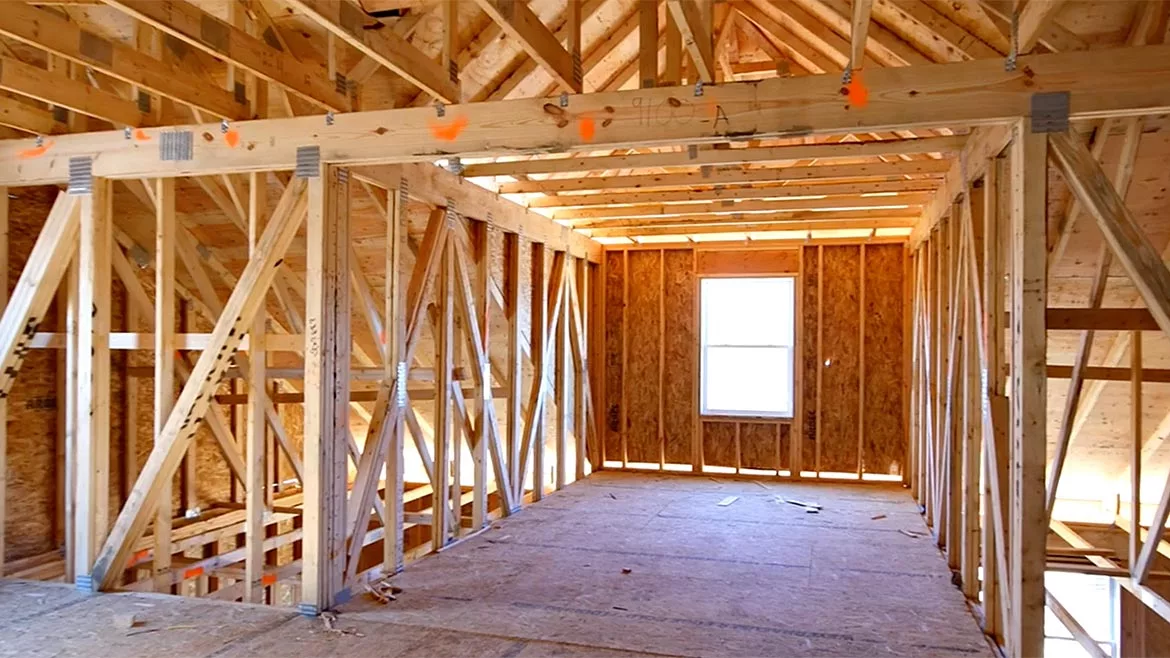
A wood-framed wall
photovs / Creatas Video+ / Getty Images Plus via Getty Images.
November 18, 2022

The Air Barrier Association of America worked with Oak Ridge National Laboratories to conduct assembly testing on a wood-framed wall to determine the gaps, cracks and holes that would leak the most. The testing was conducted at Tremco’s facility in Cleveland, where they have a fully automated test apparatus to conduct an ASTM E2357 Standard Test Method for Determining Air Leakage Rate of Air Barrier Assemblies. The funding to ORNL was supplied by the Department of Energy Building America Program.

This research was an extension of the ABAA Research Project on Air Barriers, which was to determine whether there are energy savings when you make a building very airtight.
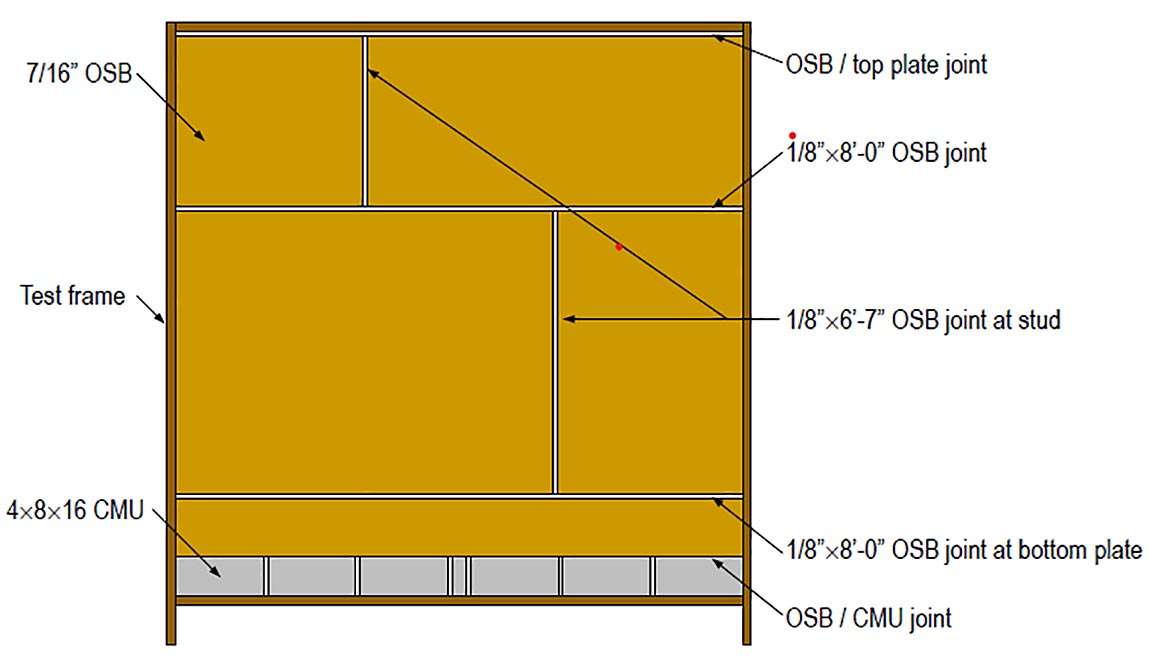
Schematic of Test Wall Assembly

Figure 1: Schematic of Test Wall Assembly

The baseline specimen was a more detailed ASTM E2357 test specimen, where the wall was purposely made very leaky. The specimen was framed in a wooden buck for ease of mounting into the test apparatus. A foundation was simulated with CMU and a wood mud sill was installed with spacers between the mud sill and the CMU to represent typical site conditions. Simulated floor joists with a header was then installed, and then a strip of subfloor was installed. The subfloor was shimmed to replicate the drying and movement of wood framing members on the construction site. A wall was then framed using two-by-fours with a single bottom plate and a double top plate. The wall was sheeted with OSB. A 1/8-inch gap was maintained between the sheets of OSB, which is a standard practice on job sites to allow for the expansion and contraction of the material due to temperature and moisture content.
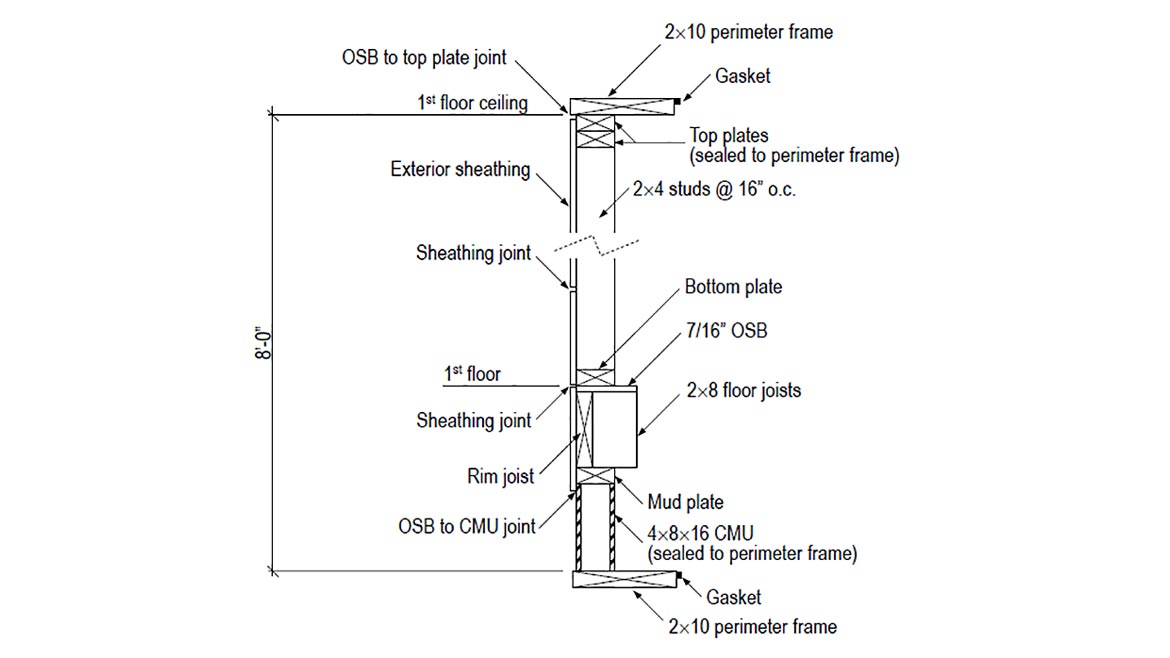
Cross Section of Mock-Up Assembly

Figure 2: Cross Section of Mock-Up Assembly

Details on the construction of this wall specimen was documented so that the base specimen could be replicated for additional testing with various types of air barrier materials being installed. To identify how much air would leak through a specific air leakage path, it was decided to test the complete wall specimen to start with, and then to seal one crack, gap or hole at a time and test after each air leakage path was sealed. The baseline wall was inserted into the test apparatus and the wall proved to be so leaky that it was impossible to create a 25 Pa pressure difference across the specimen. This confirmed that the goal of making the baseline specimen very leaky was achieved. Now, we talk about an air leakage rate at 75 Pa, but this is the reported leakage rate. In ASTM E2357, we actually test at 600 Pa, then 800 Pa and finally 1200 Pa. You will find that all testing is conducted at multiple pressure differences and normally much higher than the reported test pressure.
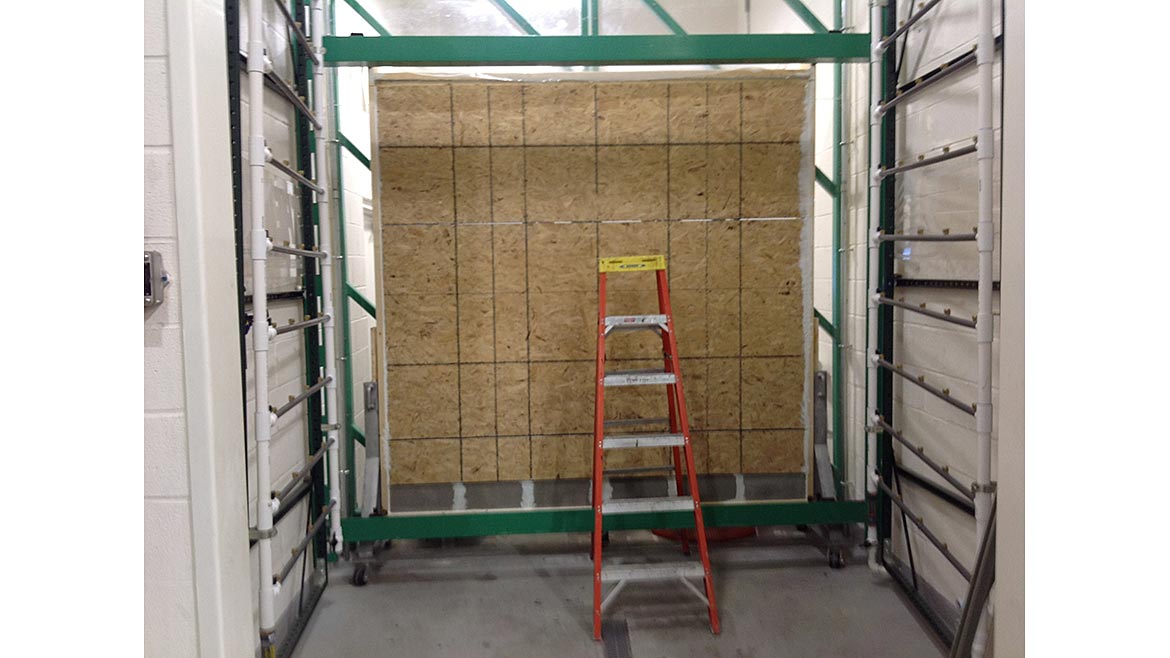
Test Wall Ready for Material Application

Figure 3: Test Wall Ready for Material Application

The next issue that the crew faced was to find a sealant that would set up in a short period of time so that the testing could almost be done continuously. Normal sealants and caulks require a curing time, which would drag out the testing process. Finally, an answer was found, which was to use a hot glue gun. This material set up as soon as it was cooled and provided a structural seal that withstood the loads imposed upon them by the test procedure, which created a pressure difference across the wall assembly. 

To give you an idea of the loads placed on the wall assembly, a steel stud-framed wall will move back and forth 3/4 of an inch during the 800 Pa cycling part of the test. Even wood studs flex due to the loads.
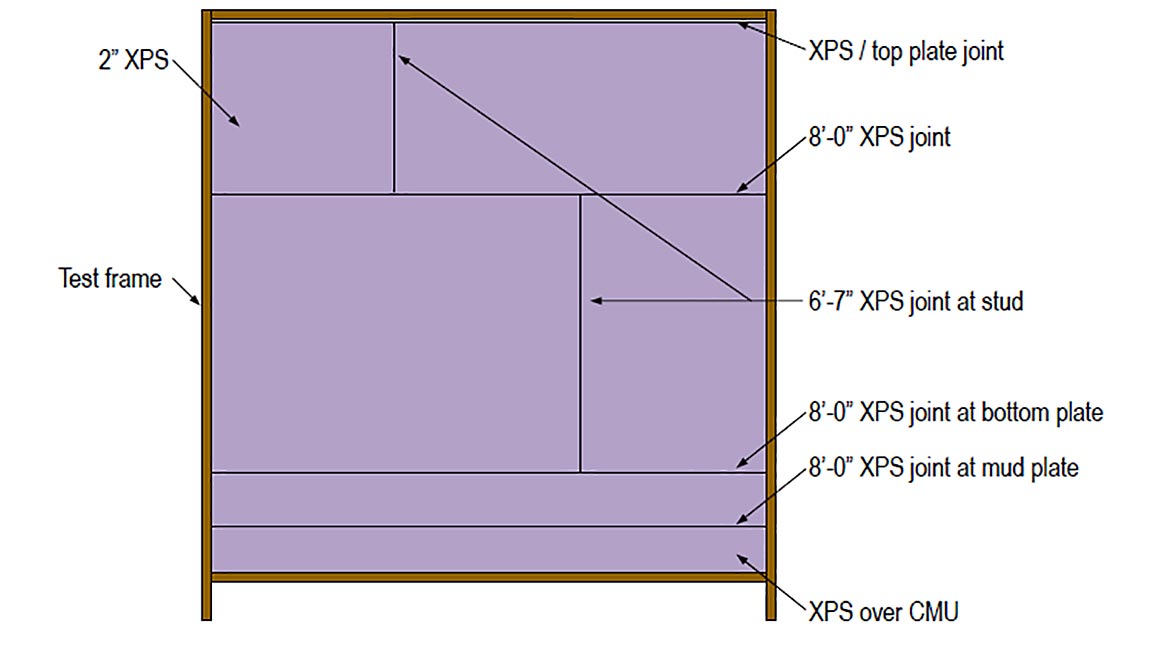
Test Wall with Exterior Foam Sheathing

Figure 4: Test Wall with Exterior Foam Sheathing

Now the crew was ready to conduct the testing. Some assumptions were made as to which air leakage path would be the largest and how leaky the different paths would be in relation to each other. The first assumption was the horizontal joints between the sheets of OSB. It was felt that if you could see through the gap, a lot of air could pass through the hole. To no one’s surprise, that air leakage path turned out to be the biggest. It was measured at 6.35 CFM/ft² at a pressure difference of 75 Pa.

I have been told forever that the foundation wall/joist header or the bottom plate to the subfloor is a huge leakage area. Turns out that is correct. It was measured at 1.91 CFM/ft² at a pressure difference of 75 Pa.
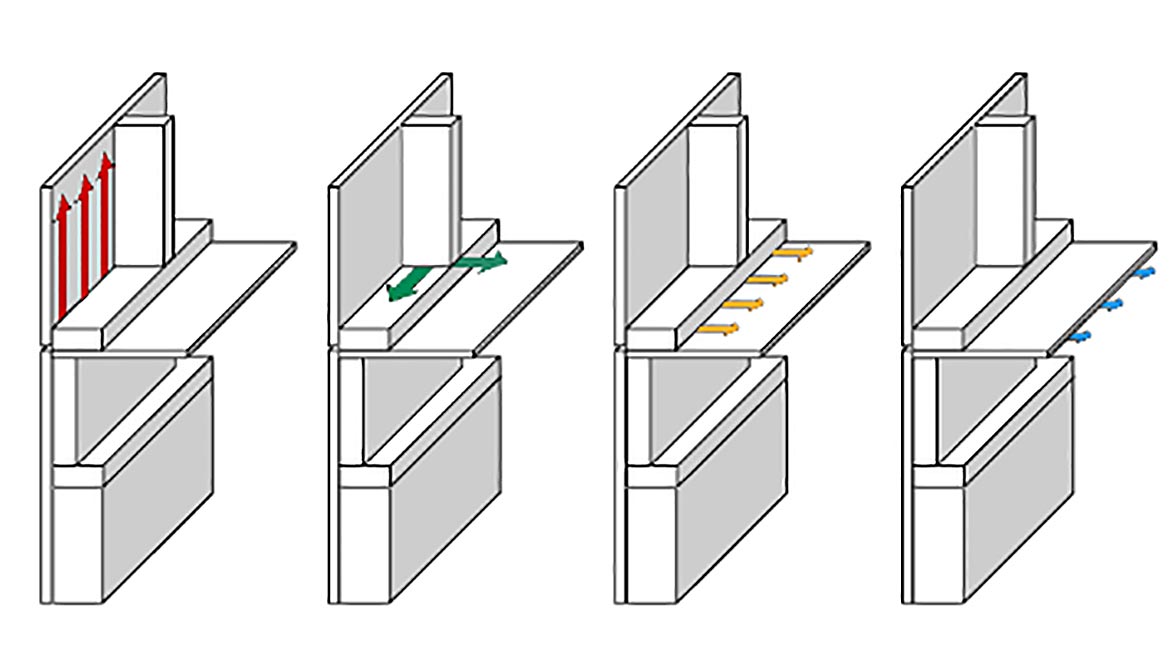
Typical Air Leakage Paths at Wall/Foundation Intersection

Figure 5: Typical Air Leakage Paths at Wall/Foundation Intersection

A large leakage gap that surprised the crew was the vertical joints between the sheets of OSB. Now, these joints are located on a framing member and the OSB is fastened to the stud at this point. In looking at the air leakage path, you would assume that this is extremely airtight and can be ignored for air sealing. This leak was measured at 0.8 CFM/ft² at a pressure difference of 75 Pa.

The balance of the air leakage paths was sealed and tested, and the drop in air leakage at a given rate was recorded.

The other interesting observation was that 92 percent of the air leakage at the wall/roof intersection is the joint between the OSB and the top plate. Also 70 percent of the air leakage at the wall foundation area was between the OSB sheathing and the bottom plate.


KEYWORDS: building envelope design CI (continuous insulation)

Share This Story

Looking for a reprint of this article?
From high-res PDFs to custom plaques, order your copy today!

Wc0522 feat abaa p7 author laverne dalgleish ld

Laverne Dalgleish, the executive director of the Air Barrier Association of America, focuses on the construction of high-performance buildings and is involved in standards and specifications development, research into air and water resistive barriers, site quality assurance and warranty programs. As part of this work, he has traveled North America to develop presentations and conduct industry meetings. As part of his involvement in standards, he chairs several standards development committees. Another part of his work has been to organize sectors of the construction industry into trade associations, which focus on specific issues.

Recommended Content

JOIN TODAY
To unlock your recommendations.

Already have an account? Sign In

  • Abercrombie & Fitch

    EIFS in 2026: How Specialty Finishes Are Redefining Exterior Wall Systems

    As building codes, owner expectations, and design demands...
    Stucco/EIFS
    By: Regi Mendoza
  • proper air and vapor control

    From Energy Efficiency to Moisture Management: Why Air and Vapor Control Matter

    How proper air and vapor control within building...
    Building Envelope
    By: Benjamin Meyer AIA, LEED AP
  • Linear Metal Ceiling Beam Baffles

    Top 25 Ceiling Contractors of 2026

    Suspended ceilings demand precision, code compliance and...
    Ceilings
    By: John Wyatt and Tanja Kern
You must login or register in order to post a comment.

Report Abusive Comment

Manage My Account
  • eMagazine Subscription
  • Newsletters
  • Online Registration
  • Manage My Preferences
  • Subscription Customer Service

More Videos

Sponsored Content

Sponsored Content is a special paid section where industry companies provide high quality, objective, non-commercial content around topics of interest to the Walls & Ceilings audience. All Sponsored Content is supplied by the advertising company and any opinions expressed in this article are those of the author and not necessarily reflect the views of Walls & Ceilings or its parent company, BNP Media. Interested in participating in our Sponsored Content section? Contact your local rep!

close
  • medical professionals moving a patient on a stretcher through the halls of a medical building
    Sponsored byNational Gypsum Company

    What Does High Performance Mean When It Comes To Gypsum Boards?

Popular Stories

Wichita Biomedical Campus

Wichita Drywall Worker Dies After Scaffolding Fall

Okan Tower in Miami, Florida

OSHA Opens Investigation Into Fatal Okan Tower Column Collapse

Construction workers in safety vests install drywall

Gypsum Sales Hold Amid Market Shifts in the U.S.

QXO Just Changed the Game-Here's What Contractors Are Asking

QXO Just Changed the Game-Here's What Contractors Are Asking

Events

June 24, 2026

The Bright Side & Benefits of Designing with Integrated Lighting

Credits 1 AIA LU/HSW; 0.1 ICC CEU

This course will explore the pivotal role architects and lighting design play in creating safer, more sustainable spaces. Learn how to avoid common lighting mistakes and make informed decisions that create the best visual environment for occupants. 

January 1, 2030

Webinar Sponsorship Information

For webinar sponsorship information, visit www.bnpevents.com/webinars or email webinars@bnpmedia.com.

See our full library of webinars

View All Submit An Event

Products

2026 National Painting Cost Estimator

2026 National Painting Cost Estimator

See More Products

Related Articles

  • Air Barriers

    Air Barriers' Impact on Energy Use in a Building

    See More
  • A field installer sprays Huntsman D Max Wall Insulation at a jobsite.

    Wall Assembly/CI Solution by Huntsman Building Solutions

    See More
  • Advances in Air Barriers and Air Leakage Control

    See More

Related Products

See More Products
  • woodceilings.jpg

    Wood Ceilings Technical Guidelines

  • bim 3e.jpg

    BIM Handbook: A Guide to Building Information Modeling for Owners, Designers, Engineers, Contractors, and Facility Managers, 3rd Edition

  • building codes illustated.jpg

    Building Codes Illustrated: A Guide to Understanding the 2021 International Building Code, 7th Edition

See More Products

Related Directories

  • Path Forward Partners, Inc.

    Path Forward Partners, Inc. founded by David Grunat, Greg Noblet, and Craig Pelletier to provide responsive, practical, and health-protective solutions to our clients’ environmental problems. To each project, we bring technical prowess, creativity, responsiveness, and scientific credibility which enable us to find solutions that are tailored to overcome the specific problems at hand. Since forming, our core principal team has expanded to include Julie Hayes and Nicholas Loizeaux as well as our valued staff of experienced scientists and engineers.
  • TRUFAST Walls

    TRUFAST® is an innovative leader in fastening systems for exterior building envelopes and facades. Products include a variety of fasteners to allow installation to continuous insulation, lath, EIFS, brick veneer, and building wrap. The products are extensively tested and conform to current energy and building standards.
×

Connect with the industry’s leading resource for unparalleled insights and education.

Join thousands of industry professionals today. Shouldn’t you know what they know?

JOIN NOW
  • RESOURCES
    • Advertise
    • Contact Us
    • Directories
    • Store
    • Want More
  • SIGN UP TODAY
    • Create Account
    • eMagazine
    • Newsletters
    • Customer Service
    • Manage Preferences
  • SERVICES
    • Marketing Services
    • Reprints
    • Market Research
    • List Rental
    • Survey/Respondent Access
  • STAY CONNECTED
    • LinkedIn
    • Facebook
    • Instagram
    • YouTube
    • X
  • PRIVACY
    • PRIVACY POLICY
    • TERMS & CONDITIONS
    • DO NOT SELL MY PERSONAL INFORMATION
    • PRIVACY REQUEST
    • ACCESSIBILITY

Copyright ©2026. All Rights Reserved BNP Media, Inc. and BNP Media II, LLC.

Design, CMS, Hosting & Web Development :: ePublishing