Walls & Ceilings logo
search
cart
facebook twitter linkedin youtube youtube Spotify Podcasts Apple Podcasts Spotify Podcasts Apple Podcasts
  • Sign In
  • Create Account
  • Sign Out
  • My Account
Walls & Ceilings logo
  • NEWS
  • TOPICS
    • Drywall
    • Stucco/EIFS
    • Ceilings
    • Steel Framing
    • Fireproofing
    • Interior Plaster
    • Building Envelope
    • Insulation
    • Technology
    • Interior
    • Exterior
    • Women In Construction
  • COLUMNS
    • Up Front
    • All Things Gypsum
    • Art & Craft of Plastering
    • Stucco Stop
    • Steel Deal
    • Industry Voices
  • PRODUCTS
    • Buzz Guide
  • EVENTS
    • Industry Events
    • Webinars
    • BUILD Expo
  • MEDIA
    • Videos
    • Podcasts
    • Photo Galleries
    • BUILD26 Videos
    • Take our Quiz!
    • Infographics
  • EXCLUSIVE
    • Newsletters
    • Top 50 Contractors
    • Contractor of the Year
    • State of the Industry
    • W&C Store
    • Market Research
    • CEUs
    • Sponsor Insights
    • Custom Content & Marketing Services
  • DIRECTORY
  • EMAGAZINE
    • eMagazine
    • Advertise
    • Archive Issues
  • SIGN UP!
CeilingsDrywallInteriorTechnology

Construction Robots Boost Quality, Earning Workers’ Approval

Advanced collaborative robotics and AI boost productivity, ensure consistent quality and enhance ergonomics in the drywall finishing process.

By Kevin Albert, Co-founder and CEO
A man standing next to a drywall finishing machine
The construction industry has historically been under-automated, as robots struggled to handle dynamic, complex environments. New robotic solutions, such as drywall finishing machines, are now changing that paradigm.
Images courtesy of Canvas.
September 24, 2024

The manufacturing and logistics sectors have seen widespread automation adoption while the construction sector has lagged. In part, this is because every construction site is a unique and highly dynamic environment, and traditional robots thrive in the more predictable and fixed conditions.

Drywall Finishing Robots

Drywall finishing robots combine advanced LIDAR and 3-D sensing, advanced collaborative robotics and AI. The robots can automatically detect the wall surface and features, enabling them to be brought on-site and put to work immediately—no prior plans or time-consuming mapping required.

Using their sensing capabilities and robotic articulation, drywall finishing robots can spray and sand material with precision. This means that extremely high levels of quality, including Level 4 and 5 standards, can be achieved consistently.

In the hands of customers’ certified finishers, drywall robots can apply a defined profile onto the wall in one shot on the first day, let that dry for one drying cycle and sand it back on the second day. This greatly improves efficiency and reduces completion time by around 60 percent, to just two days–a major cost- and time-saving boon for project managers.

The key to drywall finishing robots’ versatility is the collaborative robot arm. It’s lightweight with advanced force control, which aids with precise sanding applications. It’s also easy to move around on a mobile platform, easy to use and, because it’s collaborative, safe to operate around people following a standard risk assessment.
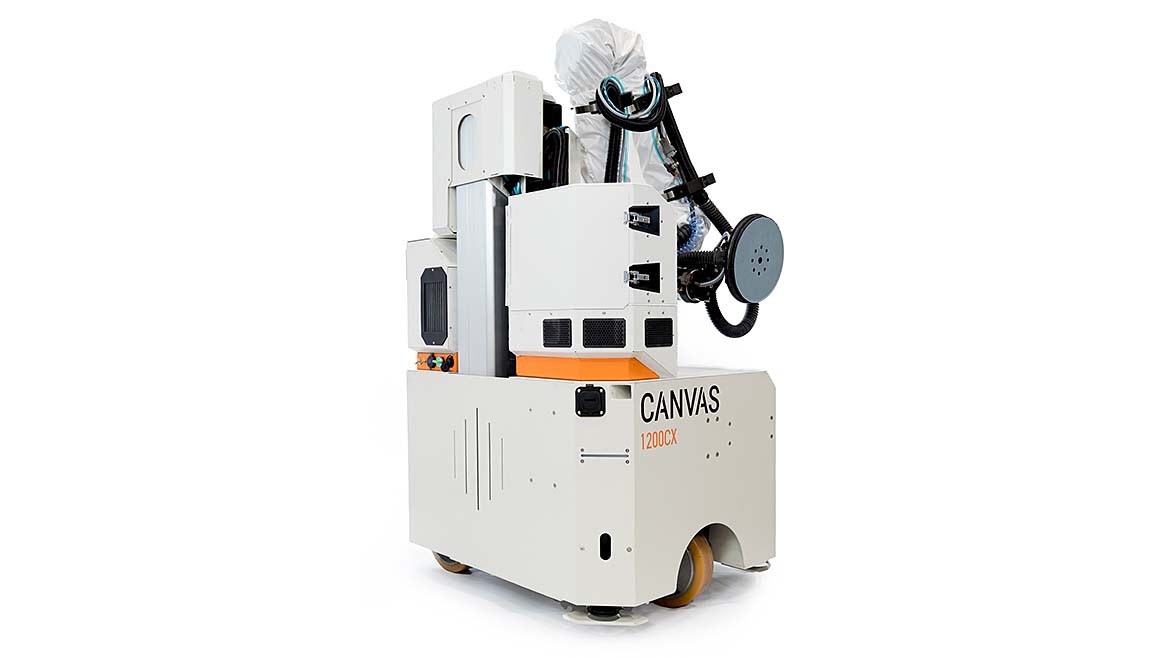
A drywalling robot from Canvas

Productivity Blues

The construction sector needs to double output over the next 40 years to meet expected demand. To put that into context, it’s the equivalent of adding an entire New York City to the world every month for 40 years. Unfortunately, the construction sector is in the midst of a severe labor shortage, with two people retiring from construction for every one that enters the sector.

Add to that a demanding and complex regulatory and safety environment, and it all results in a sector calling out for new solutions to make its workforce more productive and improve ergonomics.

Demanding Drywall

Exterior construction jobs typically involve heavy machinery, such as backhoes, excavators and tower cranes. However, if you look at the interiors of spaces across trades, the technology used is still almost entirely limited to hand tools.

A case in point is drywall finishing, one of the most labor-intensive jobs in construction, primarily because so many steps are required to get the job done. Typically, it takes between five and seven days of iterative joint compound application to finish a wall and get it ready to paint. In effect, drywalling 20,000 square feet of wall space takes about 100,000 square feet of work.

On some projects, largely because of the typical time scales involved, the drywalling component can be a loss leader or, at best, a “break even.” This is what my partner and I set out to solve, which resulted in the development of a worker-operated, robotic drywall finishing solution.
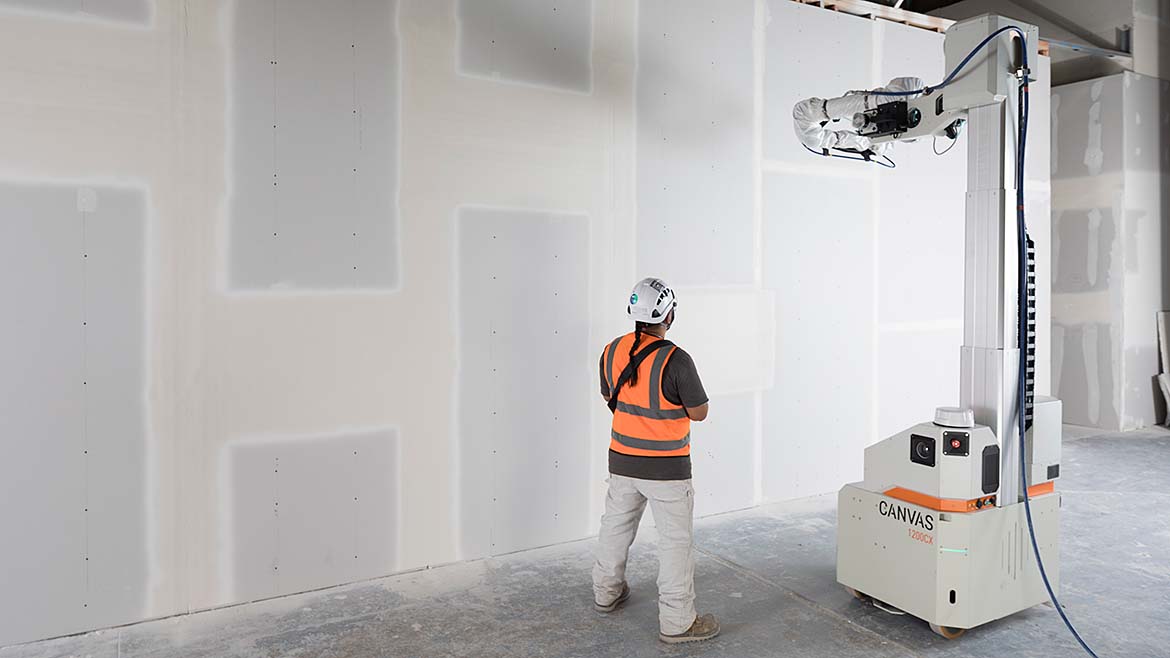
A drywalling robot from Canvas

Why Workers and Unions Approve Drywall Finishing Robots

The new technology also provides relief to workers by taking on the most physically demanding elements of drywall jobs. One in four construction workers ends their career with a musculoskeletal problem, usually either a back injury or a rotator cuff injury, from holding their arms over their head and performing finishing and sanding work for their entire career.

Training on drywall finishing robots takes a week and, once successfully completed, seasoned and apprentice finishers can operate it independently. As a result, the worker can focus on higher-value tasks, from operating the robot (or several robots) to working alongside it on other jobs.

Uniquely, the new technology was developed and tested in close collaboration with unions. It turns out that all stakeholders care about workers having the best, safest and most productive work environment. The new tool improves working conditions while providing workers with new skills and upward mobility.

There are 75 independent trades in the construction sector, and many suffer from the same challenges, from labor shortages to non-ergonomic working conditions.

Many companies that make drywall finishing robots are currently focused on assisting workers with drywall projects, but engineers are working on enabling them to perform a wide range of interior construction duties, including painting. In the next decade, collaborative robot systems will become more common on construction sites—a massive transformation from the days when such locations were considered too complex for robots to handle.

KEYWORDS: AI (artificial intelligence) canvas drywall finishing robotics technology

Share This Story

Looking for a reprint of this article?
From high-res PDFs to custom plaques, order your copy today!

Wc0924 feat canvas p4 kevin albert headshot

Kevin Albert is co-founder and CEO of Canvas, a construction technology company revolutionizing productivity by building an entirely new class of robotic machinery. With the only drywall robot that does a Level 4 finish, Canvas enables drywall subcontractors to gain a competitive edge in data center construction.

Recommended Content

JOIN TODAY
To unlock your recommendations.

Already have an account? Sign In

  • Abercrombie & Fitch

    EIFS in 2026: How Specialty Finishes Are Redefining Exterior Wall Systems

    As building codes, owner expectations, and design demands...
    Stucco/EIFS
    By: Regi Mendoza
  • proper air and vapor control

    From Energy Efficiency to Moisture Management: Why Air and Vapor Control Matter

    How proper air and vapor control within building...
    Building Envelope
    By: Benjamin Meyer AIA, LEED AP
  • Linear Metal Ceiling Beam Baffles

    Top 25 Ceiling Contractors of 2026

    Suspended ceilings demand precision, code compliance and...
    Ceilings
    By: John Wyatt and Tanja Kern
You must login or register in order to post a comment.

Report Abusive Comment

Manage My Account
  • eMagazine Subscription
  • Newsletters
  • Online Registration
  • Manage My Preferences
  • Subscription Customer Service

More Videos

Sponsored Content

Sponsored Content is a special paid section where industry companies provide high quality, objective, non-commercial content around topics of interest to the Walls & Ceilings audience. All Sponsored Content is supplied by the advertising company and any opinions expressed in this article are those of the author and not necessarily reflect the views of Walls & Ceilings or its parent company, BNP Media. Interested in participating in our Sponsored Content section? Contact your local rep!

close
  • medical professionals moving a patient on a stretcher through the halls of a medical building
    Sponsored byNational Gypsum Company

    What Does High Performance Mean When It Comes To Gypsum Boards?

Popular Stories

Wichita Biomedical Campus

Wichita Drywall Worker Dies After Scaffolding Fall

Okan Tower in Miami, Florida

OSHA Opens Investigation Into Fatal Okan Tower Column Collapse

Construction workers in safety vests install drywall

Gypsum Sales Hold Amid Market Shifts in the U.S.

data center and logos

USG, Subzero Engineering Form Data Center Alliance

Events

June 24, 2026

The Bright Side & Benefits of Designing with Integrated Lighting

Credits 1 AIA LU/HSW; 0.1 ICC CEU

This course will explore the pivotal role architects and lighting design play in creating safer, more sustainable spaces. Learn how to avoid common lighting mistakes and make informed decisions that create the best visual environment for occupants. 

January 1, 2030

Webinar Sponsorship Information

For webinar sponsorship information, visit www.bnpevents.com/webinars or email webinars@bnpmedia.com.

See our full library of webinars

View All Submit An Event

Products

2026 National Painting Cost Estimator

2026 National Painting Cost Estimator

See More Products

Related Articles

  • A robot assisting in drywall finishing

    Drywall Robots Can Be Your Competitive Edge in the Data Center Industry

    See More
  • Canvas_V171976 780 x 439.jpg

    Is Automation the Future of Drywall Finishing?

    See More
  • An interior drywalling work in progress

    Boost Profits with AI Scheduling

    See More

Related Products

See More Products
  • Accidents Waiting to Happen: Best Practices in Workers' Comp Administration and Protecting Corporate Profitability

  • 0071489738.jpeg

    Construction Waterproofing Handbook Second Edition

  • construction estimator.png

    2024 National Construction Estimator

See More Products

Related Directories

  • International Masonry Institute

    International Masonry Institute offers quality training for craft workers, professional education for masonry contractors, and free technical assistance to the design and construction communities. IMI is a strategic alliance between the Bricklayers Union (IUBAC) and their signatory contractors to promote quality masonry construction.
  • TYPAR Construction

    The TYPAR® Weather Protection System is the most comprehensive lineup of Building Wraps, Flashings, Construction Tapes and accessories. All of it designed to work together to safeguard homes and structures.
×

Connect with the industry’s leading resource for unparalleled insights and education.

Join thousands of industry professionals today. Shouldn’t you know what they know?

JOIN NOW
  • RESOURCES
    • Advertise
    • Contact Us
    • Directories
    • Store
    • Want More
  • SIGN UP TODAY
    • Create Account
    • eMagazine
    • Newsletters
    • Customer Service
    • Manage Preferences
  • SERVICES
    • Marketing Services
    • Reprints
    • Market Research
    • List Rental
    • Survey/Respondent Access
  • STAY CONNECTED
    • LinkedIn
    • Facebook
    • Instagram
    • YouTube
    • X
  • PRIVACY
    • PRIVACY POLICY
    • TERMS & CONDITIONS
    • DO NOT SELL MY PERSONAL INFORMATION
    • PRIVACY REQUEST
    • ACCESSIBILITY

Copyright ©2026. All Rights Reserved BNP Media, Inc. and BNP Media II, LLC.

Design, CMS, Hosting & Web Development :: ePublishing