Robotics
Construction Robots Advance Frankfurt Office Build
Robots drilling 16,000 ceiling anchors boost safety, accuracy and speed on Frankfurt project.
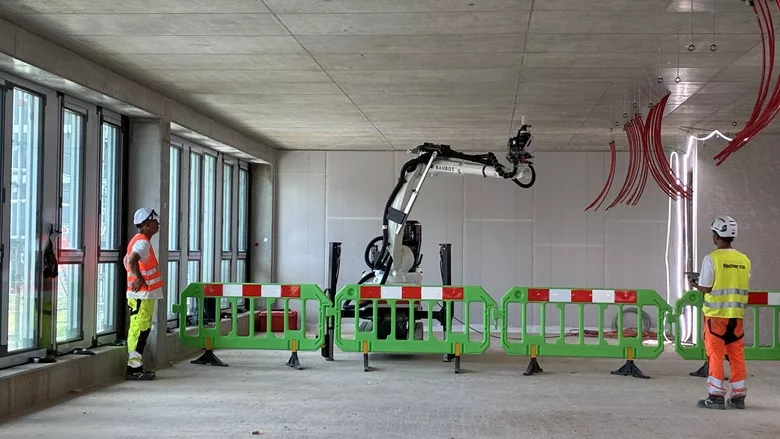
fischer construction robots are drilling the fixing holes into the concrete ceilings of the new office building in Frankfurt fully automatically. The digitally controlled processes ensure high precision, efficiency and consistent installation quality for the heating and cooling ceiling panels.
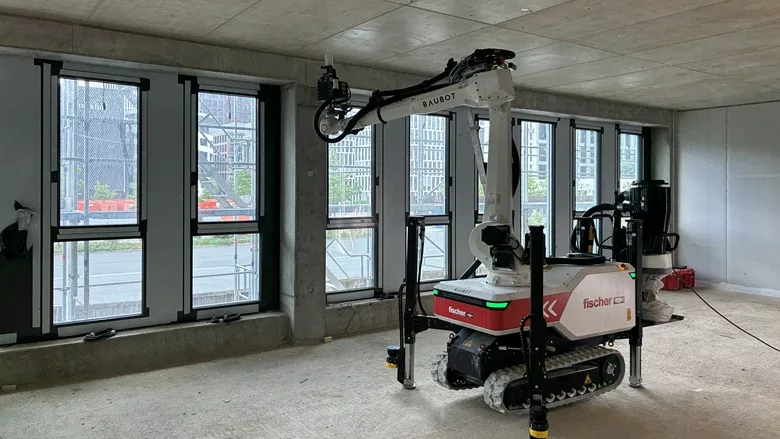
The construction robots are making a significant contribution to the efficient construction of the new office building in Frankfurt. The high precision, combined with significant time and cost savings during the drilling process, accelerates construction progress and supports the project’s success.
As demand for modern, sustainable office space remains strong across Germany, construction technology is playing an increasingly important role in delivering projects faster, safer and with greater precision. In Frankfurt, two autonomous construction robots are helping install thousands of ceiling-mounted heating and cooling panels on a new office development near the city's exhibition center.
The project, being developed by STRABAG Real Estate and constructed by Ed. Züblin AG, highlights how robotics are moving beyond pilot programs and becoming practical tools on active jobsites. Scheduled for completion in 2027, the office building spans approximately 120 meters long, 45 meters wide and 25 meters high.
Autonomous Drilling Improves Accuracy and Productivity
To support the installation of heating and cooling ceiling panels, approximately 16,000 holes measuring 10 mm in diameter and 25 mm deep must be drilled into the building's concrete ceilings. Rather than relying solely on manual labor, Ed. Züblin AG is utilizing two fischer construction robots to complete the work.
Guided by a digital construction model, the robots drill each hole autonomously before crews install fischer EA II hammerset anchors. The anchors are designed for quick installation and provide the load-bearing capacity needed to securely support the ceiling-mounted heating and cooling system.
According to project officials, the robotic drilling process delivers a higher level of accuracy while reducing installation time and helping maintain consistent quality throughout the project.
Safety Benefits Extend Beyond Productivity Gains
While efficiency is a key advantage, project stakeholders say worker safety remains one of the most significant benefits of deploying robotics on site.
“The accuracy is higher. And, of course, what is particularly important to us is that the use of construction robots also improves health and safety on site and protects the health of construction workers,” said Andreas Wörsdörfer of Ed. Züblin AG's Construction and Project Management department.
By taking over repetitive overhead drilling tasks, the robots reduce worker exposure to physically demanding activities that can contribute to long-term strain injuries. The machines also eliminate risks associated with ladder work and incorporate integrated dust extraction systems to help maintain cleaner jobsite conditions.
Emil Kral, managing director of fischer BauBot Services GmbH, noted that the robots also provide comprehensive digital documentation throughout the drilling process. Information including drilling depth, drilling time, coordinates and reinforcement strikes is automatically recorded, creating a detailed digital record that would be difficult to replicate through manual methods.
As contractors continue searching for ways to improve productivity while addressing labor shortages and jobsite safety concerns, projects like the Frankfurt office development demonstrate how robotics can deliver measurable benefits in real-world construction applications. With thousands of precise anchor installations completed autonomously, the technology is helping move the project forward while setting a benchmark for future commercial construction projects.
How Robotics Are Reshaping the Drywall and Finishing Industry
For decades, drywallers and finishers have relied on muscle, skill, and precision to get walls and ceilings ready for paint. While craftsmanship remains central, robotics are beginning to make a real impact on the trade, offering new tools that ease labor demands and boost productivity.
One of the biggest benefits robotics bring is reducing physical strain. Installing and finishing drywall (especially on ceilings) puts constant stress on the back, shoulders and arms. Robotic lift systems can now hold sheets of drywall in place while workers secure them, eliminating one of the most demanding parts of the job. Similarly, robotic sanding machines are being used to smooth large surfaces without the fatigue that comes from hours of overhead or repetitive sanding.
Robotics also help with consistency and precision. Automated taping and finishing tools are designed to apply joint compound evenly and smoothly, cutting down on rework and improving the overall surface finish. In high-volume projects, such as commercial buildings or multifamily housing, this consistency can mean tighter schedules and fewer callbacks for quality corrections.
As robotics become more affordable and accessible, drywall contractors and finishing crews who adopt them early may find they gain a competitive edge. With less physical wear on workers, faster turnaround times, and more consistent results, robotics are not just a futuristic idea—they’re quickly becoming an everyday part of building walls and ceilings.
Looking for a reprint of this article?
From high-res PDFs to custom plaques, order your copy today!