Drywall Robots Can Be Your Competitive Edge in the Data Center Industry
Integrating drywall robots into construction workflows offers drywall subcontractors a powerful competitive advantage by accelerating delivery, improving quality and safety, and addressing labor shortages amid the surging demand for faster, large-scale data center development.
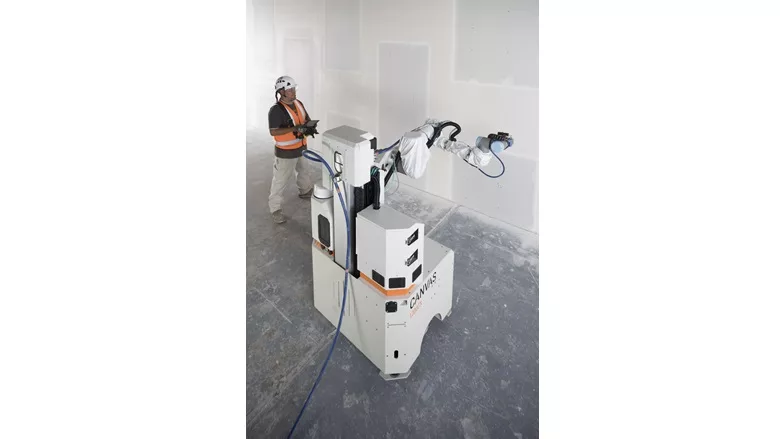
Photo courtesy of Canvas
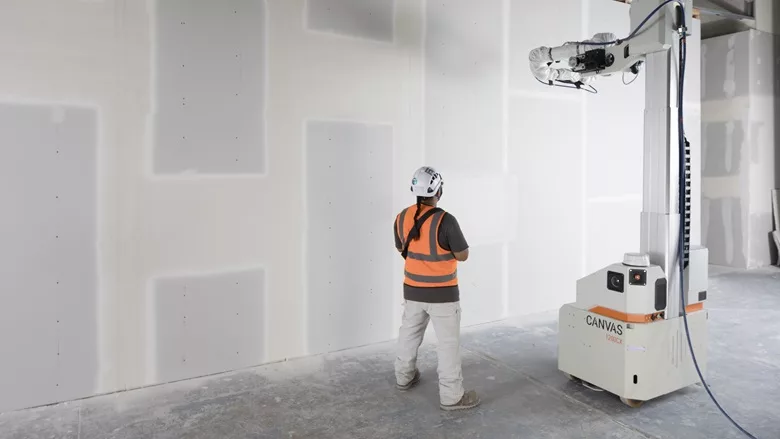
Photo courtesy of Canvas
It’s a good time to be a drywall contractor in the data center industry.
Drywall is critical path for general contractors, who are under tremendous pressure to build twice as much data center capacity in the next five years as in the previous 25. Challenges abound: More new development is occurring in secondary markets, where skilled labor is even harder to come by. At the same time, tech companies face ever-more scrutiny about the impact of their data centers, so tolerance for safety lapses is nil.
Drywall contractors that help GCs build fast, at scale, in secondary markets – and do it on time, on budget, to the highest quality and safety standards – have a unique opportunity to gain and solidify a competitive advantage. These are the kinds of campus-level contracts that can enable game-changing scale for your business.
If it were easy, it wouldn’t be a competitive advantage. The old modus operandi won’t suffice. As Bill Kleyman, program chair for Data Center World and the author of AFCOM’s State of the Data Center Report put it, “The reality is pretty straightforward: we can’t build data centers the same way we used to. The good news is that there are a lot of innovative leaders.”
WTW put it well in the Q1 2025 Global Construction Rate Trend Report: “The future of construction is being shaped by the integration of AI and robotics…the industry [is] increasingly adopt[ing] these innovations to remain competitive and meet project deadlines.” In particular, drywall robots enable you to accelerate delivery while ensuring the highest levels of quality and safety – to get, and keep, a competitive edge in the data center industry.
Accelerate Delivery
The pressure is on GCs to build two to four times the capacity, in a fifth of the time, in new markets …
Build Big
“Historically the average size of new data centers was increasing gradually, but this trend has become supercharged in the last few quarters as companies build out AI-oriented infrastructure.”
– John Dinsdale, Chief Analyst at Synergy Research Group
Build Fast
“Data center construction is all about speed in this labor-constrained market. Any and all ideas that can increase throughput on the construction site without requiring more labor will be given consideration.”
– Ron Vokoun, Director of National Market Development at Everus Construction Group and chair of Data Center Build
Build Outside Tier 1 Markets
“New development is increasingly in more rural locations, where talent pools for skilled construction labor are much smaller. “Labor shortages often require that contractors and project owners rely more heavily on less experienced skilled labor which often results in poorer quality construction and reduced adherence to safety protocols.”
– WTW Global Construction Rate Trend Report: Q1 2025
GCs are under tremendous pressure to build bigger data centers faster than ever before, and drywall is critical path. If you can accelerate delivery, you’ll be the GC’s hero, and the first subcontractor they call. That’s easier said than done, though, given that data center development is now more likely to be in secondary markets where talent pools for skilled construction labor are much smaller.
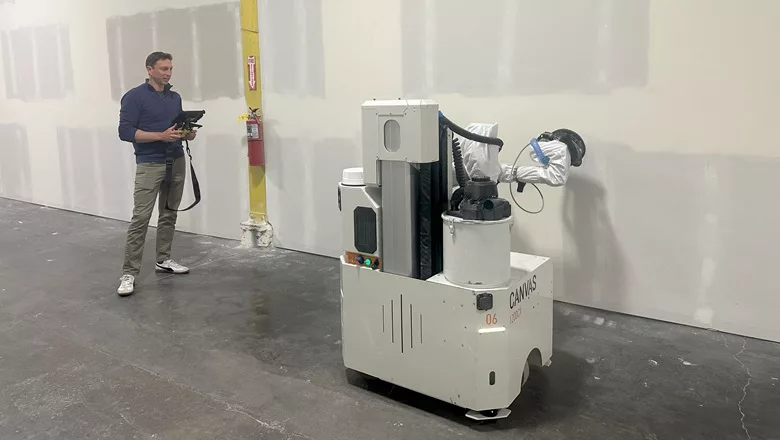
With drywall robots that are easy to set up and operate, operators can be trained in as little as a week. Then you can achieve the productivity gains that come from integrating robots into your workflows. Humans are about 50% less productive at heights above 10 feet; in contrast, a drywall robot with an integrated and automated lift is as fast at 2 feet as at 20. When robots have autonomous, self-drive capability, one human can operate multiple machines.
These advantages depend on the ease and speed of setting up the robots, and on their reliability. The ideal drywall robot can be set up within minutes, no plans or mapping steps needed. When powerful AI models help target key features and automatically split the wall into workspaces, users just have to set the target finish and review the plan. At Canvas, our long track record includes years of customer feedback, which we’ve used in development of our new robot, designed for maximum uptime.
Ensure the Highest Levels of Quality and Safety
If you have to rely on less-experienced and less-skilled drywall finishers, you risk mistakes and injuries, which can impede on-time delivery and diminish customer satisfaction. In contrast, a robot produces high quality output consistently regardless of the operator’s skill level. When the robot detects and automatically calibrates to incoming conditions, compensating for any conditions that are out of spec, it ensures accuracy and maximum uptime – critical when timelines are tight and tolerances are shrinking.
Safety has always been paramount, of course. Because tech companies face increasingly tough scrutiny of their developments, a perfect safety record is now a likely requirement for GCs and their subcontractors. Falls are the leading cause of construction injuries, so drywall robots with a 20+ foot reach improve jobsite safety. They also prevent chronic injuries associated with repetitive motion (25% of workers have work-related Musculo-skeletal disorders) and prolong workers’ careers.
De-risk Fast Growth
With the productivity gains that drywall robots afford, you can take on more work. If you’re turning down projects right now because you can’t find skilled workers, integrating drywall robots can enable you to expand. It also mitigates the significant risk that skilled labor shortages impede your ability to deliver on time (a misstep for which there is little forgiveness, given the pressure GCs are under to build bigger data centers more quickly and the fact that drywall is critical path).
Integrating drywall robots into your workflows can also make your growth more sustainable for the long-term, even as the labor market continues to change. By freeing up existing workers for less repetitive, less injurious jobs and enabling them to grow their skillsets as robotics operators, you can extend experienced workers’ tenures. Being known for a high-tech jobs with less risk of injury can be a valuable competitive differentiator in tight labor markets, especially among younger workers.
Now’s the Time to Integrate Robots
It’s no secret there is immense opportunity right now in data center construction. Most drywall subcontractors are looking to gain their competitive edge in the industry. What is now an advantage will soon become an imperative. Now is the time to secure the advantage by integrating drywall robots into your workflows.
While drywall robots can be integrated quickly and easily, becoming really good with robots as an organization is a skill that has to be developed. The subcontractors doing it now are getting ahead of competitors by building a culture designed to reap the rewards of technological advancements in robotics and AI – today’s, and tomorrow’s.
Infographic
It’s a wild time in the data center industry
Accelerating Demand
40% – average annual growth in the Global DataSphere 2010-19
56% – growth 2019-20
Shrinking Supply
9.9% – average vacancy rate in 1H 2020
3% – average vacancy rate in 1H 2024
Generative AI
60 GW – global demand for data center capacity today
298 GW – global demand for data center capacity in 2030
Tier 1 Markets are Tapping Out
Four years – timeline for land permits and power interconnection
Double what it used to be
References
1: Data Center Knowledge, Data Center Construction Trends: Build Fast, Build Smart, 3 April 2024.
2: Demand for data center capacity is often measured by the volume of data created, captured, copied, and consumed (the ‘Global DataSphere’). Source: IDC
3: JLL
4: McKinsey
5: Lawrence Berkeley National Laboratory and CBRE
Looking for a reprint of this article?
From high-res PDFs to custom plaques, order your copy today!