Walls & Ceilings logo
search
cart
facebook twitter linkedin youtube youtube Spotify Podcasts Apple Podcasts Spotify Podcasts Apple Podcasts
  • Sign In
  • Create Account
  • Sign Out
  • My Account
Walls & Ceilings logo
  • NEWS
  • TOPICS
    • Drywall
    • Stucco/EIFS
    • Ceilings
    • Steel Framing
    • Fireproofing
    • Interior Plaster
    • Building Envelope
    • Insulation
    • Technology
    • Interior
    • Exterior
    • Women In Construction
  • COLUMNS
    • Up Front
    • All Things Gypsum
    • Art & Craft of Plastering
    • Stucco Stop
    • Steel Deal
    • Industry Voices
  • PRODUCTS
    • Buzz Guide
  • EVENTS
    • Industry Events
    • Webinars
    • BUILD Expo
  • MEDIA
    • Videos
    • Podcasts
    • Photo Galleries
    • BUILD26 Videos
    • Take our Quiz!
    • Infographics
  • EXCLUSIVE
    • Newsletters
    • Top 50 Contractors
    • Contractor of the Year
    • State of the Industry
    • W&C Store
    • Market Research
    • CEUs
    • Sponsor Insights
    • Custom Content & Marketing Services
  • DIRECTORY
  • EMAGAZINE
    • eMagazine
    • Advertise
    • Archive Issues
  • SIGN UP!
Building EnvelopeInsulation

Decarbonization & Energy Independence

Why Building Insulation Is Key to Fighting Climate Change

Better insulation can help reduce fossil fuel use, lower emissions, and increase national energy security
By Doug Brady
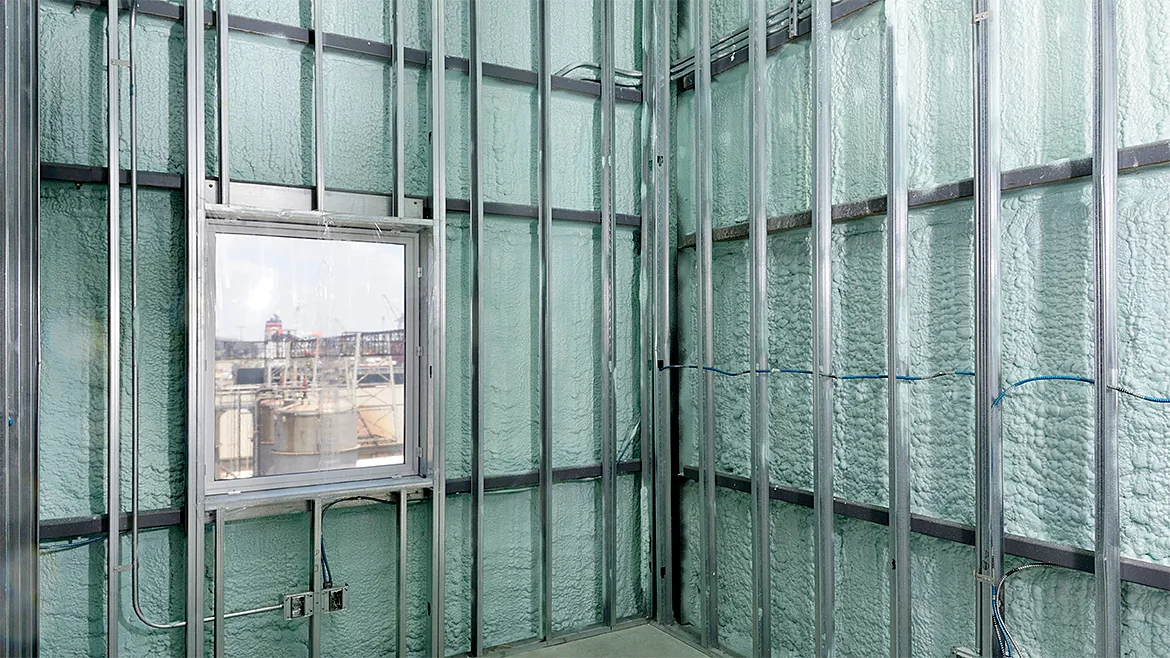
closed-cell-spray-foam-insulation
Images courtesy of Huntsman Building Products.
Closed-cell foam insulation in a commercial building.
July 18, 2025

There are numerous sources of data pointing to a warming planet and the damages it causes, both physical and financial. Rising temperatures are primarily a result of human induced greenhouse effect, which occurs when the atmosphere traps the heat radiating from Earth toward space. Unfortunately, this warming has led to numerous hurricanes, droughts, tsunamis, and ocean acidification, all valid reasons to address it.

Greenhouse gas emissions are in large part a result of burning fossil fuels, which occurs when we power, heat, and cool buildings. Thus, reducing carbon emissions from buildings, also known as decarbonization, is critical to the planet’s health. Efforts toward the decarbonization of the country’s homes and structures will also notably increase the country’s energy independence and energy security by decreasing our need to source petroleum-based fuel products from other nations.

Our industry helps all these goals when we install high-performance insulations, such as spray polyurethane foam, into the building envelope of our projects. These energy efficient insulations reduce fossil fuel-based energy consumption, resulting emissions, and energy dependence on other countries.

Consequences of a Warming Earth

Earth’s surface temperature has increased 0.14 degrees Fahrenheit per decade since 1880; the rate of the planet’s warming has more than doubled since 1981, according to NOAA.  Drought, fires, and hurricanes are known consequences of the globe’s rising temperatures with recent examples including: September 2024’s Hurricane Helene, the most deadly hurricane since 2005’s Katrina, which was responsible for 250 fatalities; October 2024’s Hurricane Milton, one of the strongest hurricanes of record in the Atlantic basin; the Pacific Palisades Fire, the January fire in southern California that took 12 lives and decimated 6,800 homes; and the Eaton Fire, the January fire in Los Angeles County responsible for 18 deaths and the destruction of 9,000 structures. 

U.S. Buildings Emissions

Research from the U.S. Environmental Protection Agency found that the residential and commercial end-use sectors accounted for 19.1 and 16.6 percent, respectively, of carbon dioxide emissions from fossil fuel combustion in 2022. The bulk of these emissions were attributable to electricity use for building related functions including lighting, heating, cooling, and operating appliances; the remaining emissions were attributable to consumption of natural gas and petroleum for heating and cooking.  

Focus on the Building Envelope

When looking at meaningful ways to conserve energy in homes and commercial structures, the building envelope takes center stage. Optimal insulation of the envelope is key for preventing energy transfer, reducing energy consumption attributed to heating and cooling the structure, and reducing emissions. However, not all insulations perform equally well. R-value, which measures the ability to limit conductive heat flow, is one measurement tool when comparing insulations; however, conductive heat flow is only one heat transfer mechanism. Air leakage or heat transfer via convection is also important to regulate. Controlling air leakage in a building can result in up to a 25% reduction in space conditioning energy usage, something not possible using insulations that only address conduction heat flow reduction. Ultimately, an air-tight seal is as important as R-value in achieving energy efficiency and reducing fossil fuel driven emissions.

Closed-cell foam insulation in a commercial building.

Closed-cell foam insulation in a residential building.

Optimal Solution: Closed Cell Spray Polyurethane Foam 

One of the highest performing insulation options available today, closed-cell spray foam insulation is a single-source solution for thermal, air, vapor control as well as weather resistive barrier. As a thermal insulator specifically, closed cell spray foam offers one of the highest R-values per inch of all available insulations. The material forms in-place, fully adheres, and eliminates the cracks and gaps that leak air or water, ultimately creating a structure with an airtight seal.

A building envelope with closed cell spray foam insulation offers greater comfort and air quality, while significantly reducing long-term heating and cooling demands, emissions and energy costs. In fact, in accordance with one product’s EPD, closed cell SPF reduces embodied carbon when compared to other types of insulation and is also much more effective in reducing buildings’ operational carbon emissions. Closed cell spray foam insulation also notably protects the structure against mold and water damage. 

Spray Foam as Continuous Insulation 

A building’s energy efficiency is optimized with the application of continuous insulation on the exterior side of the building envelope walls, when compared to the same structure without it. Closed cell spray foam is ideally suited for continuous insulation applications and can be used in both interior and exterior applications where it can essentially replace traditional insulation materials. It is also ideally utilized in smaller spaces where a higher R-value is required or where severe moisture could be an issue.  

Combining closed cell spray polyurethane foam as continuous insulation on exterior walls with an interior application in the stud cavities creates a building envelope replicating the idea of a coat (exterior continuous insulation) and a sweater (interior cavity insulation). The two applications optimize the energy efficiency of the total building envelope.  

Additional Solutions 

To meaningfully reduce building emissions, new structures must be built with high performance materials; many existing structures must undergo efficiency-focused retrofits as well. Support for policy favoring decarbonization is important, as are electrification efforts, building codes, enhanced performance of the mechanical equipment incorporated in buildings, financial and tax incentives, and the widespread use of energy monitoring technologies. All these efforts will also help the U.S. achieve energy independence.

KEYWORDS: closed-cell energy efficiency EPDs (Environmental Product Declarations) Huntsman Building Solutions natural disasters polyurethane R-value spray foam spray foam insulation

Share This Story

Looking for a reprint of this article?
From high-res PDFs to custom plaques, order your copy today!

Wc0222 feat3 huntsman p6 author doug brady

Doug Brady is vice president of global innovation and product management for Huntsman Building Solutions, the global leader in spray polyurethane foam solutions. Contact him at dbrady@huntsmanbuilds.com.

Recommended Content

JOIN TODAY
To unlock your recommendations.

Already have an account? Sign In

  • Abercrombie & Fitch

    EIFS in 2026: How Specialty Finishes Are Redefining Exterior Wall Systems

    As building codes, owner expectations, and design demands...
    Stucco/EIFS
    By: Regi Mendoza
  • proper air and vapor control

    From Energy Efficiency to Moisture Management: Why Air and Vapor Control Matter

    How proper air and vapor control within building...
    Building Envelope
    By: Benjamin Meyer AIA, LEED AP
  • Linear Metal Ceiling Beam Baffles

    Top 25 Ceiling Contractors of 2026

    Suspended ceilings demand precision, code compliance and...
    Ceilings
    By: John Wyatt and Tanja Kern
You must login or register in order to post a comment.

Report Abusive Comment

Manage My Account
  • eMagazine Subscription
  • Newsletters
  • Online Registration
  • Manage My Preferences
  • Subscription Customer Service

More Videos

Sponsored Content

Sponsored Content is a special paid section where industry companies provide high quality, objective, non-commercial content around topics of interest to the Walls & Ceilings audience. All Sponsored Content is supplied by the advertising company and any opinions expressed in this article are those of the author and not necessarily reflect the views of Walls & Ceilings or its parent company, BNP Media. Interested in participating in our Sponsored Content section? Contact your local rep!

close
  • medical professionals moving a patient on a stretcher through the halls of a medical building
    Sponsored byNational Gypsum Company

    What Does High Performance Mean When It Comes To Gypsum Boards?

Popular Stories

Wichita Biomedical Campus

Wichita Drywall Worker Dies After Scaffolding Fall

Okan Tower in Miami, Florida

OSHA Opens Investigation Into Fatal Okan Tower Column Collapse

Construction workers in safety vests install drywall

Gypsum Sales Hold Amid Market Shifts in the U.S.

data center and logos

USG, Subzero Engineering Form Data Center Alliance

Events

June 24, 2026

The Bright Side & Benefits of Designing with Integrated Lighting

Credits 1 AIA LU/HSW; 0.1 ICC CEU

This course will explore the pivotal role architects and lighting design play in creating safer, more sustainable spaces. Learn how to avoid common lighting mistakes and make informed decisions that create the best visual environment for occupants. 

January 1, 2030

Webinar Sponsorship Information

For webinar sponsorship information, visit www.bnpevents.com/webinars or email webinars@bnpmedia.com.

See our full library of webinars

View All Submit An Event

Products

2026 National Painting Cost Estimator

2026 National Painting Cost Estimator

See More Products

Related Articles

  • resurfacing walls and ceilings

    Training is Key to Safety and Efficiency on Aerial Work Platforms

    See More
  • Embracing New Technologies, Tools is Key to Success Says Drywaller

    VIDEO: Embracing New Technologies, Tools is Key to Success Says Drywaller

    See More
  • Janet Puglisi

    Is Training the Key to Employee Retention? One Company Says “Yes”

    See More

Related Products

See More Products
  • M:\General Shared\__AEC Store Katie Z\AEC Store\Images\Walls & Ceilings\new site\Contractors_guide-change-or.gif

    Contractor's Guide to Change Orders

  • bim 3e.jpg

    BIM Handbook: A Guide to Building Information Modeling for Owners, Designers, Engineers, Contractors, and Facility Managers, 3rd Edition

  • building codes illustated.jpg

    Building Codes Illustrated: A Guide to Understanding the 2021 International Building Code, 7th Edition

See More Products
×

Connect with the industry’s leading resource for unparalleled insights and education.

Join thousands of industry professionals today. Shouldn’t you know what they know?

JOIN NOW
  • RESOURCES
    • Advertise
    • Contact Us
    • Directories
    • Store
    • Want More
  • SIGN UP TODAY
    • Create Account
    • eMagazine
    • Newsletters
    • Customer Service
    • Manage Preferences
  • SERVICES
    • Marketing Services
    • Reprints
    • Market Research
    • List Rental
    • Survey/Respondent Access
  • STAY CONNECTED
    • LinkedIn
    • Facebook
    • Instagram
    • YouTube
    • X
  • PRIVACY
    • PRIVACY POLICY
    • TERMS & CONDITIONS
    • DO NOT SELL MY PERSONAL INFORMATION
    • PRIVACY REQUEST
    • ACCESSIBILITY

Copyright ©2026. All Rights Reserved BNP Media, Inc. and BNP Media II, LLC.

Design, CMS, Hosting & Web Development :: ePublishing