Walls & Ceilings logo
search
cart
facebook twitter linkedin youtube youtube Spotify Podcasts Apple Podcasts Spotify Podcasts Apple Podcasts
  • Sign In
  • Create Account
  • Sign Out
  • My Account
Walls & Ceilings logo
  • NEWS
  • TOPICS
    • Drywall
    • Stucco/EIFS
    • Ceilings
    • Steel Framing
    • Fireproofing
    • Interior Plaster
    • Building Envelope
    • Insulation
    • Technology
    • Interior
    • Exterior
    • Women In Construction
  • COLUMNS
    • Up Front
    • All Things Gypsum
    • Art & Craft of Plastering
    • Stucco Stop
    • Steel Deal
    • Industry Voices
  • PRODUCTS
    • Buzz Guide
  • EVENTS
    • Industry Events
    • Webinars
    • BUILD Expo
  • MEDIA
    • Videos
    • Podcasts
    • Photo Galleries
    • BUILD26 Videos
    • Take our Quiz!
    • Infographics
  • EXCLUSIVE
    • Newsletters
    • Top 50 Contractors
    • Contractor of the Year
    • State of the Industry
    • W&C Store
    • Market Research
    • CEUs
    • Sponsor Insights
    • Custom Content & Marketing Services
  • DIRECTORY
  • EMAGAZINE
    • eMagazine
    • Advertise
    • Archive Issues
  • SIGN UP!
Exterior

Architectural Beauty or Deadly Liability? Façades Spark Fierce Debate in Earthquake Safety

While earthquake preparedness often focuses on a building’s foundation, the real and often overlooked danger lies in aging or poorly anchored facades, urging property owners to invest in modern, discreet seismic retrofitting solutions that preserve architectural beauty while ensuring public safety and resilience.
By Kyle Tourjé
Seismic Retrofitting
Images courtesy of Alpha Structural Inc.
November 11, 2025

When we think of earthquake preparedness, we often visualize strengthening a building’s core foundation and frame. While these are critical, a significant and often overlooked danger hides in plain sight: the exterior walls, façades, and cladding systems. Historic buildings, with their ornate masonry and decorative features, were often constructed long before modern seismic codes existed. This leaves them dangerously vulnerable, not just to collapse, but to shedding heavy materials onto sidewalks and streets below. As seismic risk becomes a national concern, it’s imperative for property owners and contractors to look beyond the foundation and address the urgent threat posed by their building’s exterior.

Unmasking the Seismic Vulnerability: The Systemic Risks of Building Façades

A building’s facade is its public face, but in an earthquake, it can become its greatest liability. Many turn-of-the-century high-rises, churches, and commercial properties feature architectural elements that lack the anchorage needed to withstand intense seismic shaking. These decorative cornices, masonry veneers, and cladding systems were never designed for the lateral forces of a major earthquake, creating a substantial hazard in densely populated urban areas. The danger is twofold: the failure of these elements compromises the building’s structural envelope and poses a direct threat to public safety.

This vulnerability is magnified in unreinforced masonry buildings. Decades of deferred maintenance can lead to severely degraded mortar, weakening the entire structure. In some cases, the deterioration is so advanced that bricks can be pulled from a wall by hand. During a seismic event, these walls don’t just crack—they can disintegrate, leading to catastrophic failure. The risk isn’t confined to historic structures, either; even mid-century buildings can have poorly designed facade anchorages that are ticking time bombs.

While California’s seismic threats are well-documented, the U.S. Geological Survey has identified widespread hazards across 37 states and nearly 500 new faults nationwide. This is a national issue, yet the barriers to action remain stubbornly high. Retrofitting a building’s exterior is often seen as an inconvenient and costly undertaking. It can require extensive scaffolding, disrupt business operations, and interrupt tenant activities, leading many property owners to delay or avoid these critical upgrades.
Strategic Integration of Seismic Strength and Preservation Strategic Integration of Seismic Strength and Preservation

Photos: Alpha Structural Inc.

Innovating Urban Resilience: Strategic Integration of Seismic Strength and Preservation

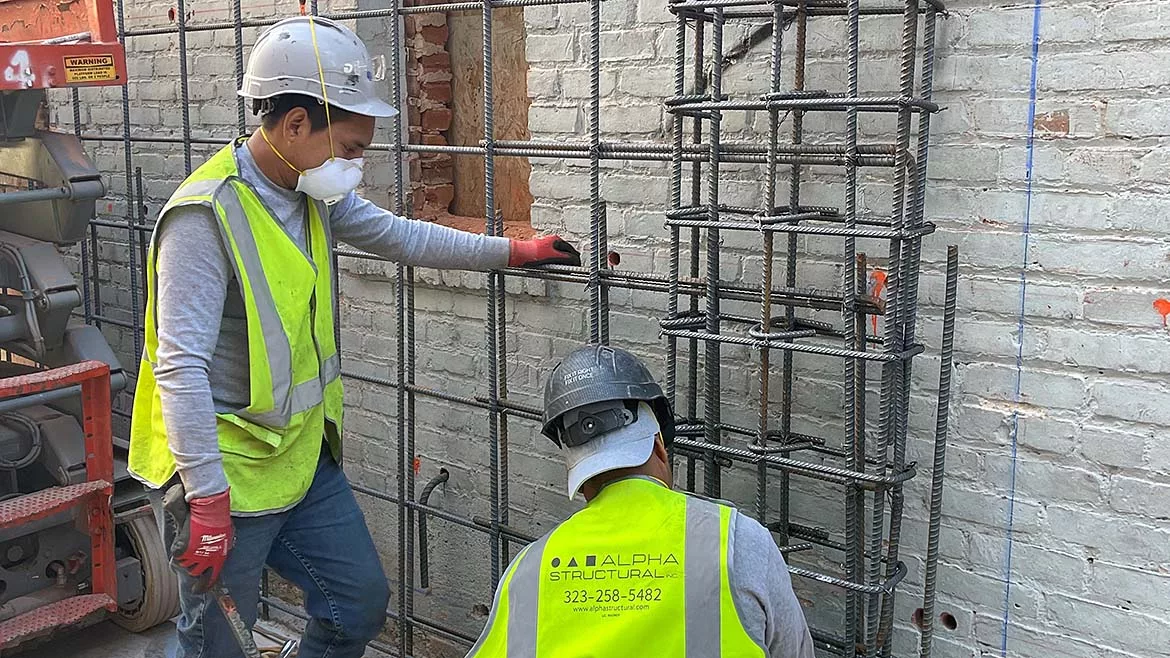
The good news is that seismic resilience does not have to come at the expense of architectural integrity. Modern engineering has produced a range of innovative solutions that allow contractors to strengthen walls and façades without erasing their historic or aesthetic character. The goal is to reinforce from within, preserving the building’s unique identity while preparing it for the inevitable.

These emerging techniques provide a toolkit for contractors and engineers to address vulnerabilities discreetly and effectively:

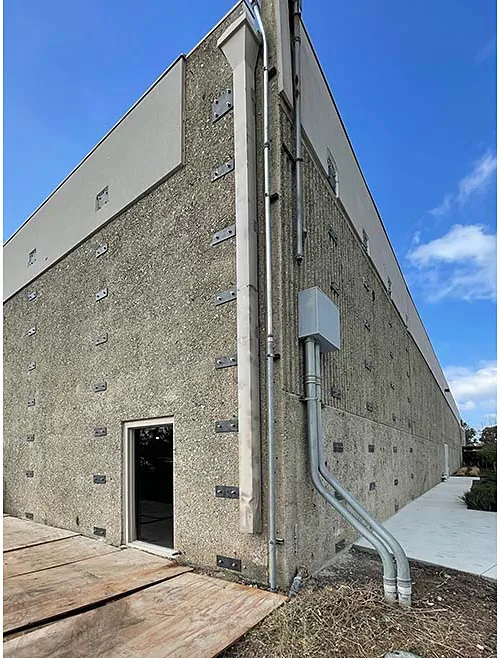
  • Advanced Anchoring Systems: Specialized, discreet anchors and mesh systems are now available to secure everything from stone and masonry façades to decorative concrete, gargoyles, and ornate architectural features. These systems are designed to be minimally invasive, providing robust reinforcement without altering the building’s appearance.
  • Targeted Masonry Restoration: Instead of a complete overhaul, techniques like tuckpointing or repointing—the process of repairing mortar joints—can dramatically improve the strength and stability of unreinforced masonry. When guided by an engineer’s analysis, this restoration work becomes a critical component of a seismic retrofit strategy.
  • Strengthening Existing Connections: For more modern façades, retrofitting may involve upgrading existing anchorage points. A thorough evaluation can identify weak connections that can be reinforced to meet current seismic standards, often at a fraction of the cost of a full replacement.

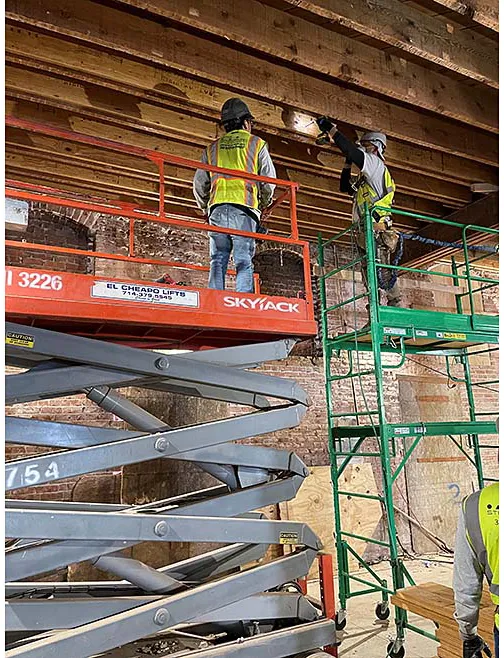
The most effective and cost-efficient outcomes are achieved when engineers and builders collaborate from the very beginning. When brought into the design phase, contractors can provide invaluable input on the practical means and methods of installation. This synergy ensures that the engineer’s design is not only theoretically sound but also constructible and cost-effective, balancing safety calculations with real-world implementation.

Pioneering Resilience: A Collaborative Path Forward

Retrofitting isn’t just about compliance or disaster-proofing; it’s about building long-term resilience. For contractors, this presents an opportunity to deliver greater value to clients. By integrating seismic upgrades into projects they are already undertaking, they can help property owners save substantial costs, eliminate redundancy, and enhance public safety. A wall and ceiling contractor working on a restoration project is perfectly positioned to explain how incorporating seismic reinforcement now is a smart, proactive investment.

The most effective first step for any property owner is to commission a professional evaluation to understand the true condition of their building’s exterior. Knowing your asset’s weaknesses is the foundation of any resilience strategy. With that knowledge, you can work with a team of experienced engineers and contractors to develop a plan that is both effective and feasible.

We can no longer afford to overlook the dangers hidden on the outside of our buildings. As our understanding of seismic risk grows, it’s clear that a building is only as strong as its most vulnerable component. By focusing on our walls and façades, we can take a critical step toward creating safer, more resilient communities that are prepared to withstand the inevitable and protect both lives and investments for decades to come.

KEYWORDS: building façade California exterior cladding natural disasters retrofitting scaffolding seismic design survey

Share This Story

Looking for a reprint of this article?
From high-res PDFs to custom plaques, order your copy today!

Wc1125 feat seismic p4 author kyle tourje

Kyle Tourjé is a second-generation contractor specializing in structural retrofitting, repair, and geohazard mitigation throughout Southern California. As Executive Vice President of Alpha Structural Inc., he oversees all engineering and construction operations. Having grown up in the trade and with more than 15 years of experience—including personally repairing and inspecting over 6,000 structures—Tourjé combines hands-on construction and field engineering expertise with leadership in real estate and disaster response. With a background spanning construction, insurance claims, and litigation support, he applies practical solutions to California’s evolving structural, legal, and environmental challenges. His focus is on advancing straightforward, lasting solutions that improve safety and resilience for communities across the region. For more information, visit alphastructural.com.

Recommended Content

JOIN TODAY
To unlock your recommendations.

Already have an account? Sign In

  • Abercrombie & Fitch

    EIFS in 2026: How Specialty Finishes Are Redefining Exterior Wall Systems

    As building codes, owner expectations, and design demands...
    Stucco/EIFS
    By: Regi Mendoza
  • proper air and vapor control

    From Energy Efficiency to Moisture Management: Why Air and Vapor Control Matter

    How proper air and vapor control within building...
    Building Envelope
    By: Benjamin Meyer AIA, LEED AP
  • Linear Metal Ceiling Beam Baffles

    Top 25 Ceiling Contractors of 2026

    Suspended ceilings demand precision, code compliance and...
    Ceilings
    By: John Wyatt and Tanja Kern
You must login or register in order to post a comment.

Report Abusive Comment

Manage My Account
  • eMagazine Subscription
  • Newsletters
  • Online Registration
  • Manage My Preferences
  • Subscription Customer Service

More Videos

Sponsored Content

Sponsored Content is a special paid section where industry companies provide high quality, objective, non-commercial content around topics of interest to the Walls & Ceilings audience. All Sponsored Content is supplied by the advertising company and any opinions expressed in this article are those of the author and not necessarily reflect the views of Walls & Ceilings or its parent company, BNP Media. Interested in participating in our Sponsored Content section? Contact your local rep!

close
  • medical professionals moving a patient on a stretcher through the halls of a medical building
    Sponsored byNational Gypsum Company

    What Does High Performance Mean When It Comes To Gypsum Boards?

Popular Stories

Linear Metal Ceiling Beam Baffles

Top 25 Ceiling Contractors of 2026

Wichita Biomedical Campus

Wichita Drywall Worker Dies After Scaffolding Fall

QXO Just Changed the Game-Here's What Contractors Are Asking

QXO Just Changed the Game-Here's What Contractors Are Asking

Less compound

Joint Compound Market to Reach $9.7B by 2033

Events

June 24, 2026

The Bright Side & Benefits of Designing with Integrated Lighting

Credits 1 AIA LU/HSW; 0.1 ICC CEU

This course will explore the pivotal role architects and lighting design play in creating safer, more sustainable spaces. Learn how to avoid common lighting mistakes and make informed decisions that create the best visual environment for occupants. 

January 1, 2030

Webinar Sponsorship Information

For webinar sponsorship information, visit www.bnpevents.com/webinars or email webinars@bnpmedia.com.

See our full library of webinars

View All Submit An Event

Products

2026 National Painting Cost Estimator

2026 National Painting Cost Estimator

See More Products

Related Articles

  • A retaining wall

    Outdated Engineering Standards Are Putting Lives at Risk Behind Retaining Walls

    See More
  • Simpson Strong-Tie 10-Story Mass Timber Building Earthquake Tests

    Simpson Strong-Tie Participates in 7.7 Magnitude Earthquake Test of 10-Story Mass Timber Building

    See More
  • You Hired Them, You Own It: Subcontractor Liability in Construction

    You Hired Them, You Own It: Subcontractor Liability in Construction

    See More

Related Products

See More Products
  • 1118458605.jpg

    Sustainable Facades: Design Methods for High-Performance Building Envelopes

  • Architectural Acoustics: Principles and Practice, 2nd Edition

  • 111890950X.jpg

    Architectural Graphic Standards, 12th Edition

See More Products

Related Directories

  • Infrastructure Health & Safety Assn.

    IHSA is a leader in health and safety education. Through skills-based training, auditing, and evaluation, we provide safety solutions to those who perform high-risk activities such as working at heights, working with energized high-voltage power systems, driving motor vehicles, transporting dangerous goods, working on suspended access equipment, and utility line clearing.
×

Connect with the industry’s leading resource for unparalleled insights and education.

Join thousands of industry professionals today. Shouldn’t you know what they know?

JOIN NOW
  • RESOURCES
    • Advertise
    • Contact Us
    • Directories
    • Store
    • Want More
  • SIGN UP TODAY
    • Create Account
    • eMagazine
    • Newsletters
    • Customer Service
    • Manage Preferences
  • SERVICES
    • Marketing Services
    • Reprints
    • Market Research
    • List Rental
    • Survey/Respondent Access
  • STAY CONNECTED
    • LinkedIn
    • Facebook
    • Instagram
    • YouTube
    • X
  • PRIVACY
    • PRIVACY POLICY
    • TERMS & CONDITIONS
    • DO NOT SELL MY PERSONAL INFORMATION
    • PRIVACY REQUEST
    • ACCESSIBILITY

Copyright ©2026. All Rights Reserved BNP Media, Inc. and BNP Media II, LLC.

Design, CMS, Hosting & Web Development :: ePublishing