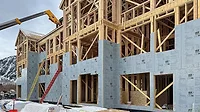
How Modern Building Science Is Creating “Frankenstein Walls” — And How to Stop Them
Modern exterior walls have become so complex that mix-and-match components often create untested, unreliable “Frankenstein assemblies,” highlighting the need for coordinated, proven, manufacturer-backed systems.

Walk any commercial jobsite today and you’ll notice something happening to exterior walls. Once simple combinations of framing, sheathing, water-resistant barriers, and cladding, they have evolved into complex building-science machines—expected to manage moisture, deliver energy performance, resist fire, and remain durable in increasingly severe climates.
But along with this evolution comes a troubling trend. High-performance wall assemblies are increasingly cobbled together from parts and pieces pulled from various manufacturers, based on unrelated test reports and incompatible systems. While these assemblies are often designed with good intentions, they could fairly be called “Frankenstein walls.” They promise exceptional performance and appear code-compliant on paper, yet their real-world behavior is often unknown. The result? Unintended consequences such as cracking, premature failure, and a failure to meet the marketed high-performance claims.
Fifty years ago, designing an exterior wall was largely a matter of aesthetics, structural loads, and basic weather protection. Even if there were gaps in design or detailing, the assembly was simple enough that field installers could make it work. Today, exterior walls are far more complicated, and the interaction of new components with increasingly creative architectural designs pushes us into unfamiliar territory. Modern commercial walls must now meet three demanding criteria:
1. Moisture Management
Bulk water, capillary action, vapor diffusion, and solar vapor drive all influence performance. WRBs, drainage planes, and vented claddings must operate together as an integrated system—not as isolated layers.
2. Fire Resistance
The rise of continuous insulation and combustible facades means more walls are required to meet NFPA 285 or equivalent multi-story fire tests. Assemblies with combustible components must be verified, not assumed.
3. Energy Performance
To meet modern energy codes, walls routinely incorporate exterior continuous insulation, air barriers, and high-performance sheathing—materials that can significantly alter both moisture behavior and fire characteristics.
Change one layer and the entire assembly can shift. That’s one reason why untested, mix-and-match walls carry so much liability. These Frankenstein walls often emerge from value engineering, design gaps, contractor workarounds, poor trade coordination, or aggressive marketing claims. Each factor may seem manageable on its own, but together they often produce wall systems with no proven performance history. The consequences are familiar: trapped moisture, premature failures, failed fire inspections, costly RFIs, and post-occupancy disputes.
Modern commercial walls are simply too complex for any one person to manage. They require a multidisciplinary team—yet too often, key players are ignored or brought in only after problems surface. A successful high-performance wall typically requires input from an envelope consultant, code specialist, structural engineer, manufacturer’s technical representative, project coordinator, and specialty subcontractor.
Coordination is critical, and its absence is a major driver of problematic walls—especially under tight construction timelines. Drawings may be produced to meet code and address the three key criteria, but the moment construction begins, reality exposes gaps: parts and pieces that do not integrate as planned. When installers submit RFIs, the common (and unrealistic) response is simply “build it as drawn.”
The last line of defense becomes the specialty subcontractor. Yet they face their own challenges, including a shortage of skilled labor and project managers who may not be fully versed in the trade. They are often handed wall assemblies far more complicated than anything previous generations encountered, while lacking the experience and training to navigate the complexity. When raising concerns results in criticism for delaying the project, many installers simply “make it work,” unknowingly absorbing significant liability.
There is a straightforward solution: re-establishing a culture of historically proven assemblies or adopting systems that are designed, tested, and backed by manufacturers. This is far preferable to selecting components based on marketing claims or fear-driven sales pitches, then mixing them together and hoping for the best. A manufacturer-tested system—not a Frankenstein assembly—helps designers meet the standard of care, reduces contractor RFIs, and gives project coordinators a reliable authority to resolve design gaps and constructability issues. Trade associations also play a valuable role as a source of education, verification, and conflict resolution.
A functional exterior wall can no longer be a commodity assembly of random parts. It must be a coordinated engineering system requiring skill, judgment, and collaboration. When the right team is in place, walls work. When they aren’t, we end up with Frankenstein assemblies destined to fail. The industry knows better. Now it must build better.
Looking for a reprint of this article?
From high-res PDFs to custom plaques, order your copy today!