Walls & Ceilings logo
search
cart
facebook twitter linkedin youtube youtube Spotify Podcasts Apple Podcasts Spotify Podcasts Apple Podcasts
  • Sign In
  • Create Account
  • Sign Out
  • My Account
Walls & Ceilings logo
  • NEWS
  • TOPICS
    • Drywall
    • Stucco/EIFS
    • Ceilings
    • Steel Framing
    • Fireproofing
    • Interior Plaster
    • Building Envelope
    • Insulation
    • Technology
    • Interior
    • Exterior
    • Women In Construction
  • COLUMNS
    • Up Front
    • All Things Gypsum
    • Art & Craft of Plastering
    • Stucco Stop
    • Steel Deal
    • Industry Voices
  • PRODUCTS
    • Buzz Guide
  • EVENTS
    • Industry Events
    • Webinars
    • BUILD Expo
  • MEDIA
    • Videos
    • Podcasts
    • Photo Galleries
    • BUILD26 Videos
    • Take our Quiz!
    • Infographics
  • EXCLUSIVE
    • Newsletters
    • Top 50 Contractors
    • Contractor of the Year
    • State of the Industry
    • W&C Store
    • Market Research
    • CEUs
    • Sponsor Insights
    • Custom Content & Marketing Services
  • DIRECTORY
  • EMAGAZINE
    • eMagazine
    • Advertise
    • Archive Issues
  • SIGN UP!
Building EnvelopeInsulationInterior

What R-Value Really Means—and Why It Doesn’t Tell the Whole Insulation Story

Tom Harris breaks down the limitations of R-value
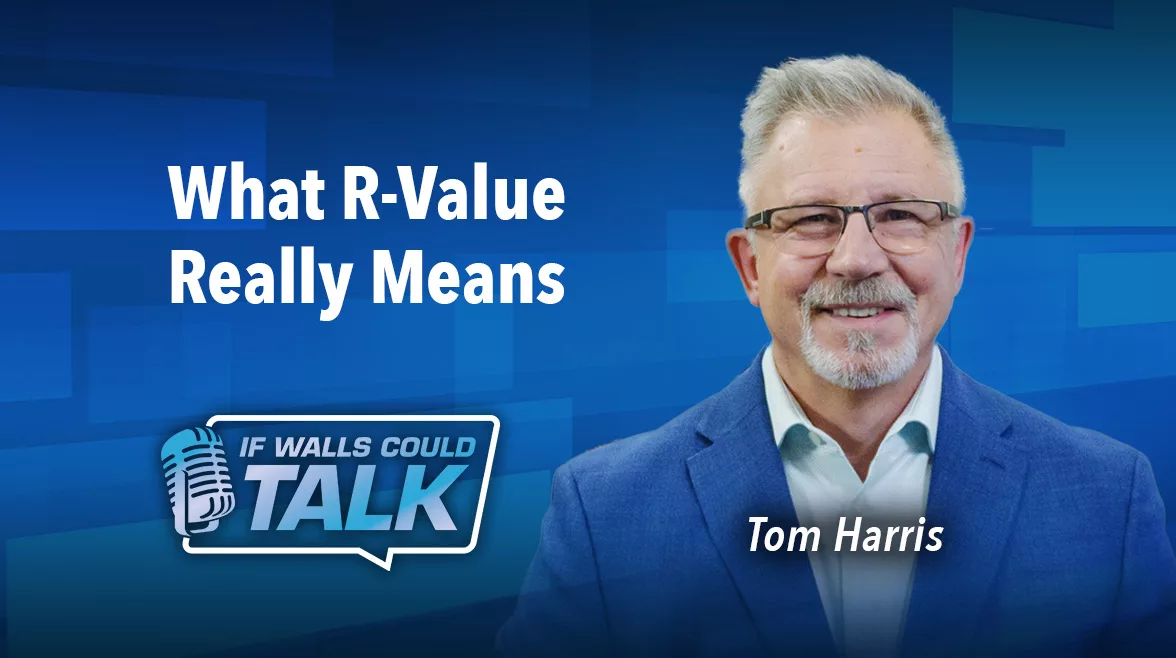
By Tom Harris, John Wyatt, Editor
What R-Value Really Means—and Why It Doesn’t Tell the Whole Insulation Story
James Hohner | W&C
February 13, 2026

In this episode of “If Walls Could Talk,” W&C Editor John Wyatt talks with Tom Harris of Tom Harris PUR Consulting. In this discussion, we chat about getting “back to basics” on one of the most common—and most misunderstood—terms in construction: R-value.

At its core, Harris explains, insulation is installed for two main reasons: to manage condensation and to reduce the energy needed to maintain comfortable indoor conditions across different climates. R-value is the metric the industry and all three major building codes use to measure how effective insulation is at doing that job.

If Walls Could Talk Podcast show presented by Walls and Ceilings magazine

What R-Value Really Means—and What It Doesn’t

Tom Harris explains that R-value only measures conductive heat transfer, overlooking convection and moisture effects that significantly impact real-world insulation performance.

Your browser does not support the audio element.

But here’s the catch: R-value only measures one type of heat transfer—conduction.

To make it relatable, Harris paints a picture most people recognize. Imagine sitting around a campfire and grabbing a metal poker that’s been resting in the flames. The heat travels from the fire, through the metal, and into your hand. That’s conduction. Materials that conduct heat poorly are what we call insulation, and their resistance to conductive heat flow is what R-value measures in a lab under controlled conditions.

The problem? Heat doesn’t move in just one way.

“There are actually three ways heat is transferred,” Harris says: conduction, convection, and radiation. R-value ignores the latter two entirely.

Convection, for example, is the heat you feel when you hold your hand above a campfire or a stove burner. In wall assemblies, convection shows up as air movement inside insulation—particularly in fibrous materials like fiberglass, mineral wool, and cellulose. When these materials reach certain thicknesses and densities, warm air can rise inside the cavity while cooler air sinks, creating what’s known as convective looping.

As insulation gets thicker to meet higher code-mandated R-values, this looping can actually increase—reducing real-world thermal performance instead of improving it.

“So we increase the R-value requirement, use thicker fibrous insulation, and unintentionally make it perform worse,” Harris notes.

Add air movement and moisture into the mix, and the gap between lab-tested R-values and actual installed performance grows even wider. That’s why modern codes now require air barriers and vapor retarders. Insulation, especially fibrous insulation, must stay dry and protected from airflow to work as intended—factors the standard R-value test simply doesn’t capture.

Harris points to past and ongoing third-party research, including studies often referred to as “Thermal Metric” studies, which evaluate insulation performance under real-world conditions like air pressure differences and varying indoor humidity levels. These studies consistently show that installed performance can differ significantly from rated R-values.

So what’s being done about it?

According to Harris, the spray foam industry is taking a proactive role. Organizations like the Spray Polyurethane Foam Alliance and the Spray Foam Coalition are supporting a large-scale, third-party research effort known as the A-Value (Assembly Value) Study. Unlike R-value, A-value looks at the thermal performance of entire wall assemblies—not just insulation material tested in isolation. More information on the study is available at Sprayfoam.org.

Harris sums up the main drawback of the current R-value system simply: it only accounts for conduction, ignores air movement and moisture, and allows testing at temperatures that favor certain materials—like fiberglass, which performs best at a mean temperature of 72°F.

“The game is rigged,” he says bluntly.

As the industry continues to push for more accurate ways to measure insulation performance, Harris and Wyatt agree that better education and better metrics are essential. The goal isn’t just higher numbers—it’s buildings that actually perform better where it matters: in the real world.

In the next episode of If Walls Could Talk, the conversation will continue with a deep dive into hybrid insulation assemblies.
KEYWORDS: building codes If Walls Could Talk podcast R-value reports and studies SPFA (Spray Polyurethane Foam Alliance) spray foam

Share This Story

Looking for a reprint of this article?
From high-res PDFs to custom plaques, order your copy today!

Tom harris
Tom Harris is president of Tom Harris PUR Consulting LLC. He has more than 35 years of polyurethane foam development and deployment experience ranging from Development Chemist, Product and Marketing Management, Business Development and Building Science in Canada and the United States. He can be reached at tom@letstalkpur.com.
John wyatt 2025 crop1
John Wyatt is editor of Walls & Ceilings magazine, bringing more than two decades of experience with BNP Media. He joined the company in 2000 as an associate editor, contributing to both Walls & Ceilings and Roofing Contractor before assuming the role of editor in 2008. In addition to his work with the brand, Wyatt collaborates across BNP’s architecture, engineering and construction (A/E/C) portfolio, supporting related publications and initiatives. He can be reached at 248-205-6659 or wyattj@bnpmedia.com.

Recommended Content

JOIN TODAY
To unlock your recommendations.

Already have an account? Sign In

  • Abercrombie & Fitch

    EIFS in 2026: How Specialty Finishes Are Redefining Exterior Wall Systems

    As building codes, owner expectations, and design demands...
    Stucco/EIFS
    By: Regi Mendoza
  • proper air and vapor control

    From Energy Efficiency to Moisture Management: Why Air and Vapor Control Matter

    How proper air and vapor control within building...
    Building Envelope
    By: Benjamin Meyer AIA, LEED AP
  • Linear Metal Ceiling Beam Baffles

    Top 25 Ceiling Contractors of 2026

    Suspended ceilings demand precision, code compliance and...
    Ceilings
    By: John Wyatt and Tanja Kern
You must login or register in order to post a comment.

Report Abusive Comment

Manage My Account
  • eMagazine Subscription
  • Newsletters
  • Online Registration
  • Manage My Preferences
  • Subscription Customer Service

More Videos

Sponsored Content

Sponsored Content is a special paid section where industry companies provide high quality, objective, non-commercial content around topics of interest to the Walls & Ceilings audience. All Sponsored Content is supplied by the advertising company and any opinions expressed in this article are those of the author and not necessarily reflect the views of Walls & Ceilings or its parent company, BNP Media. Interested in participating in our Sponsored Content section? Contact your local rep!

close
  • medical professionals moving a patient on a stretcher through the halls of a medical building
    Sponsored byNational Gypsum Company

    What Does High Performance Mean When It Comes To Gypsum Boards?

Popular Stories

Linear Metal Ceiling Beam Baffles

Top 25 Ceiling Contractors of 2026

Wichita Biomedical Campus

Wichita Drywall Worker Dies After Scaffolding Fall

QXO Just Changed the Game-Here's What Contractors Are Asking

QXO Just Changed the Game-Here's What Contractors Are Asking

An interior drywalling work in progress

Boost Profits with AI Scheduling

Events

June 24, 2026

The Bright Side & Benefits of Designing with Integrated Lighting

Credits 1 AIA LU/HSW; 0.1 ICC CEU

This course will explore the pivotal role architects and lighting design play in creating safer, more sustainable spaces. Learn how to avoid common lighting mistakes and make informed decisions that create the best visual environment for occupants. 

January 1, 2030

Webinar Sponsorship Information

For webinar sponsorship information, visit www.bnpevents.com/webinars or email webinars@bnpmedia.com.

See our full library of webinars

View All Submit An Event

Products

2026 National Painting Cost Estimator

2026 National Painting Cost Estimator

See More Products

Related Articles

  • Jennifer Roeder, CEO of City Wide Insulation, with her son, Alex.

    Family, Foam and Foundation: The City Wide Insulation Story

    See More
  • Cameron Group on What it Means to be a Top Insulation Contractor by W&C

    Cameron Group on What it Means to be a Top 25 Insulation Contractor

    See More
  • SPF Market Pushes Toward Measurable Quality

    SPF Market Pushes Toward Measurable Quality

    See More

Related Products

See More Products
  • building codes illustated.jpg

    Building Codes Illustrated: A Guide to Understanding the 2021 International Building Code, 7th Edition

  • 1118749847.jpg

    The Gypsum Construction Handbook, 7th Edition

See More Products

Related Directories

  • Telling Industries LLC

    TELLING Industries is US owned and operated full line manufacturer of premium metal framing products. As a leader in innovation, TELLING consistently introduces new and exciting products to enhance customer service. Telling provides exceptional service from order placement to delivery to earn a trusted partner position with our customers.
×

Connect with the industry’s leading resource for unparalleled insights and education.

Join thousands of industry professionals today. Shouldn’t you know what they know?

JOIN NOW
  • RESOURCES
    • Advertise
    • Contact Us
    • Directories
    • Store
    • Want More
  • SIGN UP TODAY
    • Create Account
    • eMagazine
    • Newsletters
    • Customer Service
    • Manage Preferences
  • SERVICES
    • Marketing Services
    • Reprints
    • Market Research
    • List Rental
    • Survey/Respondent Access
  • STAY CONNECTED
    • LinkedIn
    • Facebook
    • Instagram
    • YouTube
    • X
  • PRIVACY
    • PRIVACY POLICY
    • TERMS & CONDITIONS
    • DO NOT SELL MY PERSONAL INFORMATION
    • PRIVACY REQUEST
    • ACCESSIBILITY

Copyright ©2026. All Rights Reserved BNP Media, Inc. and BNP Media II, LLC.

Design, CMS, Hosting & Web Development :: ePublishing