Canadian Taper Builds Career, Mentors Next Trades
Drywall finisher Kayla Beckett built a company, mentors students and promotes women in trades.

Drywall finishing contractor Kayla Beckett entered the wall and ceiling industry the same way many tradespeople do: by learning on the job. Today she runs her own finishing company, mentors young workers and advocates for women entering the skilled trades.
Beckett is the owner of One ChickTaper and Company, based in Alberta, Canada. She began working in drywall finishing in 2006 after deciding to leave a wood technology manufacturing program at Algonquin College in Ottawa, Ontario. The move shifted her from classroom training into full-time jobsite experience in the interior finishes sector.
Her introduction to construction started much earlier. Beckett grew up helping her father, a carpenter who worked across multiple trades. Those early experiences exposed her to jobsite tools, construction processes and the satisfaction of building projects with her hands.
“I always liked seeing the end result,” Beckett said in her nomination materials. “Being able to build something and see it completed was what drew me to the trades.”
From Hand Taper to Business Owner
Beckett initially worked as a hand taper for roughly five years, developing the core skills required for drywall finishing. Hand taping requires careful control of joint compound application, tape embedding and feathering to achieve Level 4 or Level 5 finish requirements depending on project specifications.
In December 2011 she relocated to Alberta, a move that expanded her exposure to different crews and installation techniques. In 2012 she formally registered One ChickTaper and Company and began operating as an independent finishing contractor.
During her time in Alberta, Beckett also gained experience with automatic taping tools (often referred to in the field as “auto tools”). These systems improve production rates by mechanically applying tape and compound to gypsum board joints, reducing manual passes and increasing efficiency on large residential or multifamily projects.
Beckett later spent nearly two years with Qual Pro Interiors in Edmonton as a quality control supervisor. That role expanded her responsibilities beyond finishing production to include attic inspections, field training and workforce development.
Quality control positions in drywall finishing often focus on verifying joint treatment consistency, corner bead installation, surface readiness for texture or paint and compliance with specified finish levels.
Mentoring Future Tradesworkers
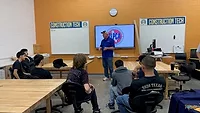
In addition to running her business, Beckett works with high school co-op programs that introduce students to construction careers. The programs place students on jobsites where they can observe drywall installation and finishing, safety procedures and the day-to-day workflow of a residential construction crew.
Exposure to real jobsites can help students understand the physical demands, teamwork requirements and skill development needed to succeed in the wall and ceiling trades.
Beckett also reports partnering with other women on projects and actively hiring women to join her crew. Over the past decade she has seen more women entering the trades, though she believes workforce recruitment remains a major challenge for the industry.
Contractors across North America continue to report labor shortages in drywall installation and finishing, particularly as experienced tradespeople retire.
Industry Advocacy and Training
Beyond project work, Beckett has participated in industry events and training programs internationally. She has also taught drywall finishing techniques at the community college level in Iowa in partnership with a training program connected to Habitat for Humanity.
Instruction included patching techniques, joint finishing methods and demonstrations of modern finishing tools.
For Beckett, the biggest appeal of the wall and ceiling industry remains the visible results.
“Helping build someone’s home and seeing their reaction when the work is done,” she said, “that’s what makes the job rewarding.”
Looking ahead, she believes the industry must continue expanding training pathways and highlighting skilled trades careers—especially for younger workers considering construction as a long-term profession.
Looking for a reprint of this article?
From high-res PDFs to custom plaques, order your copy today!