Acoustic Equity: Why Quiet Must Be a Fundamental Right in High-Density Housing
As housing density increases, the construction industry must recognize acoustic comfort not as a luxury upgrade, but as a basic public-health and equity requirement for all residents.

Key Takeaways
- Quiet is emerging as a health and equity issue in housing
- Building design plays a critical role in acoustic equity
- Building codes and standards may need to evolve
For decades, quiet has been marketed as a premium amenity. In luxury condominiums and high-end mixed-use developments, acoustic comfort is bundled alongside concierge services, spa bathrooms, and premium finishes. Thickened walls, resilient floor assemblies, and upgraded windows are selling points—features to be upgraded, not expected.
But in high-density housing, quiet should not be optional. It should be foundational.
As cities grow denser and housing affordability becomes a defining challenge of our time, the industry must confront a hard truth: acoustic comfort is a public-health necessity, not a luxury feature. The growing conversation around acoustic equity reframes noise control as a matter of fairness, health, and dignity, especially for residents who do not have the economic power to buy their way out of noise.
Defining Acoustic Equity
Acoustic equity refers to the fair and consistent provision of healthy sound environments for all occupants, regardless of income level, building type, or zip code. In practice, it means ensuring that residents of affordable housing and market-rate apartments are afforded the same basic protections from intrusive noise as those in luxury developments.
This is not about absolute silence. Cities are inherently noisy. Acoustic equity is about reasonable protection from chronic, disruptive sound, the kind that interferes with sleep, concentration, learning, and mental health.
Noise exposure is not distributed evenly. Lower-income households are more likely to live near highways, rail corridors, industrial uses, and legacy commercial buildings repurposed for housing. These residents experience higher baseline noise levels while often occupying buildings constructed to the minimum allowable acoustic standards. The result is a compounding burden: higher exposure paired with lower protection.
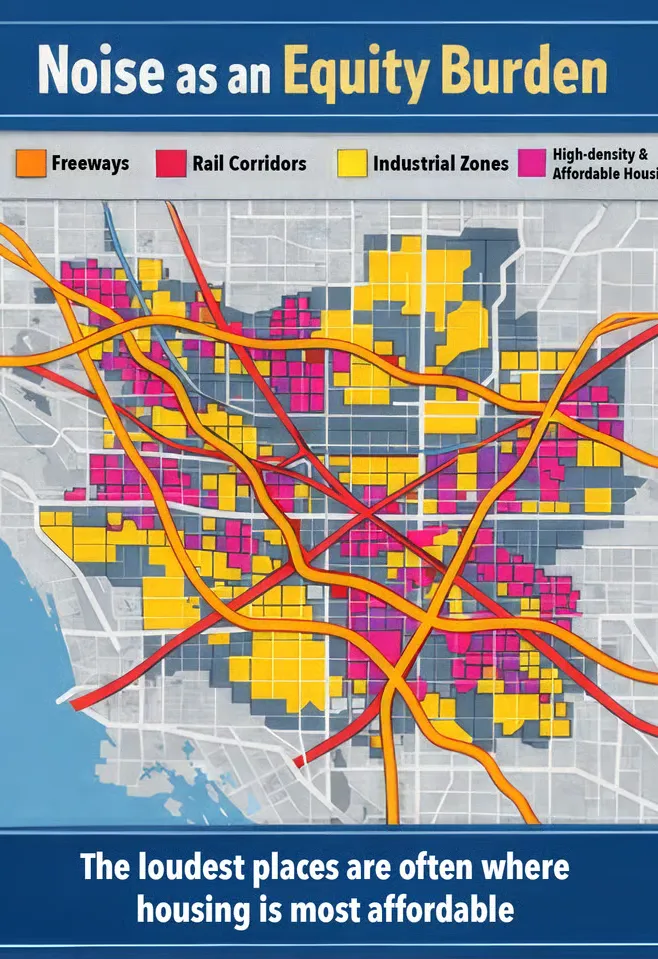
Graphic: PABCO Gypsum; created using AI
Noise as a Public-Health Issue
The health impacts of chronic noise exposure are well-documented. Persistent unwanted sound is associated with sleep disruption, elevated stress hormones, cardiovascular disease, reduced cognitive performance in children, and decreased overall well-being.
From a public-health perspective, acoustics sit alongside indoor air quality, thermal comfort, and daylight access as core components of healthy buildings. Yet acoustics are routinely deprioritized during design and value engineering.
The irony is that the populations most sensitive to noise (children, seniors, and those working multiple shifts) are often the least able to mitigate it. Acoustic equity demands that the industry stop treating noise as an inconvenience and start treating it as an environmental health risk.
The Myth of “Code-Compliant Equals Comfortable”
At the heart of the acoustic equity conversation lies a persistent misconception: that meeting code minimums guarantees acceptable living conditions. In reality, compliance and comfort are not the same.
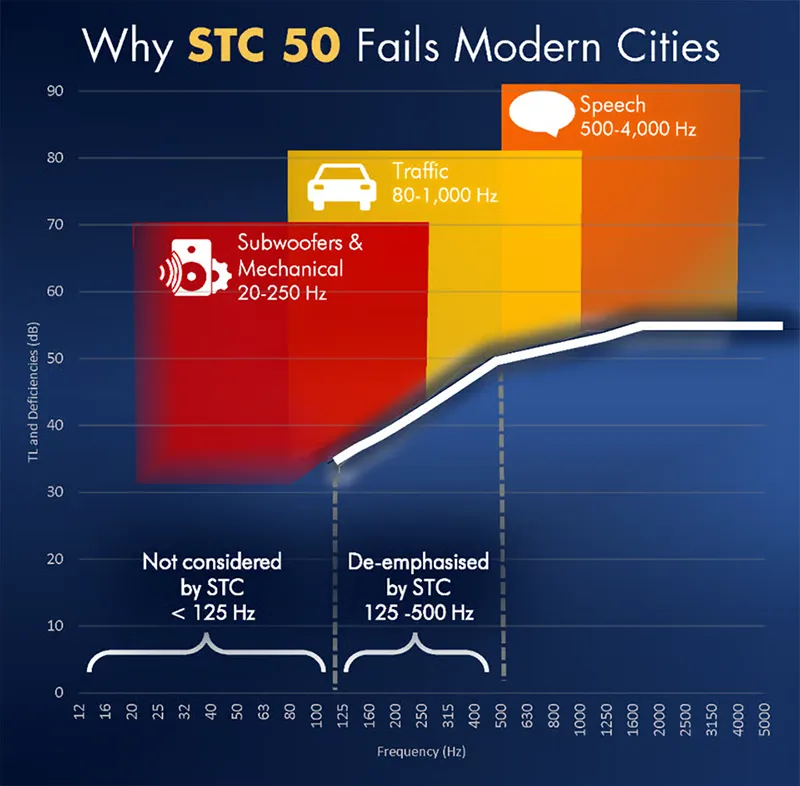
Most multifamily residential construction in the United States targets the minimum required sound transmission class rating between dwelling units—STC 50 in laboratory tests and STC 45 in the field. On paper, this threshold appears to establish a baseline of privacy. In practice, many residents in “code-compliant” buildings still report hearing neighbors’ televisions, music, conversations, and footfall.
This disconnect is not anecdotal; it is systemic.
Is STC 50 Enough? The Short Answer: No
Graphic: PABCO Gypsum; created using AI
The industry has treated STC 50 as a gold standard for so long that it has become unquestioned, but that assumption is long overdue for reexamination.
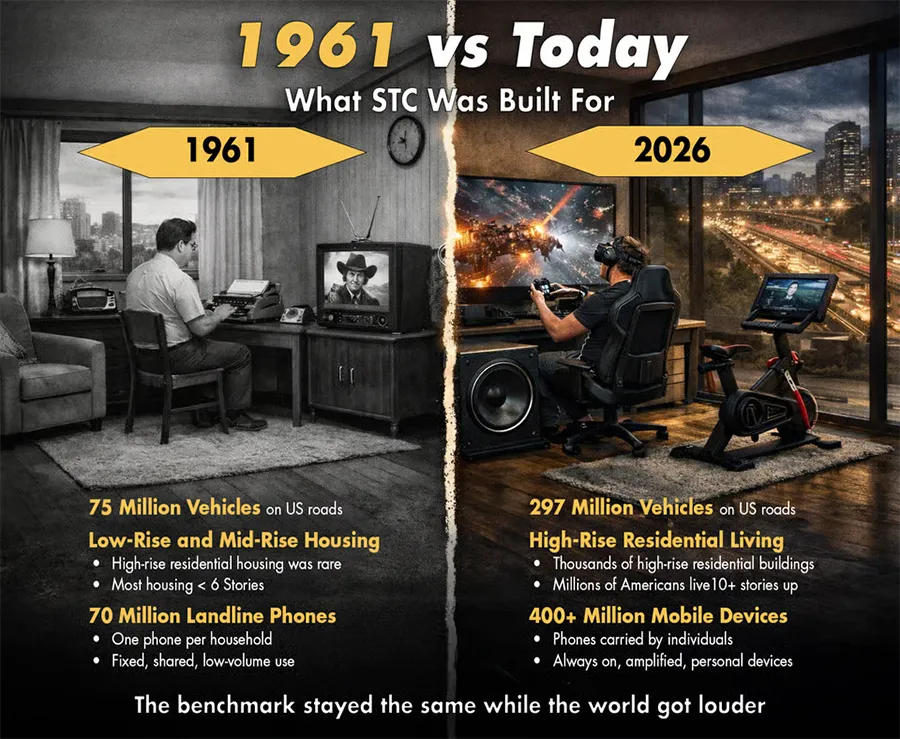
STC as a rating system was introduced in the early 1960s, when building materials, construction practices, and occupant behavior were fundamentally different. The benchmark itself was established in 1961, when expectations around acoustic privacy were shaped by lighter sound sources, lower residential densities, and far less amplification technology.
Today’s residential noise profile bears little resemblance to that era. Subwoofers, home theaters, mechanical equipment, and dense urban traffic all generate low-frequency energy, exactly the range that STC is least equipped to represent.
More importantly, STC values are not timeless. An STC 50 wall tested in a laboratory in the 1970s does not translate cleanly to today’s construction environment. Modern test methods are more stringent, flanking paths are better understood, and materials behave differently. It is widely acknowledged within the acoustics community that assemblies once rated at STC 50 under older protocols will not achieve equivalent performance if tested today.
Graphic: PABCO Gypsum; created using AI
As an industry, we do not accept thermal, structural, or fire-safety data that is 30 or 40 years out of date. Acoustics should be no different. We should be relying on contemporary testing and modern expectations.
The Real-World Gap Between Lab Ratings and Lived Experience
Graphic: PABCO Gypsum; created using AI
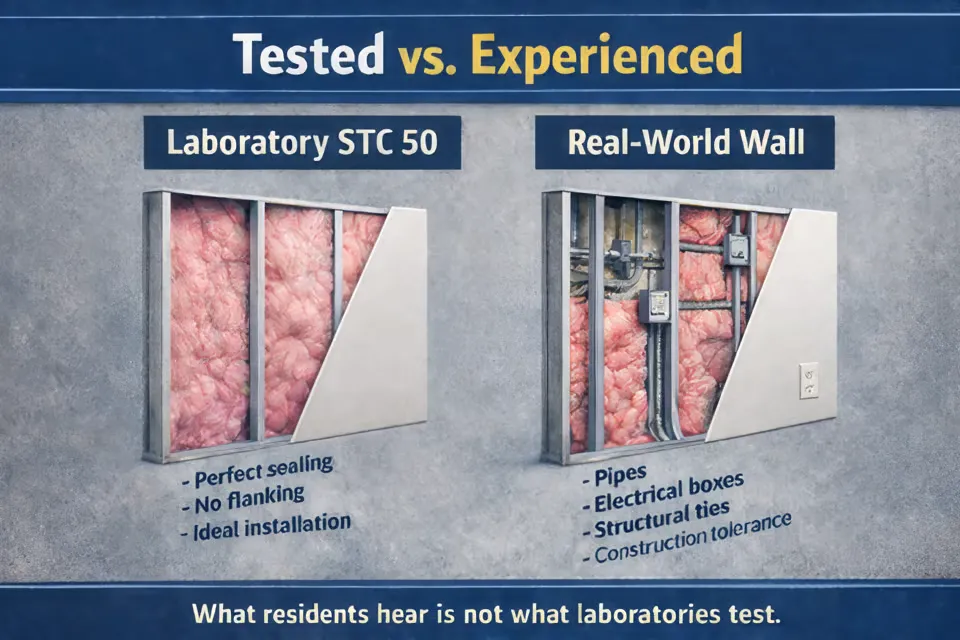
Another equity challenge lies in the distinction between laboratory ratings and field performance. STC ratings are derived from controlled laboratory tests of idealized assemblies. Real buildings introduce variability: penetrations, installation tolerances, structural connections, and workmanship all degrade performance.
Codes implicitly acknowledge this by allowing field-tested assemblies to perform below laboratory targets. But from an occupant’s perspective, this technical nuance is irrelevant. Residents do not live in laboratories; they live with the results in the real world.
When minimum targets are already marginal, any degradation disproportionately affects those living in denser, more cost-constrained buildings.
Acoustic Equity Beyond the Wall Assembly
Acoustic equity is not achieved solely by increasing wall ratings. It requires a holistic approach that considers how buildings are planned, detailed, and occupied.
Key aspects include:
- Low-frequency control, which STC alone does not adequately address
- Floor-ceiling assemblies, where impact noise often dominates complaints
- Mechanical system noise, especially in adaptive reuse projects
- Exterior noise intrusion, particularly in transit-oriented developments
- Construction consistency, ensuring performance is repeatable—not theoretical
In luxury projects, these issues are often addressed through layered solutions: thicker assemblies, sound-damping technologies, isolated framing, upgraded glazing, and rigorous testing. Acoustic equity extends the use of those strategies everywhere.
Reframing Quiet as Infrastructure
One way to advance acoustic equity is to stop framing quiet as a finish-level upgrade and start treating it as building infrastructure.
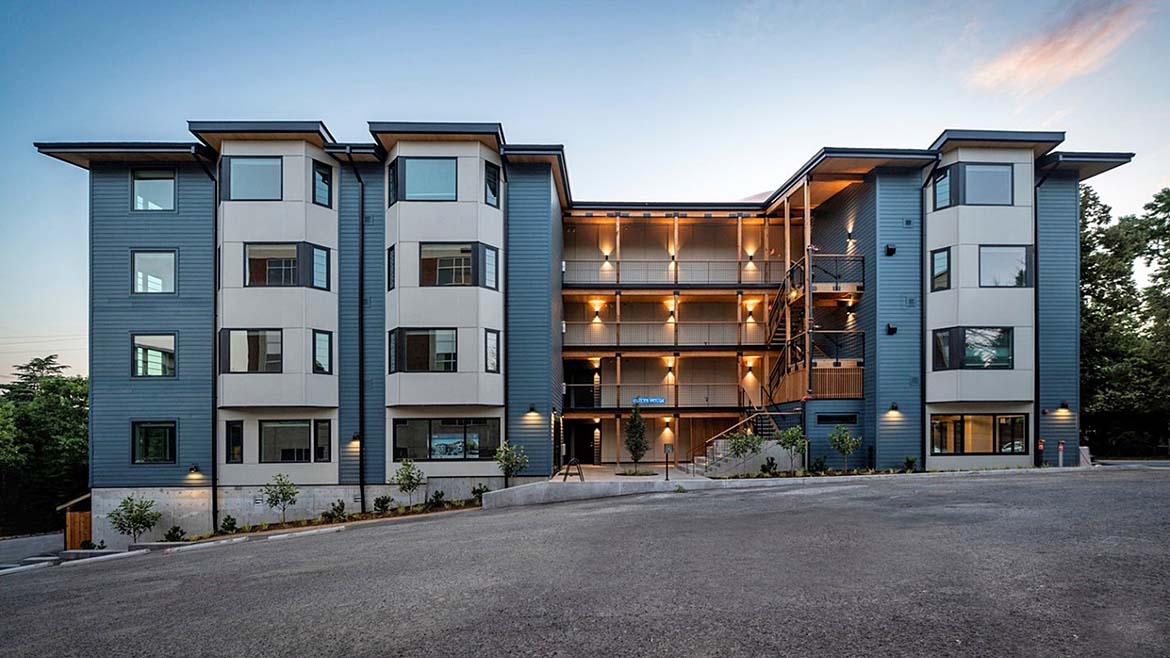
The Chiles House in Portland, Oregon, utilizes trauma-informed design and advanced sound-reducing materials, including QuietRock as a standard feature to provide a peaceful, dignified living environment for residents.
Photo courtesy of PABCO Gypsum Credit: Truebeck Construction
Chiles House
Building Type: 27 multi-family affordable housing
Location: Portland, Oregon, USA
Co-Developers: Sister City & Catholic Charities of Oregon
Architect: All Hands Architecture
Design Principal: Ben Carr
Structural Engineer: Holmes Structures
Civil Engineer: Froelich Engineers
MEP/FP Engineers: Piper Mechanical, Squires Electric, Red Hawk Fire Protection
Interior Designer: All Hands Architecture
Acoustical Consultant: Aacoustics
Solar Consultant: Elemental Energy
Energy Modeling: Alentuur
Contractor: Truebeck Construction
Mass Timber Fabricator: Kalesnikoff
Site Area: 6,259 square feet
Building Area: 20,000 square feet
Just as we design for structural loads we hope never to see, or for fire events that may never occur, we must design for acoustic resilience, even if occupants are not consciously aware of it when systems work properly.
The cost premium for improved acoustic assemblies is often modest relative to the lifecycle benefits: reduced tenant turnover, fewer complaints, improved sleep quality, and better long-term health outcomes. When viewed through this lens, acoustic upgrades are not indulgences; they are risk mitigation.
Building Standards: Necessary, But Not Sufficient
Building codes and standards are the last—and most critical—piece of the equity conversation.
In the United States, residential acoustics are governed primarily through the International Building Code, which sets minimum requirements for airborne and impact sound transmission between dwelling units. These provisions establish a legal floor, not a comfortable ceiling.
While the underlying STC test method, maintained by ASTM International, has evolved significantly over time, its application as a static pass/fail threshold has not kept pace with modern expectations or urban realities.
Voluntary frameworks, such as the WELL Building Institute and the U.S. Green Building Council have begun to address this gap by focusing on interior noise levels, reverberation control, and occupant experience. However, these programs are more commonly adopted in premium developments, not in the housing sectors where acoustic equity is most urgently needed.
Toward a More Equitable Acoustic Baseline
Achieving acoustic equity does not require reinventing the industry; it requires raising expectations.
That may mean reexamining whether STC 50 remains an appropriate baseline in high-density housing. It may mean supplementing STC with metrics that better capture low-frequency performance. It may mean narrowing the gap between laboratory ratings and field outcomes or prioritizing acoustic performance in adaptive reuse incentives and affordable housing programs.
Most importantly, it means acknowledging that quiet is not a luxury amenity, it’s a prerequisite for healthy living.
As cities continue to densify, the industry must decide who deserves protection from noise and who does not. Acoustic equity insists on a simple answer: everyone.
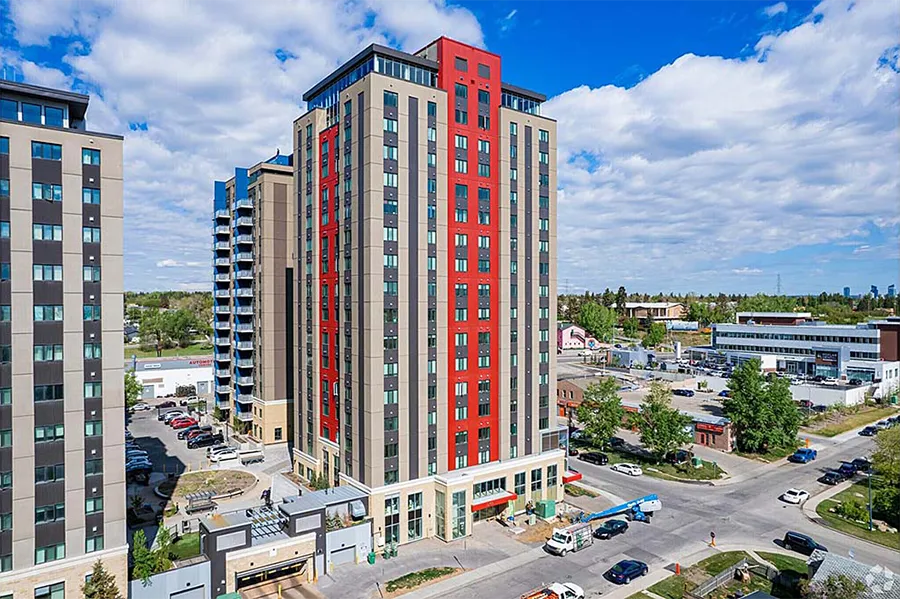
Innovation in acoustic equity: Using QuietRock sound-reducing drywall at Orion at Lumino Park allows for thinner wall assemblies, maximizing living space while ensuring every tenant has a fundamental right to a quiet home.
Photo courtesy of PABCO Gypsum Credit: Kanas Corporation
Orion at Lumino Park
Building Type: 18-story high-rise, 135-unit multifamily affordable housing
Location: Calgary, Alberta, Canada
Architect: Casola Koppe Architects
Engineer: Eco Engineering
Owner/Developer: Kanas Corp.
General Contractor: Kanas Corp.
Building Area: 115,000 sf
Looking for a reprint of this article?
From high-res PDFs to custom plaques, order your copy today!