ABC Reports Historic Slowdown in Construction Hiring, Minimal Workforce Turnover
Construction hiring hit a record low in February as contractors held crews and job openings declined.
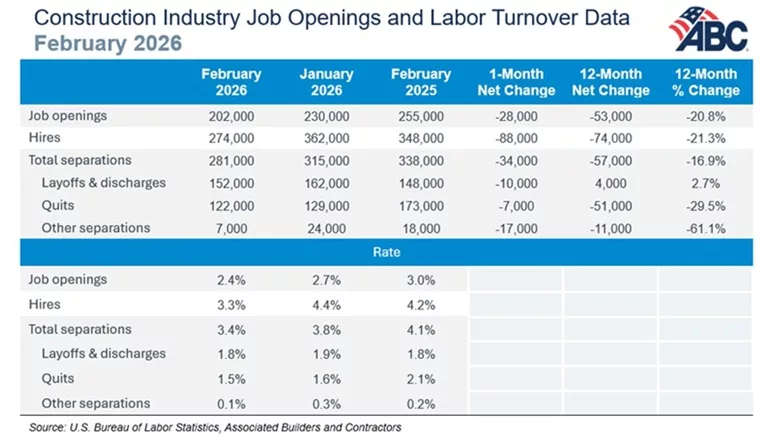
Construction hiring activity slowed to its lowest level on record in February, even as contractors continued to hold onto existing crews—an indicator of tightening labor mobility that could affect project scheduling and backlog execution across interior trades.
According to an analysis by Associated Builders and Contractors of U.S. Bureau of Labor Statistics Job Openings and Labor Turnover Survey data, the industry reported 202,000 open positions at the end of February. That figure declined by 28,000 month over month and is down 53,000 compared to the same period last year. JOLTS defines an opening as any unfilled role for which an employer is actively recruiting.
For wall and ceiling contractors, reduced hiring alongside stable staffing levels suggests limited availability of skilled labor for gypsum board installation, framing, and finishing scopes. This dynamic can constrain crew scaling on fast-track projects and increase reliance on overtime or subcontractor availability.
“Construction hiring fell to the slowest rate on record in February,” said ABC Chief Economist Anirban Basu. “At the same time, contractors remained reluctant to lay off workers while employees were even more reluctant to leave. The combination of historically slow hiring and exceedingly few separations made February 2026 the month with the least construction labor force churn since the BLS began this survey in December 2000.
“Of course, this data pertains to February, when the Strait of Hormuz was open and the price of oil was under $100 per barrel,” said Basu. “While contractors continue to express optimism regarding their staffing intentions, according to ABC’s Construction Confidence Index, recent data and developments suggest that hiring is unlikely to rebound in the near future.”
From a field execution standpoint, persistently low labor churn may stabilize core crews but limits opportunities to onboard and train new workers—an ongoing concern for finishing trades facing skilled labor shortages. Contractors may need to prioritize retention strategies, cross-training, and productivity gains to maintain installation timelines as hiring remains constrained.
Looking for a reprint of this article?
From high-res PDFs to custom plaques, order your copy today!