Supplier News
Home Depot Supply Chain Advances Impact Project Delivery
Expanded distribution and smarter routing are improving delivery timing and reducing jobsite disruptions for interior trades.
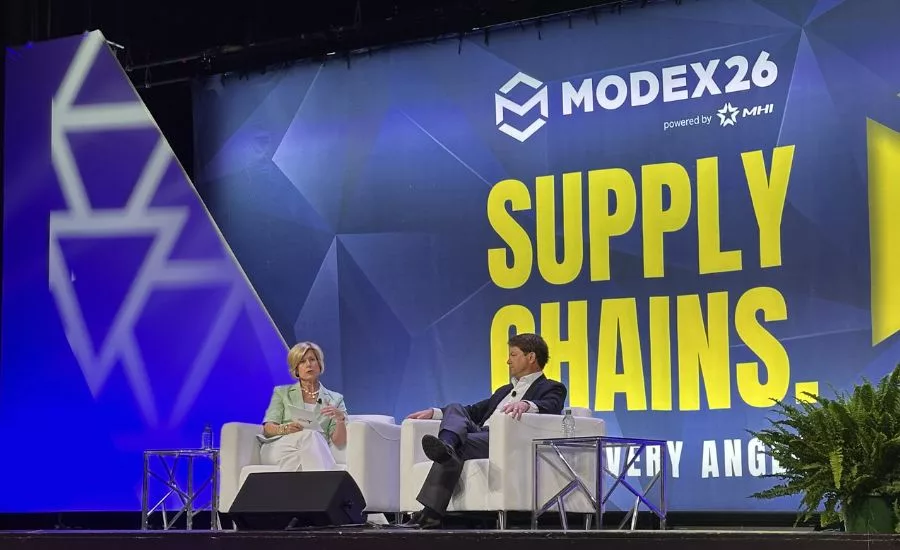
Richard McPhail, executive vice president and CFO of The Home Depot, joined Katie Kirkpatrick, president and CEO of the Metro Atlanta Chamber, for a keynote conversation on supply chain strategy at Modex 2026 in Atlanta.
Key Takeaways
- Delivery reliability is now a project risk factor: Material flow to the jobsite — not just availability — can impact schedules. Projects that plan for coordinated deliveries are less likely to face delays.
- Faster supply chains enable tighter schedules if planned correctly: Improved logistics and delivery precision can shorten timelines but only if projects are structured to take advantage of them.
- Material sourcing impacts cost and certainty: Tariffs, global sourcing and supply disruptions can quickly affect pricing and availability. Early visibility into materials can reduce surprises and budget risk.
Two decades ago, a senior leader at The Home Depot said the supply chain would never be a competitive advantage for the company. Richard McPhail, EVP and chief financial officer, opened his Modex 2026 keynote in Atlanta by saying the exact opposite is now true.
Today, Home Depot’s supply chain is what McPhail calls “a strategic weapon” — an approximately $25 billion e-commerce operation supported by hundreds of distribution facilities, same-day delivery capabilities, and a contractor-focused network spanning thousands of delivery branches. For wall and ceiling contractors, that evolution is directly influencing how materials reach jobsites — and how projects are planned and executed.
From Store Replenishment to Jobsite Delivery
In 2007–2008, roughly 90 percent of Home Depot’s product moved directly from vendor to store, an inefficient model that couldn’t scale. Early investments in rapid-deployment centers improved store replenishment but the real shift came in 2015, when leadership identified delivery, not just product, as the key differentiator.
That decision launched a multi-billion-dollar transformation that continues today. The company now operates 17 flatbed distribution centers designed for bulk material and jobsite delivery, 20 direct fulfillment centers supporting homedepot.com, and 160 market delivery operations built for same-day and bulky item flow.
Just as important has been the expansion through acquisitions. SRS Distribution brought specialty trade supply across roofing, pool, and landscape, while Gypsum Management and Supply expanded Home Depot’s reach into drywall and interior construction. Together, those two acquisitions added more than 1,250 delivery branches. HD Supply contributes another roughly 100 distribution points focused on multifamily work.
For interior contractors, the GMS acquisition is particularly relevant. It strengthens access to drywall, ceilings, steel framing and other core materials through a network designed to support jobsite delivery and project sequencing — not just store availability.
“Over half of our sales go to the professional contractor,” McPhail said. “Serving that customer with reliability and speed is critical.”
That focus is increasingly reflected in how materials are delivered. The system is moving toward scheduled drops aligned with installation phases, bulk staging for larger projects, and more predictable material flow. For contractors managing multi-phase interior work, timing is becoming just as important as supply.
Speed is Giving Way to Precision
Speed expectations are also evolving. What once defined best-in-class performance — two-day delivery — is now baseline. Same-day delivery is increasingly expected, and the next shift is toward tighter delivery windows.
For wall and ceiling contractors, that shift toward precision has real implications: less congestion on jobsites, fewer material handling issues, and better alignment between deliveries and installation crews.
McPhail emphasized that those outcomes didn’t happen by accident. They were guided by a set of core lessons learned over years of transformation.
The first is to start with the customer problem. Too often, companies jump to solutions without defining what they’re trying to sell, how they plan to sell it, and who they’re serving. “Clarity of language and alignment are probably the most important things,” he said.
The second is flexibility. COVID tested every assumption built into Home Depot’s supply chain. Rapid growth followed by shifting demand forced the company to rework product flows and inventory strategies in real time. “Make sure that when you build platforms, you build in flexibility,” McPhail said.
The third is that customer expectations for speed will always outpace projections. What seemed ambitious in 2015 quickly became standard, reinforcing the need to constantly adapt.
Finally, McPhail stressed the importance of prioritizing sales over cost savings. “Nothing happens until you sell something,” he said, warning against projects that promise efficiency but don’t support growth.
Beyond operations, Home Depot has also invested heavily in managing supply chain risk. The company has been diversifying its supplier base for more than a decade and is working toward a model where no single country accounts for more than 10 percent of its purchases.
At the same time, it has built detailed visibility into sourcing and costs at the SKU level.
“When you have periods of volatility, you can push a button and know immediately what your position is,” McPhail said.
For interior contractors, particularly those sourcing steel studs, ceiling systems, or imported components, that level of awareness is increasingly important. Price swings and supply disruptions can quickly affect both margins and project timelines.
McPhail also pointed to relationships as a critical factor in managing disruption. Long-term partnerships with suppliers and carriers helped Home Depot navigate recent volatility and remain flexible when conditions changed.
Technology is another key piece of the strategy, but McPhail framed it in practical terms. Robotics is improving safety and reducing physical strain in distribution centers. Automation is helping maximize space and efficiency, particularly through vertical storage systems. And AI is being used to improve decision-making across the network.
Two applications stand out for contractors.
The first is “ship-from-best-location” logic — determining whether an order should be fulfilled from a store, distribution center, or branch. At Home Depot’s scale, those decisions have major cost and speed implications.
The second is delivery routing. AI is increasingly being used to optimize routes, reduce costs, and enable tighter delivery windows.
Just as important, those systems are being designed to reflect how contractors actually work. A contractor may not want material immediately; they may need it delivered days later, within a specific window tied to framing, hanging, or finishing phases. That level of coordination can reduce delays and improve labor efficiency on-site.
The Need for Skilled Labor
Despite these advances, McPhail made it clear that supply chain improvements won’t solve the industry’s biggest challenge: labor.
Demand for construction work continues to rise as U.S. housing stock ages, but the pipeline of skilled tradespeople is not keeping pace. The result is a widening gap between demand and available labor, putting pressure on wages and making it harder for contractors to staff jobs.
For wall and ceiling contractors, that means workforce strategy will be just as important as supply chain strategy in the years ahead.
Looking forward, McPhail pointed to agility and strong partnerships as the defining traits of successful supply chains. The ability to adapt quickly — combined with strong relationships with suppliers, carriers, and internal teams — will determine who can keep projects moving as conditions change.
“Supply chain is always going to be driven by human talent,” he said.
Looking for a reprint of this article?
From high-res PDFs to custom plaques, order your copy today!