Engineering Color That Lasts, High-Performance Pigments in Modern Coatings
High-performance colorant systems—built around UV-stable organic and inorganic pigments, proper dispersion, and validated accelerated weathering tests—deliver measurably better fade resistance, color uniformity, and long-term exterior coating durability than standard “universal” architectural tinting colorants.
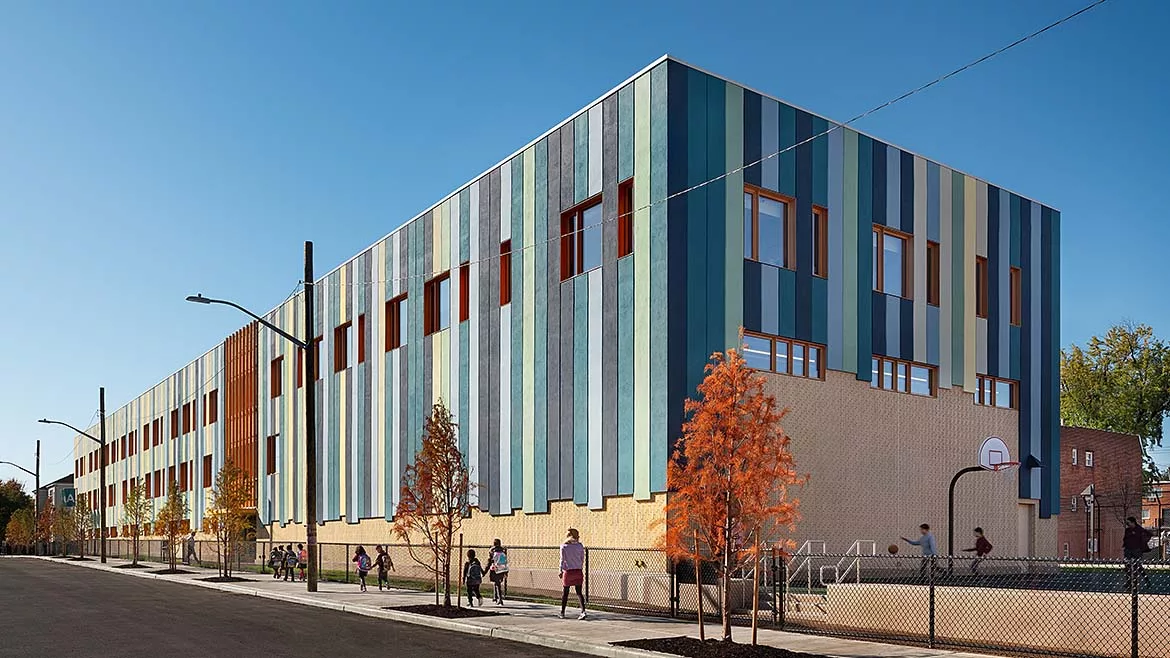
Color in architecture is not merely a visual choice, but a material decision that extends well beyond aesthetics. Climate factors, maintenance, local regulations, and psychological impact are just a few considerations. As the industry demands greater color stability and resilience, selecting the right colorant system has become a critical factor in coating formulations. With an ever-growing range of available colorant technologies, distinguishing true high-performance systems from standard formulations is increasingly important. This article reviews the optical behavior, weather resistance, and long-term color retention of advanced pigment technologies compared with conventional alternatives. High-performance colorants, when properly formulated, stabilized, and dispersed, provide measurable improvements in fade resistance, color uniformity, and aesthetic longevity.
What is a High-Performance Colorant?
High-performance color systems with catchy names are trending. But what exactly is a high-performance colorant? High-performance colorants are pigment systems engineered to meet rigorous ASTM standards for accelerated weathering, UV exposure, and long-term stability. Unlike conventional colorants, these systems use advanced pigment chemistry–polycyclic and inorganic–and controlled particle dispersion to achieve superior fade resistance, color consistency, and durability across a wide variety of environmental conditions.
Benefits of high-performance colorants include:
- Maintain vivid, consistent color with significantly improved UV-fade resistance
- Outperform and outlast the generic colorants used in house paints
- Enhanced pigment stability and dispersion
- Proven performance through rigorous testing
In short, high-performance colorants deliver beautiful, long-lasting color that stands out. But what’s the secret behind their performance? It’s all in the formulation.
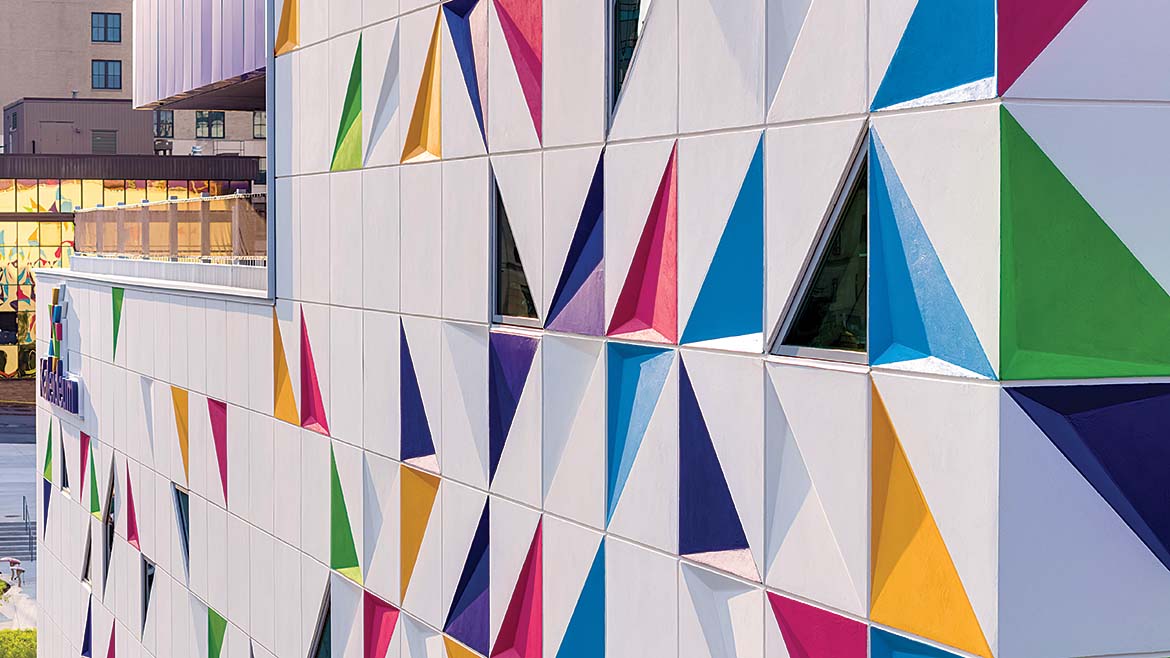
Photo: Sto Corp.
The Science Behind Longer-Lasting Color
Standard coatings typically consist of three core components: binders, pigments, and solvents, each contributing to performance in different ways. Binders (Resins), generally found in high-end acrylics, form the protective film and hold the coating together, influencing adhesion, flexibility, and weather resistance. Pigments provide high chroma and high performance for organic and inorganic types, and, depending on the pigment chemistry, contribute to UV resistance, lightfastness, and long-term stability. The careful selection of optimal pigments is the key to the “high performance” aspect of HP colorants. Solvents adjust viscosity for application and then evaporate as the coating cures.
Creating high-performance colorants requires precise formulation. This includes selecting the appropriate binder system, ensuring proper pigment dispersion, and balancing the pigment-to-binder ratio to optimize durability. Finding the right balance results in the perfect opacity (one-coat hide), color permanence, and optimal cost of use.
One of the most critical determinants of long-term color performance is the selection of optimal pigments, those with inherent UV stability, chemical resistance, and colorfastness. Even advanced binders or additives cannot overcome weak pigment chemistry, which is why high-performance colorants rely only on pigment families engineered for exterior exposure.
Advanced Pigment Chemistry and Why It Matters
At the heart of a high-performance colorant is the pigment itself, its composition, particle size, and stability. Pigments should not be confused with dyes. Dyes are soluble, produce bright colors, but lack UV stability and are not used in exterior façade finishes. Pigments, by contrast, are insoluble particles that reflect and scatter light. Their chemical structure determines not only color but also durability, UV resistance, chemical stability, and maintenance requirements. Organic pigments offer high chroma, while inorganic pigments offer opacity, added durability, and resistance to efflorescence:
- HP Colorants outperform conventional formulations through enhanced pigment stability and dispersion.
- Each colorant is meticulously balanced to withstand UV exposure, moisture, alkalinity, temperature cycles, and pollutants, conditions that typically break down ordinary coatings.
Pigments are typically classified into two categories—organic and inorganic—each with distinct performance and aesthetic implications.
The Natural Brilliance of Organic Pigments
Organic pigments are carbon-based colorants synthesized primarily from aromatic hydrocarbons, which are ring-shaped molecules composed of carbon and hydrogen. These pigments are insoluble particles that provide color through selective light absorption. Major classes include azo pigments (reds, oranges, yellows) and phthalocyanines (blues and greens known for exceptional colorfastness).
Unlike dyes, which are soluble and prone to UV breakdown, organic pigments remain insoluble and must be dispersed into a binder system to function in a coating. Their performance depends heavily on particle size, surface treatment, and the extent of stabilization within the coating matrix.1
Because organic pigments involve complex synthesis processes and specialized chemistries, they typically tend to be more costly than inorganic pigments. This cost reflects their high chroma, purity, and the manufacturing precision required to stabilize them for architectural use.
How Organic Pigments Behave in Formulation
While the chemistry of organic pigments governs their color strength and vibrancy, their durability in coating depends heavily on formulation factors, especially pigment volume concentration.
Photo: Sto Corp.
What is PVC?
PVC refers to the ratio of the volume of pigment particles to the total volume of the pigment and binder in the paint film. Essentially, it tells you how much of the paint is pigment and how much is binder that holds it together. Reducing the amount of binder compromises performance. High PVC formulations accelerate UV degradation and pigment exposure, increasing the risk of chalking and fading. Low PVC formulations eliminate chalking and fading.
Advantages of incorporating organic pigments into coatings include:
- Brilliant, high-chroma colors such as red, teals, magentas
- Lower environmental impact in many formulations
- Compatibility with water-based, low-VOC systems
However: Some lower-grade organic pigments exhibit reduced UV and heat resistance, but many modern high-performance organic pigments can deliver exceptional durability when properly dispersed and encapsulated within a high-quality binder system.
Organic pigments are ideal for accent areas, branding colors, and smaller-scale applications where high chroma is desired.
The Proven Performance of Inorganic Pigments
Inorganic pigments differ from organic pigments because they rely on minerals such as silica, alumina, and titanium dioxide, rather than carbon-based compounds. These minerals are often combined with other additives to improve adhesion, flexibility, and other performance characteristics.
Yielding more muted colors, inorganic pigments are an effective solution to environments threatened by heat, chemicals, and UV radiation. Benefits of inorganic pigments include:
- Durable, long-lasting finish
- Perfect for earth tones, whites, and muted shades
- Exceptional UV and chemical resistance
- High opacity and coverage efficiency
- Heat Resistant, ideal for full facades and high-exposure environments
- Environmentally friendly – non-flammable and no volatile organic compounds (VOCs)
Inorganic pigments, while durable and lightfast, generally yield muted colors with reduced color intensity and brightness than organic alternatives. Despite being heavy, some inorganic pigments also have poor covering power, requiring more layers or product, and certain types, such as older chromate or lead-based pigments, can pose health risks and environmental toxicity.
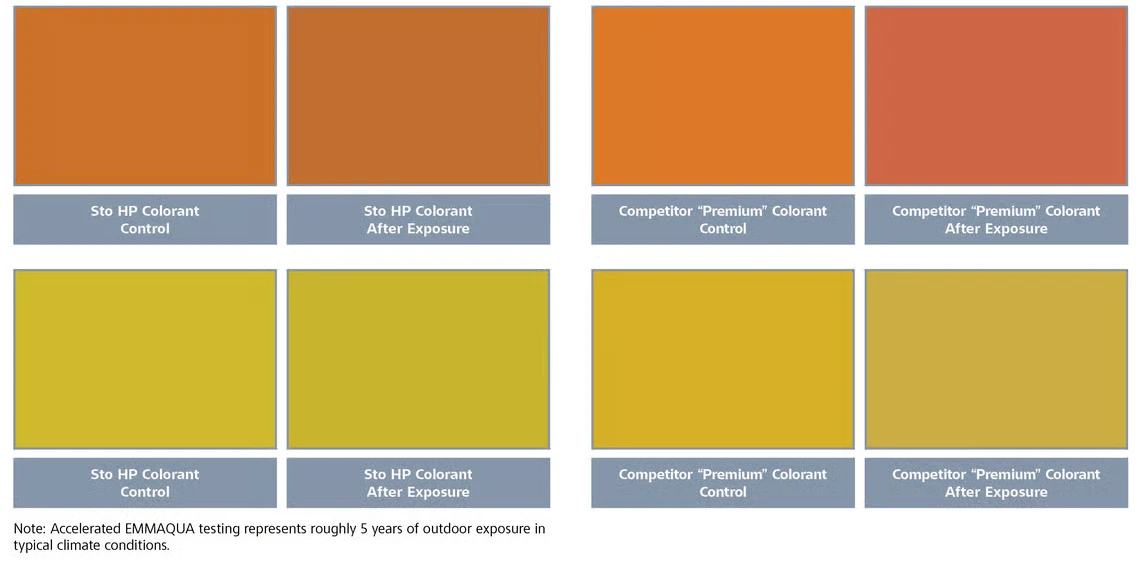
Photo: Sto Corp.
The Role of Additives in High-Performance Systems
Additives play a crucial supporting role in stabilizing pigments, enhancing application properties, and improving coating longevity. Additives allow a manufacturer to fine-tune the coating’s properties and performance. According to highperomancecoatings.org: “These additives can provide functionalities such as improved flow and leveling, anti-foaming properties, UV stabilizers, anti-microbial agents, or surface tension modifiers. The selection and incorporation of additives are based on specific performance requirements and the desired characteristics of the final coating.”
Key additive functions include:
- UV stabilizers/HALS: Reduce fading and photodegradation
- Dispersants: Keep pigments evenly distributed
- APEO free and biocides for stability and improved shelf life
- Rheology modifiers: Improves flow and leveling
- Anti-foaming agents: Prevent bubbles and surface defects
- Antimicrobials: Resistant to mold and mildew growth
Proper additive selection is essential. Incompatible additives can cause pigment flocculation, uneven color, or reduced film strength, issues avoided in well-engineered systems.
Architectural Coatings and Universal Colorants
You may have heard the term “universal colorants” before. Most often used in standard architectural coatings, these are general-purpose pigment blends designed primarily for tinting convenience, not exterior longevity, Universal colorants often include mixed pigment types, including lower-grade organics that lack the UV stability required for long-term outdoor exposure.
High-performance colorants, by contrast, rely exclusively on pigment families with proven exterior durability. In accelerated weathering tests such as EMMAQUA and QUV, high-performance pigments consistently retain color far longer than universal colorants, showing dramatically reduced fading, slower chalking, and improved long-term appearance.
This performance gap is especially noticeable in saturated hues such as reds, blues, and greens, where universal colorants often degrade quickly under UV stress, while high-performance pigments maintain brightness and integrity for many years.
The Proof is in the Performance Testing
Manufacturers claims of higher performance carry little weight without validation. The proof is in the rigorous testing that high-performance coatings undergo. Typically, these coatings endure extensive laboratory tests and field trials to evaluate properties such as adhesion, corrosion resistance, chemical resistance, hardness, flexibility, and durability. These tests help refine the formulation and adjust the ingredient ratios to achieve optimal performance under real-world conditions.
A few of these tests include:
- EMMAQUA testing method (ASTM G90) – An outdoor accelerated weathering standard that uses mirrors to concentrate natural sunlight onto test samples, simulating years of outdoor exposure in a shorter time, often by eight times the normal intensity, while periodically spraying the samples with purified water to mimic rain or dew and induce thermal shock.
- QUV (ASTM D4587) is another accelerated weathering test for paints and coatings, using a special lab device to rapidly simulate outdoor damage from sunlight (UV light) and moisture (rain/dew) in cycles, revealing long-term durability issues like cracking, fading, and gloss loss in days or weeks instead of years.
- ASTM D4541 is a test method for measuring the pull-off strength (adhesion) of coatings on rigid substrates like metal, concrete, or wood, using portable testers. It involves gluing a loading fixture (dolly) to the coated surface, applying a gradually increasing force until detachment occurs, and recording the maximum force required to determine coating quality and performance.
- SOUTH FLORIDA EXPOSURE TESTING exposes coatings to strong sun, high humidity, and salt spray to simulate real-world weathering. According to Atlas MTS, facilities use 45-degree racks (ISO 2810:2004) for 12 months or more to assess corrosion, color change, and film degradation.
These testing methods expose clear differences between high-performance pigments and universal colorants commonly used in standard architectural coatings.
Environmental Considerations of High-Performance Coatings
While the environmental benefits may not be immediately obvious, high-performance coatings significantly contribute to a building’s sustainability by:
- Preventing premature replacement of materials and structures
- Reducing maintenance requirements
- Allowing the use of lighter-weight materials that would otherwise deteriorate quickly
Per High Performance Coatings2: “High-performance eco-friendly coatings often exceed the longevity of traditional alternatives, creating significant environmental benefits through reduced maintenance cycles and material consumption. Lifecycle Advantages: Enhanced durability extends service life from 7-10 years to 15-20 years or more.”
An Obvious Choice for Beauty and Performance
Analysis of accelerated testing and exploration of colorant composition reveals that high-performance colorants enhance visual longevity, reduce fading, and improve overall aesthetic consistency. They are, simply put, the best choice for durable, high-quality exterior finishes.
If you’re looking for beauty, performance, and design freedom on your next project, consider specifying a high-performance colorant. It will hold truer to your original vision for longer while meeting a higher standard for the building owner, a win-win for all parties.
References:
1 Britannica, Pigment – Organic Colorants
2 High Performance Coatings.org
Looking for a reprint of this article?
From high-res PDFs to custom plaques, order your copy today!