From Jobsite to Tech Powerhouse
How AI is Rewriting the Rules for Building and Construction
Key Takeaways
- AI now makes tech-enabled operations practical for firms of all sizes.
- High-impact use cases like estimating, design optimization and invoicing are delivering immediate ROI.
- The biggest gains are coming from decentralizing AI across the organization.
For decades, building and construction companies sat largely on the sidelines of the technology revolution. While other industries embraced software, automation and data-driven decision-making, contractors and specialty trades were often excluded, not by lack of ambition, but by economics.
Custom technology was simply too expensive to build, too complex to maintain, and too disconnected from the realities of how construction actually operates. Margins were tight, teams were lean, and the return on large IT investments was uncertain at best. As a result, spreadsheets, emails and manual processes became the de facto operating system for much of the industry.
The consequences have been well documented. Construction productivity has lagged the broader economy for decades, contributing to chronic cost overruns, schedule delays and margin pressure. At the same time, labor shortages and an aging workforce are making it harder to rely on experience alone to offset inefficiency.
Generative AI has fundamentally changed that equation.
Today, with limited resources, small teams and minimal external support, construction companies can become genuinely tech-enabled organizations—capturing significant value, improving margins and redeploying talent toward higher-impact work. What was once inaccessible is now within reach, and the implications for the walls and ceilings industry, and construction more broadly, are profound.
Gen AI Lowers the Barrier to Entry
The most important shift brought by generative AI is not incremental efficiency; it is accessibility.
In the past, building software required large development teams, long timelines and heavy upfront investment. Gen AI flips that model. Modern AI systems can be configured rather than built from scratch, trained on existing company data, and deployed in weeks instead of years. More importantly, they can be shaped directly by the people who do the work every day.
This matters in an industry under pressure to do more with fewer experienced people. AI is increasingly becoming a structural response to labor constraints and complexity, not just a productivity enhancement.
This is why we are seeing adoption accelerate not in theory, but on jobsites, in back offices and inside estimating departments and across the specialty contracting sector.
From Weeks to Minutes: AI-Powered Estimating for Complex Renovations
One of the clearest examples comes from contractors developing AI-powered estimating solutions.
Historically, estimating complex projects, particularly Class A office renovations driven by return-to-work initiatives, required weeks of manual effort. Estimators had to interpret evolving design standards, reconcile architectural and MEP drawings, account for tenant-specific requirements, and build fragile Excel-based cost models. The process was slow, error-prone and dependent on a small number of highly experienced individuals.
AI-driven estimating tools are now transforming that workflow. These systems can read plans, extract quantities, apply historical pricing logic and generate ready-to-submit estimates in minutes rather than weeks.
For contractors and suppliers competing in fast-moving office renovation cycles, this speed is decisive. AI-enabled estimating helps teams design and price highly complex renovation scopes earlier and more accurately, respond faster to client requests, iterate options in real time and ultimately win work more quickly.
The impact goes beyond speed. By eliminating manual spreadsheet manipulation, companies have been able to reposition five to six full-time employees away from low-value administrative tasks and into sales-oriented, customer-facing roles, where human judgment and relationships matter most.
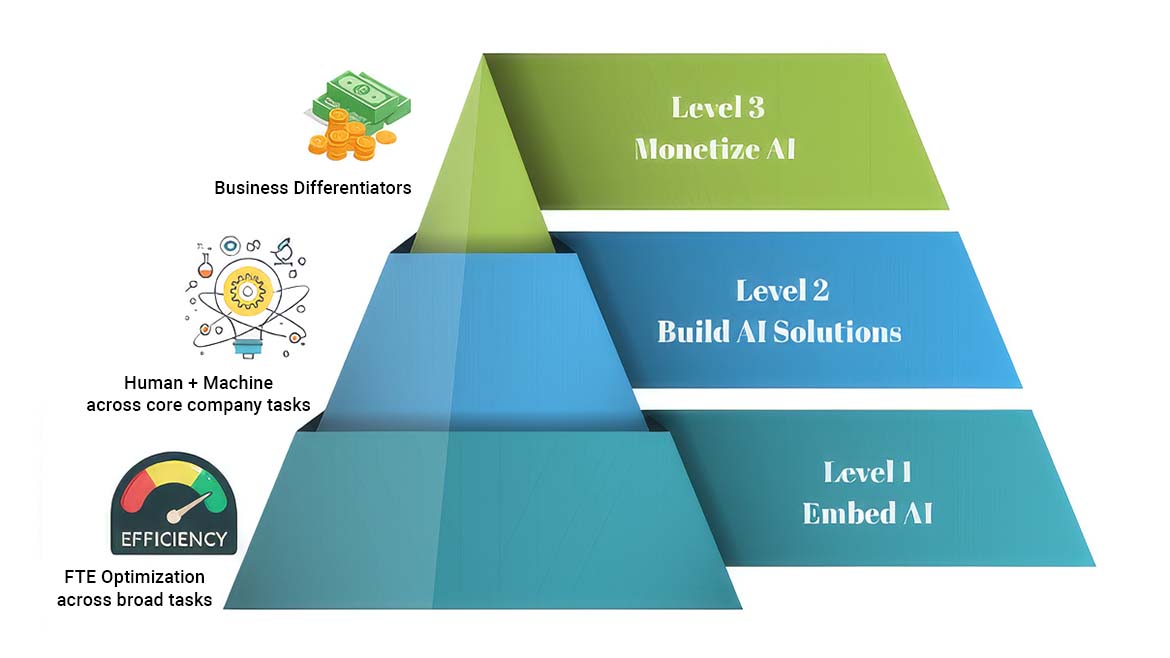
Chart: Fabien Cros
Designing for Sound, Air and Experience in the Modern Office
Return-to-work strategies are not just bringing people back into offices, they are redefining what those spaces must deliver.
Modern Class A office renovations increasingly favor open plenum designs, exposed structure and flexible layouts. While visually compelling, these environments introduce complex challenges around acoustics, airflow and occupant comfort. Poor sound control and inadequate ventilation can materially reduce focus, collaboration and productivity.
Advanced AI-driven design tools are helping teams navigate this complexity.
By incorporating scientific testing data related to acoustics and indoor air quality, AI-enabled platforms can rapidly simulate how different wall systems, ceiling treatments, baffles and airflow strategies will perform in a given space. Instead of relying on rules of thumb or limited precedent, sales teams, engineers, design professionals and customers can evaluate multiple design scenarios, balancing performance, aesthetics and cost.
For open plenum environments in particular, where traditional ceiling systems no longer mask noise or manage airflow, AI provides a way to optimize system selection, budget and performance. These tools expand the range of viable options, enabling better-informed trade-offs and more confident decisions for all stakeholders.
Automating Invoicing: Faster Cash, Fewer Errors
Another high-impact use case is AI-driven invoicing and billing automation.
Construction invoicing has long been a pain point. Manual processes, inconsistent documentation and human error often result in underbilling, missed change orders and delayed cash collection. In many organizations, entire teams exist solely to manage these workflows.
AI-based solutions now automate the end-to-end invoicing process, matching contracts, purchase orders, change orders and field data against invoices in real time. These systems routinely identify billing discrepancies that would otherwise go unnoticed.
Equally important, they accelerate cash collection. By reducing disputes and improving accuracy, companies are getting paid faster, often within 30 days versus 60-90, while redeploying teams that previously managed invoicing manually. The financial impact is immediate and material.
The Biggest Lesson: Stop Chasing One Use Case at a Time
As AI adoption scales across construction, one lesson stands out. Many companies try to identify and perfect one AI use case at a time. They pilot a tool, assign it to a small group and wait for results before expanding. While logical, this approach often limits momentum and value creation.
The companies seeing the greatest impact take a different path. They decentralize AI.
They establish governance and guardrails, then put AI directly into the hands of users—allowing innovation to emerge organically from the field, the office and the back end. The people closest to the problems drive the solutions.
The Rise of the Citizen Developer
This decentralized approach, often called the “Citizen Developer” model, is proving to be a powerful unlock.
Employees are not expected to be engineers or data scientists. Instead, they are equipped with AI tools, basic training and clear governance, enabling them to build, adapt and improve workflows on their own.
Several specialty contractors have adopted this decentralized approach with notable results. Rather than limiting AI to a single department or use case, these firms established governance frameworks and empowered employees across estimating, project management and operations to experiment with AI tools. The outcomes have included faster takeoffs, more accurate material orders, streamlined RFI responses and reduced administrative overhead, often adding up to six-figure annual savings for mid-sized firms.
The Future Is Already Here
The idea that construction companies cannot be technology leaders is no longer true. Gen AI has removed the historical barriers of cost, complexity and scale.
Today, contractors, specialty trades and material suppliers can operate like tech-enabled organizations, moving faster, pricing complex work more intelligently, designing better-performing spaces, billing more accurately and redeploying talent toward growth.
The future of the industry will not be defined by who adopts a single AI tool first, but by who builds the capability to continuously adapt. Those who move quickly will capture disproportionate value. Those who wait risk being left behind. The choice is no longer whether AI belongs in construction. The choice is how fast you are willing to embrace it.
Looking for a reprint of this article?
From high-res PDFs to custom plaques, order your copy today!