Project Profile
Mass Timber Takes Center Stage at Vancouver's New Amphitheater
The Freedom Mobile Arch combines glulam arches, CLT panels and steel supports to create a landmark public venue showcasing the potential of mass timber construction
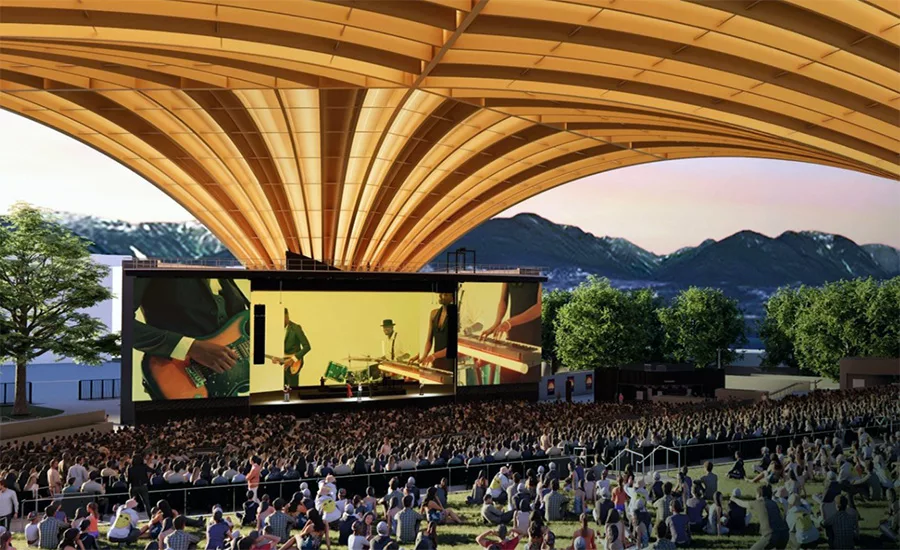
A rendering of Vancouver's Freedom Mobile Arch amphitheater shows the 345-ft clear-span hybrid steel-and-timber roof designed by Revery Architecture and engineered by Fast + Epp. The 10,000-seat venue at Hastings Park opened on June 5 and showcases one of the world's longest timber arch roof structures.
A massive timber roof over the new Freedom Mobile Arch amphitheater in Vancouver, British Columbia, is demonstrating how mass timber could become a viable alternative to steel and concrete in large public assembly venues.
The approximately $183-million venue at Hastings Park opened June 5 and will host FIFA World Cup events. Its 105-meter clear-span roof is supported by just three primary points.
The structure combines 60 glulam timber arches with three heavily loaded steel king arches arranged in six intersecting barrel vaults, creating a starburst-shaped roof over the 10,000-seat venue. The project was developed by the Pacific National Exhibition and the City of Vancouver.
"Most long-span timber arch structures worldwide are exhibition halls, arenas or soccer facilities with spans in the 80-90 m range," Fast + Epp, the venue's structural engineer, said in a project statement.
The firm's Richmond Olympic Oval roof, completed for the 2010 Winter Olympics, spanned about 95 m and was believed to be among the world's longest timber roof spans at the time.
For Fast + Epp partner Robert Jackson, the significance of the Freedom Mobile Arch lies not simply in its size but in what it suggests about timber's future in large civic venues.
"This one is what we believe to be one of the longest timber arches in the world," Jackson says. "The big innovation is pushing timber into long-span conditions and showing that it can be a good material to use for stadiums and civic centers."
Three-Point Structural Solution
Designed by Revery Architecture, the roof was conceived to meet an architectural brief that called for unobstructed views of Vancouver's North Shore Mountains while creating a covered venue that extends the city's outdoor concert season beyond the summer months.
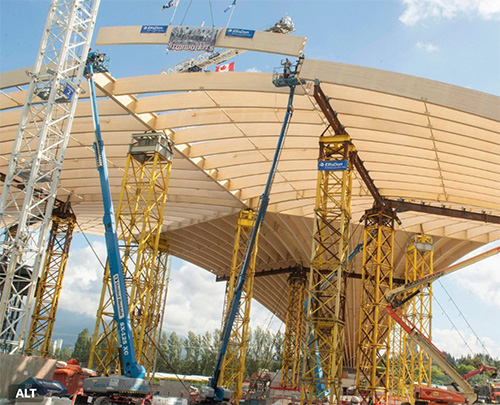
Temporary crane-mast towers and hydraulic jacks support the Freedom Mobile Arch roof during construction in Vancouver. Engineers used 13 temporary support towers while assembling the hybrid steel-and-timber structure before executing a carefully sequenced de-shoring operation once the roof diaphragm and arch system were complete.
Courtesy of the City of Vancouver/X
The resulting structure lands on three massive concrete supports positioned at the corners of an equilateral triangle, an unusual geometry that drove the engineering solution. As the timber arches splay outward toward the roof's center, they generate significant thrust forces. Those forces are transferred to steel king arches in the roof valleys before moving into the concrete buttresses.
"The king arches went steel because they took tremendous force from that kick," Jackson says. "We did try and do the king arches and the keystones in timber but felt it wasn't really the right material in the right place."
The form evolved from three intersecting barrel vaults. Engineers then lowered the valleys between the vaults, creating a doubly curved roof surface that allowed the structure to rest on three primary supports rather than four.
"What that gave us was just three points instead of four, and it worked best for the site," Jackson says, adding that the project drew inspiration from the CNIT exhibition hall in Paris' La Défense district, a postwar concrete-shell structure associated with engineer Pier Luigi Nervi.
Fast + Epp viewed the project as an opportunity to revisit a proven compression-based form using modern mass-timber fabrication, robotics-assisted machining and advanced structural modeling.
"We very quickly said, okay, that's been done by Nervi," Jackson said. "Let's see if we can do it with new materials, mass timber, steel, new technology for all the modeling of the connections and the form finding and all the machining."
RELATED
Construction Challenge
The glulam members were manufactured by Nordic Structures in Quebec and shipped cross-country by rail. Individual segments were limited to about 70 ft in length and had to be connected on site. Engineers also conducted extensive global buckling analysis, designed complex timber connections and commissioned a full wind-tunnel study to model forces acting on the open-air structure.
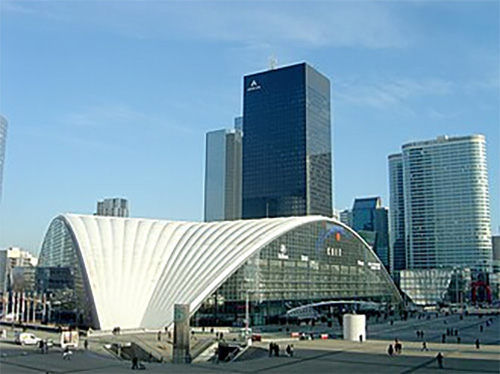
The CNIT exhibition hall in Paris' La Défense district helped inspire the structural concept behind Vancouver's Freedom Mobile Arch. Fast + Epp partner Robert Jackson said the design team looked to the postwar shell structure and asked: "Let's see if we can do it with new materials, mass timber, steel, new technology for all the modeling of the connections and the form finding and all the machining."
Image/Wikipedia
Construction relied on 13 temporary crane-mast towers equipped with hydraulic jacks to support the roof while crews assembled the steel arches, timber framing and cross-laminated timber diaphragm. Once complete, engineers executed a carefully sequenced de-shoring operation. Jackson noted that Italy-based Maffeis Engineering performed construction-stage engineering and de-shoring analysis for the project.
The erection effort unfolded under intense schedule pressure.
Jackson says that while the city plans to use the venue as a fan festival site during the World Cup, project stakeholders looked further ahead to create a covered facility that extends Vancouver's outdoor concert season beyond its traditional summer window.
He calls the project one of the strongest examples of collaboration he has seen among engineers, contractors, fabricators and specialty trades.
Fabricator Walters Group supplied approximately 800 tons of structural steel and installed both the steel and timber arch systems, including roughly 900 tons of timber arches. According to Ontario-based contractor EllisDon, crews preassembled and spliced the steel king arches on a custom truss rack before lifting them into position, with each arch weighing more than 16,000 kg.
"The canopy is incredibly challenging, and the installation is going to be equally as rewarding," Brendon Vining, senior project manager at EllisDon, said in a statement.
Asked when he knew the ambitious design would work, Jackson replies dryly, "When the jacks came down. That was a big moment for the team."
Jackson says the lessons learned on the project could extend well beyond a single venue: "The big innovation is pushing timber into long-span conditions and showing that it can be a good material to use for stadiums and civic centers."
Looking for a reprint of this article?
From high-res PDFs to custom plaques, order your copy today!

Bryan Gottlieb is the online editor at Engineering News-Record (ENR).
Gottlieb is a five-time Society of Professional Journalists Excellence in Journalism award winner with more than a decade of experience covering business, construction, and community issues. He has worked at Adweek, managed a community newsroom in Santa Monica, Calif., and reported on finance, law, and real estate for the San Diego Daily Transcript. He later served as editor-in-chief of the Detroit Metro Times and was managing editor at Roofing Contractor, where he helped shape national industry coverage.
Gottlieb covers breaking news, large-scale infrastructure projects, new products and business.

email gottliebb@enr.com | office: (248) 786-1591