History of the Gypsum Association
The Past is Prologue: The First 30 Years
Looking into the past leads us to where the Gypsum Association is today.
Looking into the past leads us to where the Gypsum Association is today.
Looking into the past leads us to where the Gypsum Association is today.
Looking into the past leads us to where the Gypsum Association is today.
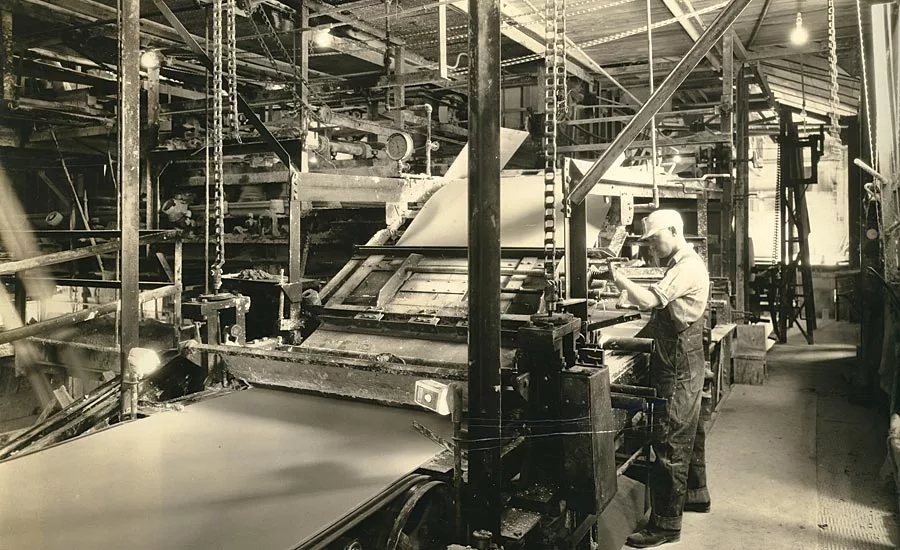
Like Walls & Ceilings, the Gypsum Association emerged during the 1930s, a time when both the manufacturing and the construction industries were caught up in the downward economic spiral we know as the Great Depression. With scant resources, the newly established association quickly identified the components needed to be successful in the industry: notably rigorous testing, standards work, identifying solutions to common technical problems and creating publications laying out best practices. Promotion efforts celebrated the versatility of gypsum as well as the important role gypsum plays in the creation of fire-resistant building assemblies. To this day, and even as our member companies continue to innovate, these efforts form the bedrock of the association’s work.
Table of Contents
How it Formed
A precursor to the Gypsum Association, the Chicago-based Gypsum Industries was an informal alliance of manufacturers who participated in third-party standards development organizations such as ASTM. In addition, Gypsum Industries supported a research associate at the Bureau of Standards, the governmental organization subsequently known as the National Institute of Science and Technology. By the late 1920s, several companies participating in Gypsum Industries supported the idea of a formal association.
The first meeting of the Gypsum Association was called to order on April 17, 1930, at the Palmer House Hotel in Chicago. Henry J. Schweim was appointed the first executive, and granted the authority to establish an office. That office was located at 211 West Wacker Drive in downtown Chicago. Schweim’s title would change over the years but he served as the chief executive officer of the GA until his retirement in 1947. Twelve company’s representatives attended the first meeting.
The association had its work cut out for it. In 1934, Buel W. Patch reported, “Before the depression residential building exceeded in value all other separate types of construction and its decline from 1929 to 1933 was more severe than that of any other branch of the industry.” He went on to note a decline of nearly 74 percent in this sector between 1928 and 1933. Reflecting the need to rebuild the industry—or at the very least shore up its existence—the activities of the association in the early years revolved around increasing the use and specification of all gypsum products, especially gypsum plaster, lath and block. In addition, the association played a key role in negotiating rail transport agreements on behalf of the entire plaster industry.
The Economy
Early records of the association reflect this dismal economic picture. Membership ebbed and flowed throughout the first decade of the association’s existence with companies continuing to resign for economic reasons. When the government passed the National Industrial Recovery Act in 1933, the Gypsum Association called an emergency meeting to galvanize the entire gypsum industry around development of a Code of Fair Practice for the Gypsum Industry. Associate membership dues were lowered significantly to ensure full participation in this new government program. With nearly 20 members participating, the association completed a draft, which was accepted by the National Recovery Administration. However, even before its sunset date of 1935, Supreme Court ruled the National Industrial Recovery Act unconstitutional.
More successful were early Gypsum Association efforts to engage in fire testing, a practice that would become a hallmark of the association. In 1931, the Technical Problems Committee requested and received approval to conduct four fire tests with the National Bureau of Standards. Developing and providing fire-rated gypsum building assemblies for the design and construction industry is work the association and its members continue to this day. Despite economic challenges, technical issues continued to be investigated via testing, or exploration of installation methods used in various regions of the country.
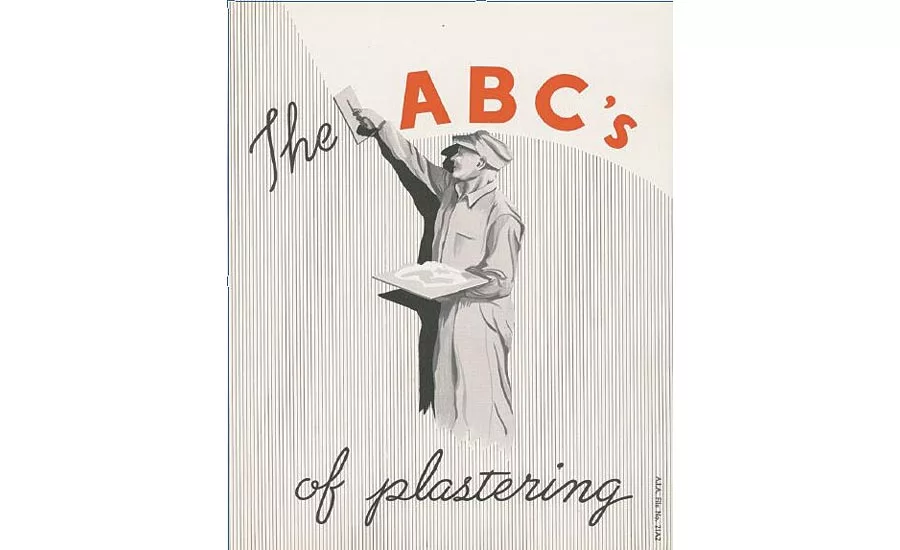
In 1938, Henry Schweim authored one of the association’s first technical publications, The Fire Resistance of Gypsum Plaster, which presented official data from fire tests performed on walls and partitions of various base construction. Shortly thereafter, the association developed The ABC’s of Plastering. The newly established Promotional Committee considered this publication “most important” and its intent were “to teach the architects the ABC’s of plastering so that they not only would be qualified to inspect but [also] that they actually would inspect it … as they now inspect other branches of the building trades.”
World War II Influences
As World War II began, all manufacturers were subject to government oversight as production was directed toward meeting the needs of the military and winning the war. Automobile construction ceased entirely as factories that formerly built cars began to produce planes and tanks. Hosiery companies switched to parachute production. Meanwhile, industries already providing military goods and machinery expanded.
Construction unrelated to the war effort was suspended. However, construction of military facilities and the expansion and renovation of plants to facilitate a switch to wartime production created a building boom of its own. Moreover, gypsum panel products were in great demand by the military for barracks, hospitals, chapels and offices—a precedent set during WWI, when the Army recognized the value of inherently fire-resistive gypsum wallboard. Over the course of the war, the military used approximately 2.5 billion square feet of gypsum board in overseas and domestic installations.
At a September 1942 meeting, the association welcomed a representative of the Building Materials Branch of the War Production Board who spoke on “promoting the use of gypsum products in place of lumber, which is becoming exceedingly critical.” Wood was in short supply because military demand was high. With wartime restrictions on steel and most metals, the use of metal lath as a base for plaster diminished quite significantly. Gypsum wallboard became the preferred product for plaster application because of its ease of installation and ready availability. In fact, metal was so scarce that glue laminated timber was used as a substitute for metal reinforcement in concrete.
Wartime industry prosperity allowed the association to engage the services of a public relations company in 1944. Looking toward the post-war future, the public relations campaign placed numerous articles in both trade and popular publications. These publications educated consumers, designers and the trades on the fire-resistance of gypsum, and generally “populariz[ing] the word Gypsum to the degree that consumers know the meaning of the word, products manufactured of Gypsum, and something of the industry’s activities—its growth and accomplishments.”
Women’s Influences
The campaign, which featured both print and radio placements, successfully leveraged the public’s hopes for the future while acknowledging that the gypsum industry was playing its part in winning the war. Stories released for the “Women’s Page” of papers across the country exemplified this approach. Women workers in the gypsum industry was a print and radio topic that led to a query from the Chicago Times requesting a survey of women who had entered the gypsum industry during the war “to ascertain their intentions of working after the war.”
Other subjects deemed interesting to feminine audiences included remodeling the attic with gypsum wallboard, remodeling rooms to suit the needs of returning service men, and a fire safety piece highlighting fire danger areas in the home—a companion to the association’s “Make the Home Front Firesafe” radio campaign that was broadcast on stations across the United States.
Post-war Building Boom
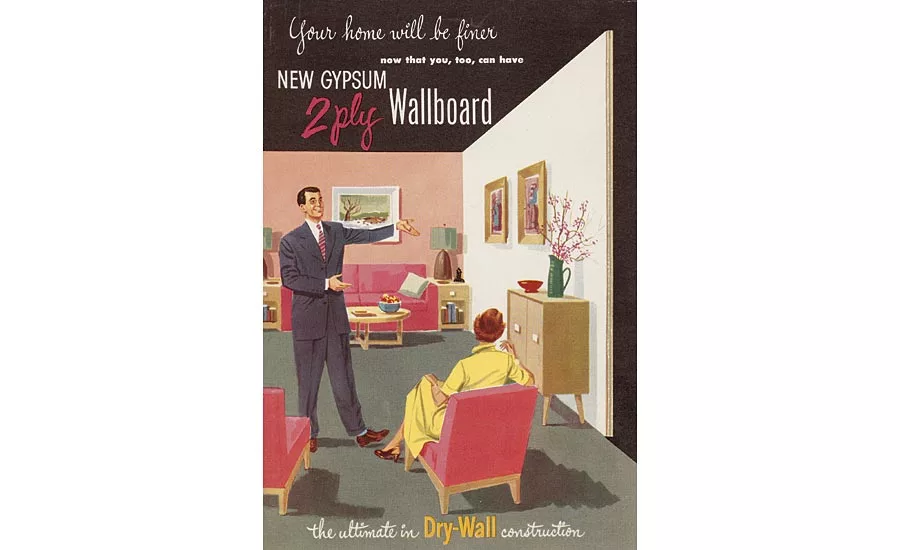
The GA anticipated a post-war building boom and its member companies were not disappointed. Lightweight gypsum lath, plaster and gypsum wallboard systems were extremely compatible with the urgency of post-war residential and commercial building efforts. In 1949, a one-hour fire rating was achieved on a system comprised of wood studs with gypsum wallboard on each side. Additional fire tests of gypsum systems, the development of specialized nails for attachment of wallboard, the use of gypsum to form curved partitions, studless partitions and sound control systems provided confidence around the use of new products, such as type X wallboard, and contributed to ease of construction. By 1955, half of new homes were built using wallboard; the other half relied on gypsum lath and plaster.
Popularizing Gypsum in Film
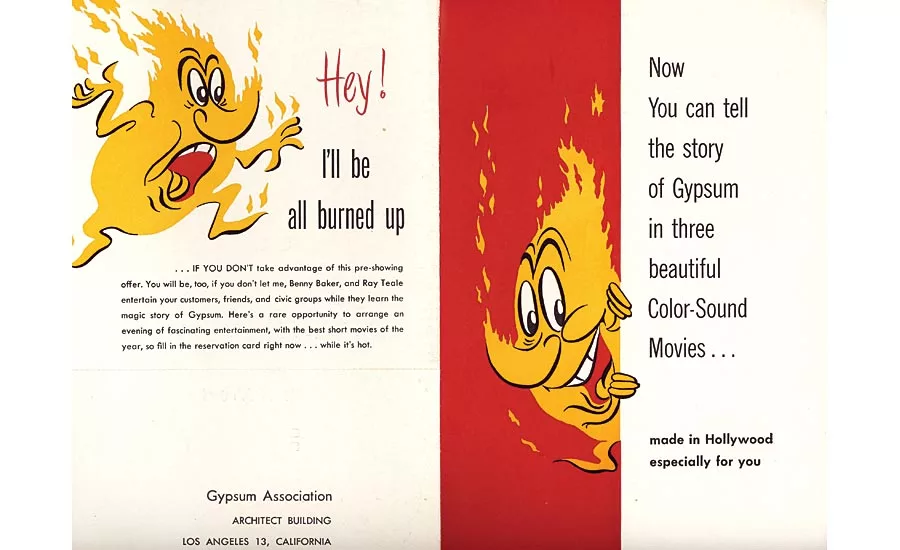
In addition to testing and technical problem solving, the association also embarked on a post-war campaign to popularize gypsum by taking advantage of a medium just entering its heyday; sponsored film. Now largely forgotten, this branch of the film industry once employed thousands of people and supported a dedicated trade journal. The association contracted with one of the very best studios working in the genre, Jerry Fairbanks Productions.
As an Academy Award winning producer and director, Fairbanks was a well-known producer and director in the Hollywood motion picture and television industry. His work spans the genre of short film and includes movies produced in collaboration with Popular Science, as well as sponsored films created for corporations including Sherwin-Williams, General Motors, and FTD, to name just a few. If the name sounds familiar to some, it is likely through the Crusader Rabbit animated series, which ran in TV syndication from 1949 to the 1970s.
Fairbanks produced at least two films for the Gypsum Association. The Gypsum Association’s Promotional Committee conceived White Magic, in 1947 to “dramatize gypsum and show its utility.” The film shows the mining and production process of member company products while emphasizing the natural fire resistive properties of the mineral and gypsum building materials. The production values of White Magic are high, with orchestral music, color animation and sweeping footage of production facilities and construction sites as well as intimate views of fashionable interiors.
Lathing and Plastering takes a different approach and focuses on the proper installation of gypsum lath and plaster. In this short film, intrepid DYI homeowner “Handy Andy, a jerk of all trades” briefly skims Lathing and Plastering in One Easy Lesson and gets right to work. Slapstick hilarity ensues. Meanwhile, on another jobsite, an expert craftsman shows how the work is properly performed.
A 1953 Gypsum Association sponsored film, Shaping The Future with Gypsum Wallboard, this time by Dallas Jones Productions, abandons comedy entirely and returns to more serious themes including the chemistry of gypsum, rigorous testing programs designed to measure gypsum’s physical properties, wall assemblies created to “relieve the growing problem of sound transmission.” The ease of installation gypsum wallboard offers in a rapidly expanding construction market, and most importantly gypsum’s inherent fire resistance. Setting the scene, the narrator intones:
Seldom has an industry faced a greater opportunity for creating ideas that are in step with the mood of our times. Our continual research and development has grown a material whose properties set few limitations on the creativity, or exactitude, of architects, engineers, builders and craftsmen. Whose remarkable qualities permit structures that combine beauty and function, economy and long life. Gypsum the magic mineral—a product not of the test tube, but of nature’s boundless laboratory.
Gypsum Association sponsored films were shown at federal agencies, schools, garden club meetings, and all types of architect, engineer and building official gatherings. Between 1950 and 1955, the 25-minute White Magic even aired on television to an estimated audience of 54 million viewers, and was shown in Paramount and Warner theaters. Now, these films can be viewed on the Gypsum Association’s YouTube channel.
The Evergreen Effect of Gypsum
Throughout the 1950s, the Technical Problems Committee continued to conduct fire tests and gather data. By 1959, the committee recommended producing a complete reference manual on fire resistance. The first Fire Resistance Design Data Manual, now the association’s flagship publication, was published in 1961 and its 30 pages included assemblies arranged according to their hourly fire-resistance rating and construction use, much like today. Sound transmission loss data also was provided. The first editions of the Manual were revised more frequently than they are today. Over the next 20 years, the Fire Resistance Design Manual was revised 10 times—a reflection of both demand, the addition of new data and changes in the building codes. It was not until 1984, when the Association produced the 11th edition, that this publication was designated “GA-600.”
Drywall would eventually render gypsum, metal or wood lath, unnecessary for modern construction, and gypsum wallboard itself would quickly become a near universal wallcovering. Ensuing decades would bring new products, including specialized performance gypsum panels. There were new technical documents dedicated to preventing and repairing problems in the field, as well as the proper installation, handling and storage of gypsum panel products. These were produced and revised by members of the association’s Technical Committee. Increasing numbers of both generic and proprietary systems would be included in GA-600, which will further expand in 2018 to include additional sound data and information on acoustics.
Still, the association’s core competencies were set within its first 30 years. While the association’s last foray into film, was entitled The Miracle Mineral, rather than the “Magical Mineral,” as it was styled in 1953, due to gypsum’s essential role in fire resistive construction these lines from Shaping The Future with Gypsum Wallboard ring as true today as they did when that film debuted, “At play, at work, at home, at school, you should never be far from a gypsum wall.”
Looking for a reprint of this article?
From high-res PDFs to custom plaques, order your copy today!




