Dual Technology Exit Signs
Increased Reliability, Whether Power is On or Off
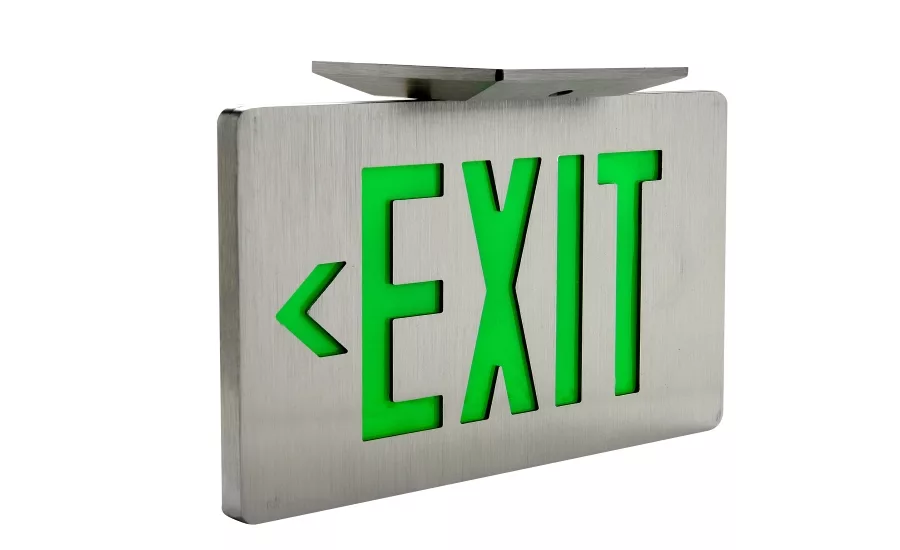
Since there is no battery to check on a monthly basis, the Dual Tech 2.0 from Isolite costs less to maintain and is expected to perform for 20 or more years, officials said.
For building and facility owners or managers striving to meet fire and safety codes, new “dual technology” exit signs are combining the efficiency of LED lighting with revolutionary new photoluminescent materials to increase reliability and performance over decades of use.
This hybrid approach combines two established exit sign technologies in a single unit – LED and photoluminescence. During normal power conditions, the sign is illuminated with highly efficient LEDs. When the power goes out, a translucent exit stencil diffusor made of photoluminescent material provides the illumination. This is charged by the LEDs while electric power is provided to the sign.
Egress marking requirements often dictate the installation of exit signs in locations of low light conditions. This problem, coupled with energy conservation strategies such as occupancy sensors, can make it impossible to use photoluminescent signs and achieve code compliance. Recognizing this problem, leading emergency lighting manufacturers now offer advanced, dual technology options that utilize internal LEDs to “charge” the photoluminescent material, rather than relying on an external charging source.
This ensures the exit sign will be visible, no matter the power conditions. The increased reliability of this dual technology also has a significant side benefit – it eliminates the need for battery backup, reducing some of the costs related to testing, maintaining or replacing exit signs over time.
“The dual technology approach eliminates the need for backup power for the exit sign, whether through an internal battery or an external inverter or generator,” says Bill Lynch, president of Isolite, a manufacturer of specification-grade emergency lighting products. “This significantly increases reliability, simplifies maintenance and reduces total costs.”
The Battery Problem
Traditionally, exit signs include internal batteries to power the sign in case of power outage, yet batteries remain the single highest potential point of failure in these systems. Batteries typically have a lifespan of 5-7 years before they must be replaced; less if damaged by corrosion, overheating, and other issues.
Because it is a safety issue, exit signs must meet a number of standards from regulatory agencies. This includes, most notably, the NFPA 101 Life Safety Code (which requires a reliable source of light and at least 90 minutes of emergency light if the building’s power goes out) and UL 924, UL’s Standard for Safety of Emergency Lighting and Power Equipment.
To meet the requirements of these codes, exit signs with backup batteries much be tested every thirty days, a practice that typically involves sending a maintenance worker to climb a ladder and push a small button that confirms the batteries are still in good working order.
In reality, these guidelines are not always followed, so if the battery fails, it is often not known until an actual power outage. If the sign fails to illuminate fully, or at all, when it is most needed, it could constitute a major life safety issue and even potential liability.
Photoluminescent Signs
Standard photoluminescent exit signs have been in use for more than a decade. However, as a standalone technology, this technology has limitations.
For example, such signs require an activating light source to shine on them during all times of building occupancy. Often the available light is not sufficient to charge the photoluminescent material, particularly as energy efficient building standards such as California’s Title 24 lead to lights being dimmed or switched off more frequently when not in use.
When insufficient light is available, photoluminescent signs will fail to illuminate to the required standards and could pose a serious safety hazard.
Better in Combination
The hybrid approach combines technologies to provide even more reliable illumination, whether the power is on or off. However, designing such units turned out to be far more complex than simply putting both in a single architectural fixture.
One system that takes this unique design approach is Isolite’s hybrid LED photoluminescent exit sign, the Dual Tech 2.0. The sign utilizes internal LEDs to charge the photoluminescent material to ensure it is visible at all times at a 100 foot viewing distance for a minimum of 90 minutes – the normal standard for electric signs.
Since there is no battery to check on a monthly basis, the unit costs less to maintain and is expected to perform for 20 or more years. The Dual Tech 2.0 comes with OSHA, NFPA 101 Life Safety Code, NFPA 70-NEC, and UL 924 approvals.
According to Lynch, special LEDs had to be manufactured to emit the specific wavelength of light required to optimally charge the photoluminescent material so that it would provide the proper illumination to meet code requirements.
Cost Savings
According to Lynch, there are other benefits to this hybrid approach as well, which costs only nominally more than the traditional LED signs
Compared with typical battery reliant, LED exit signs that use about 4 watts of power, the hybrid unit uses about half the power, less than 2 watts. This is due to a unique electronic driver circuit that provides current control and protection, which helps to ensure optimum LED efficiency and life.
Eliminating a reliance on batteries is also good for the environment, since both the manufacture and disposal of batteries involves toxic chemicals.
“While LED technology has improved to the point where it can last over 20 years, battery technology has not kept pace and has been the weak point in exit sign reliability and maintenance,” concludes Lynch. “Hybrid LED/photoluminescent technology eliminates this weakness and provides a more reliable operation for decades.”
Looking for a reprint of this article?
From high-res PDFs to custom plaques, order your copy today!