Integrated Sheathing
Integrated sheathing can be used for thermal barriers instead of layering.
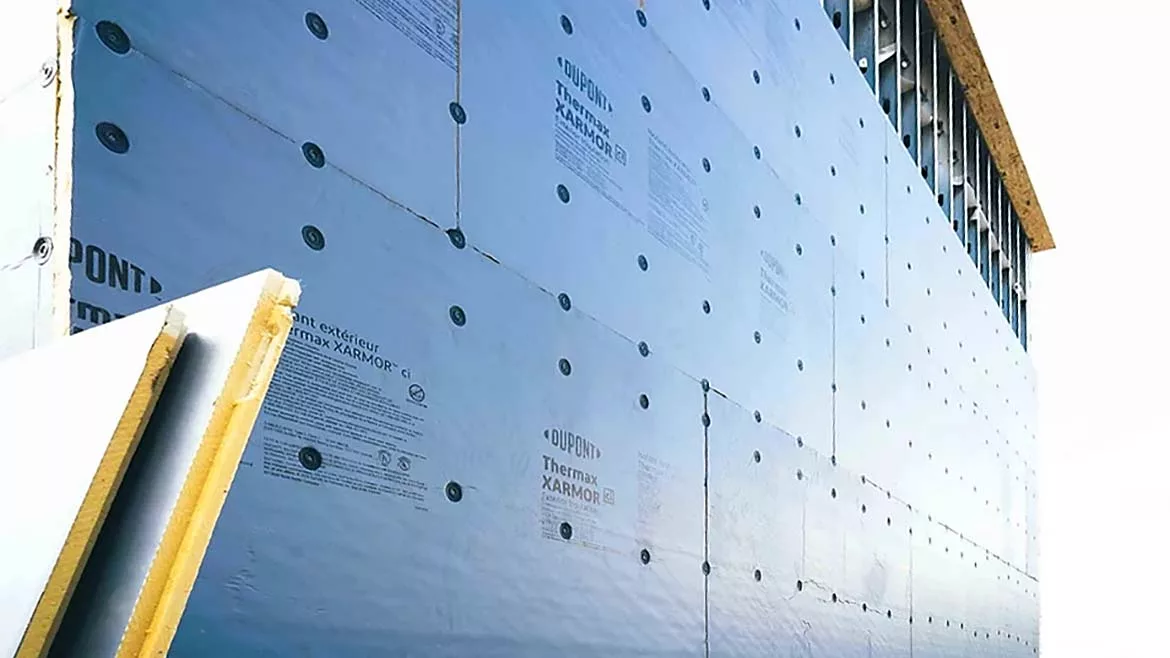
The great philosopher Plato is often cited as coining the term “necessity is the mother of all invention.” The construction industry, and specifically those of us involved in the design and construction of the exterior building envelope, has seen significant evolution of how we design and construct our buildings over the past few decades. Performance requires complete air- and water-resistive barriers to control the passage of air, water and vapor; exterior continuous insulation to reduce the effects of thermal bridging; and drainage and ventilation behind the cladding to reduce the effects of water penetration and keep walls dry.
All of these are examples of smart building envelope science that, if done right, can lead to a more sustainable and durable built environment. With the addition of these performance expectations, new products and product categories have been invented that efficiently and effectively achieve these performance goals. Integrated sheathing is a great example. What used to require multiple individual layers to achieve air, water and thermal performance can now be achieved in an integral solution, if designed and installed correctly.
Advancements in building science and building codes have created an opportunity and a need for new material science and systemized solutions that also enable builders to fit the budget, hence the invention and utilization of various forms of integrated sheathing.


Examples of integrated sheathing: continuous exterior insulation, exterior gypsum sheathing and insulated plywood, all with integral air and water barriers.
Using Control Layers
Much is expected from the building envelope with the most common control layers, consisting of the air barrier, water-resistive barrier, thermal insulation and, often, radiant/fire barrier performance. Truly sustainable wall design is only possible when energy efficiency and, most importantly, long-term durability is achieved. Perhaps the greatest enemy of long-term durability is water intrusion into the building envelope, which causes rot, decay, corrosion and mold, not to mention a loss of energy efficiency.
These various control layers all play a role in keeping moisture from penetrating the building envelope. Historically, these layers have been added one over the other, creating a semi-redundant, durable and effective building envelope. The multi-layer approach creates inherently more layers to slow down and stop water penetration, creating a robust and sustainable design. Alternatively, with the need to reduce installed costs, integrated sheathing with systemized performance solutions have been developed, which often incorporate two, three or four of these control layers into a single installed “layer.”
Examples of integrated sheathing include foil-faced polyiso insulation with fluid or tape sealant at the board joints and fenestrations, along with washers and fasteners tested to self-seal on the surface of the rigid insulation face. Additionally, exterior gypsum sheathing products are now available with integrated air or water barriers, either factory-applied on the exterior surface of the sheathing or otherwise incorporated into the gypsum. Both the insulation and exterior gypsum examples above require mechanical attachment of not only the integrated sheathing, but also the subsequent cladding through the sheathing and into the substrate or studs, creating multiple penetrations that must be sealed.
Additional integrated sheathing solutions take systemization even further to include structural and nailable or screwable sheathing, often combined with continuous insulation and the air or water barrier. The greatest advantage of these integrated and nailable or screwable sheathing solutions is that the subsequent cladding can often be attached to the structural sheathing, reducing thermal bridging of long fasteners through the insulation and to the studs. Examples of systemized integrated sheathing that includes air, water, thermal or structural capabilities can be found with both wood- and fire-resistant MgO-based sheathing.
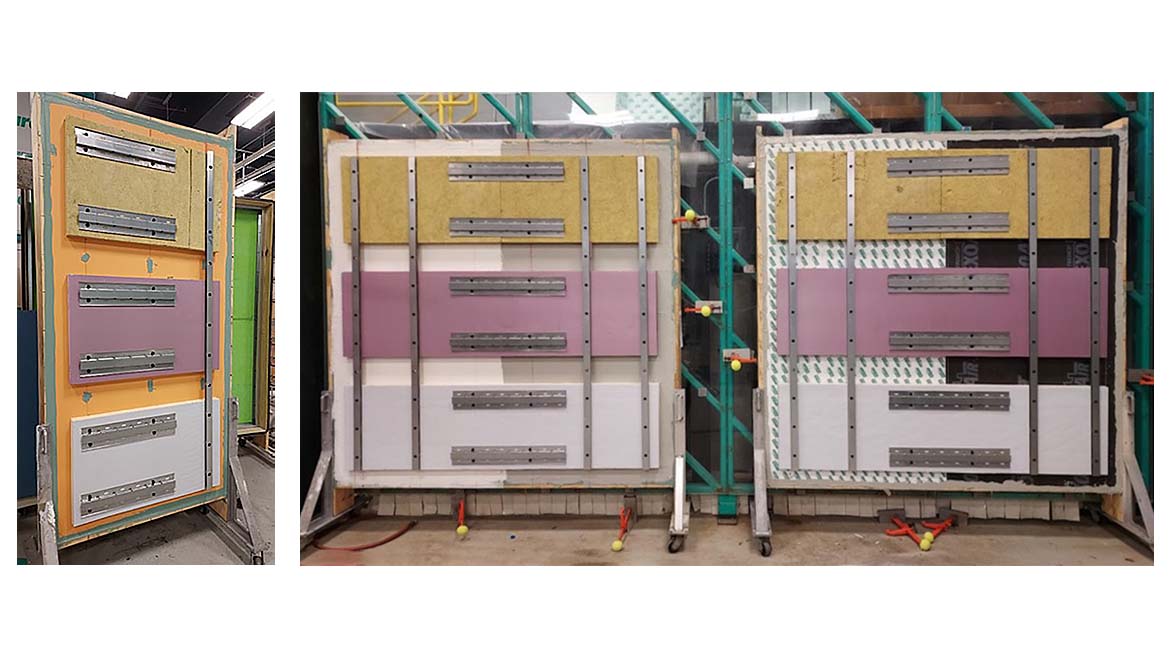
Test walls utilizing various combinations of integrated air barrier sheathing (on left), fluid-applied air barriers (middle) and self-adhered air barriers (right). Note various types of exterior continuous insulation to simulate multiple configurations.
Layered Approach vs. Integrated Sheathing Approach
Like all choices, both the “multi-layered” approach and integrated sheathing approach have pros and cons that must be considered. Pros for the “traditional” layered approach include an element of redundancy, the ability to shingle large rolls of building wraps that can span entire walls, a reduced reliance on sealants at every sheathing board joint, flexibility of various material selections for each control layer, and detailed installation of each layer by specialized subcontractors for a more robust solution. Cons for the multi-layered approach are a potentially higher construction cost, sequencing of trades and difficulty sealing fastener and anchor penetrations through the air and water barrier, often hidden behind the layer of continuous insulation. Often referred to as blind fastener penetrations, this issue can be solved easily with fasteners and anchors that utilize gasketing tube seals that penetrate the insulation and then compress against the air or water barrier to effectively self-seal the screw penetration.
Pros for integrated sheathing are a potential reduction of installed cost (possibly achieved via labor savings); consistent quality of factory-applied air or water barriers vs. field-applied (highly weather- and applicator-dependent); faster dry-in of the structure, enabling interior trades to begin work sooner, reducing further construction timelines; and confidence in specifying and building with completely tested and systemized solutions. Cons of integrated sheathing solutions include potentially higher material costs; significantly more seams between all sheathing panels, which require sealing with tape or sealants; and a lack of robust, individual control layers that otherwise add redundancy to reduce risk of moisture penetration through each individual layer.
Important to note also is that the fasteners required to attach integrated sheathing must be sealed as the air or water barrier is penetrated with a significant number of fasteners.
Furthermore, fasteners and anchors that attach outer layers, including exterior continuous insulation and cladding, must also be sealed in order to reduce the chance of moisture migration through the sheathing. Fasteners and anchors that incorporate gasketing tube seals are capable of sealing the air or water barrier hidden behind the exterior continuous insulation and are typically utilized in the case of rigid insulation that doubles as the air or water barrier since they have been tested to hold out water (typically ASTM E-331) and air (typically ASTM E-2357). It is important to note that each air and water barrier on the market performs differently when penetrated by fasteners and anchors.
An example is that when attaching integrated gypsum sheathing with air or water barriers over steel studs, the drill tip of the SDS screw doesn’t immediately penetrate the steel, but rather the screw spins to drill through the steel while the threads of the screw auger out the gypsum, enlarging the hole through the air and water barrier. The same issue is evident when attaching the subsequent cladding layer and should be addressed with fasteners and anchors, which are capable of self-sealing blind penetrations.


Tube-seal insulation fasteners and brick veneer anchor assemblies capable of sealing against air and water.
How to Use Integrated Sheathing
Integrated sheathing can be a viable solution for many types of assemblies and structures, but designers must weigh the factors per project and consider all pros and cons to determine a durable and sustainable solution that also fits the budget. Attention to details is important, from the sealing of the seams to the sealing of the sheathing fasteners to the sealing of the cladding fasteners and anchors. Expectations for building envelope performance has only become more stringent over the past couple of decades. Integrated sheathing can help meet performance and budget expectations, but with a simplification of the materials and systems comes an even greater demand to get the details right…right down to the fasteners and anchors attaching through and to the sheathing.
Looking for a reprint of this article?
From high-res PDFs to custom plaques, order your copy today!