Walls & Ceilings logo
search
cart
facebook twitter linkedin youtube youtube Spotify Podcasts Apple Podcasts Spotify Podcasts Apple Podcasts
  • Sign In
  • Create Account
  • Sign Out
  • My Account
Walls & Ceilings logo
  • NEWS
  • TOPICS
    • Drywall
    • Stucco/EIFS
    • Ceilings
    • Steel Framing
    • Fireproofing
    • Interior Plaster
    • Building Envelope
    • Insulation
    • Technology
    • Interior
    • Exterior
    • Women In Construction
  • COLUMNS
    • Up Front
    • All Things Gypsum
    • Art & Craft of Plastering
    • Stucco Stop
    • Steel Deal
    • Industry Voices
  • PRODUCTS
    • Buzz Guide
  • EVENTS
    • Industry Events
    • Webinars
    • BUILD Expo
  • MEDIA
    • Videos
    • Podcasts
    • Photo Galleries
    • BUILD26 Videos
    • Take our Quiz!
    • Infographics
  • EXCLUSIVE
    • Newsletters
    • Top 50 Contractors
    • Contractor of the Year
    • State of the Industry
    • W&C Store
    • Market Research
    • CEUs
    • Sponsor Insights
    • Custom Content & Marketing Services
  • DIRECTORY
  • EMAGAZINE
    • eMagazine
    • Advertise
    • Archive Issues
  • SIGN UP!
Building EnvelopeExterior

Rainscreen Performance

Rainscreen cladding attachment and performance considerations: beyond traditional fasteners.

By Jason Wigboldy
A building with rainscreen cladding
A beautiful example of rainscreen façade design. Note the aesthetic use of multi-cladding design, shapes, and sizes.
Images courtesy of Trufast.
April 1, 2025

The Rainscreen Association in North America defines a rainscreen as “an assembly applied to an exterior wall that consists of at least an outer layer, an inner layer, and a cavity between them, sufficient for the passive removal of liquid water and water vapor.”

The concept of multi-layered, ventilated wall construction for durability dates back to Scandinavia in 1130 A.D. Despite advances in construction technology, the core principles of rainscreen design remain unchanged—creating a multi-layered system that actively drains bulk water while passively ventilating air and vapor to ensure dry and healthy buildings.

The Benefits of Rainscreen Design

Rainscreen systems offer multiple advantages, including enhanced aesthetic flexibility and sustainability. Sustainability, at its core, encompasses energy efficiency (operational carbon), the use of recycled and recyclable materials (embodied carbon), and durability (long-lasting, healthier buildings). By employing multiple functional layers, rainscreen designs contribute to long-term structural resilience and energy conservation.
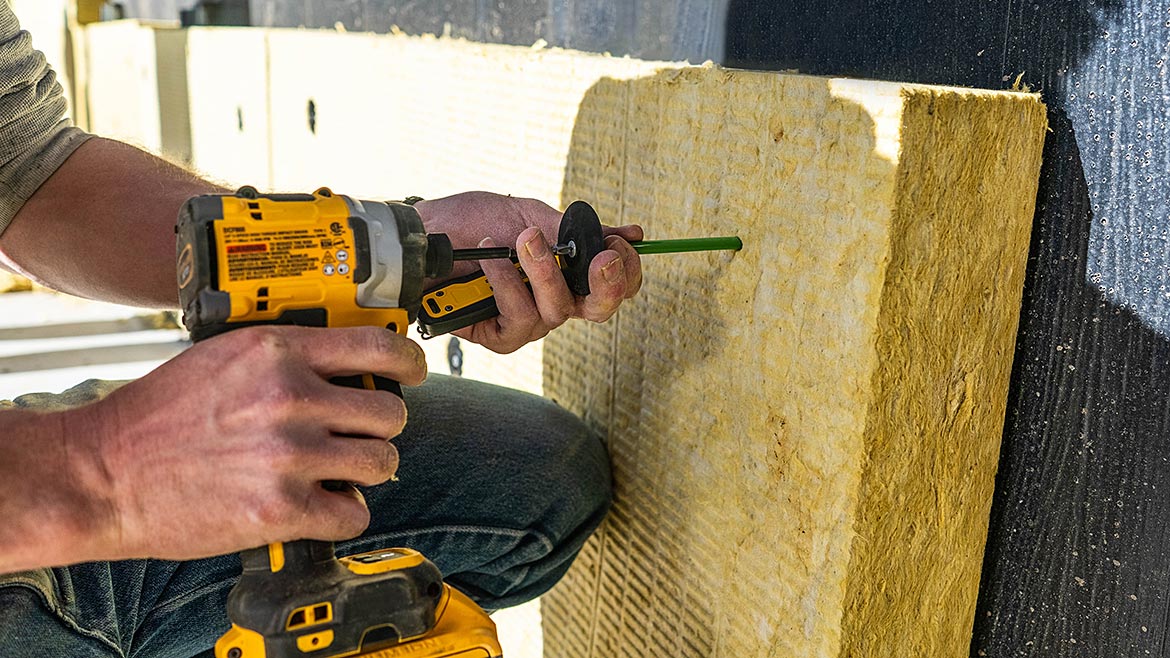
A drill and a fastener

A tube seal insulation fastener attaching continuous insulation. The green tube acts as a gasket to seal off the screw penetration of the AWRB.
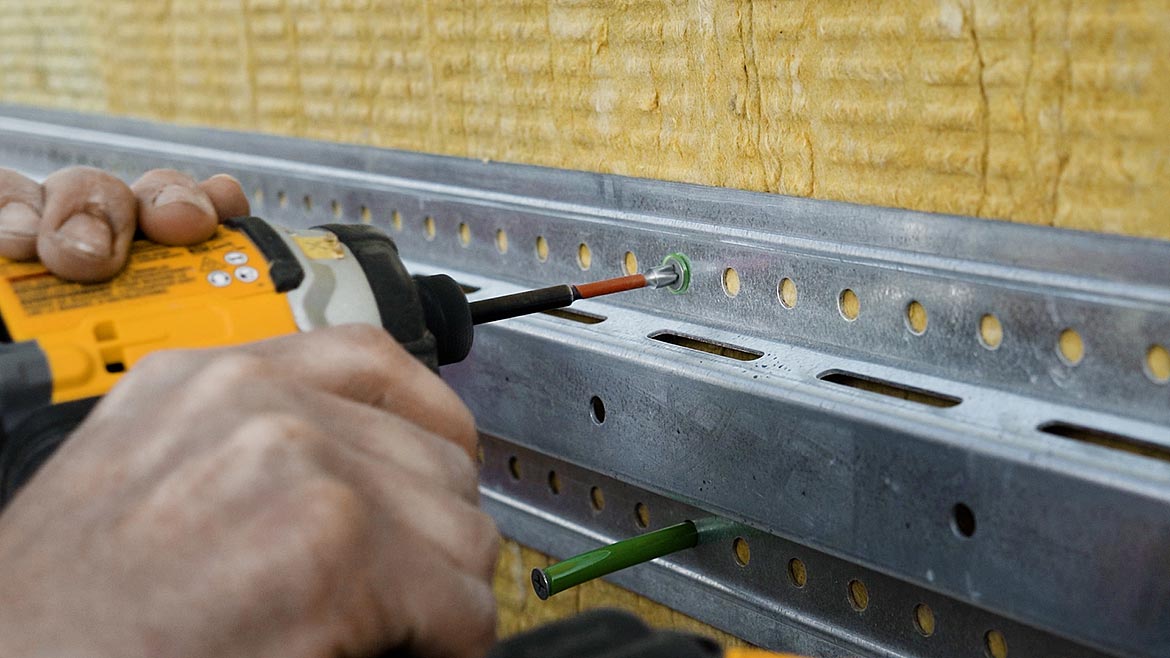
Mass Timber

A tube seal insulation fastener attaching a ventilated hat channel. The green tube acts as a gasket to seal off the screw penetration of the AWRB and also creates a thermal-break by separating the steel fastener from contacting the steel channel.

Evolving Building Codes and Multi-Layered Rainscreen Design

The term “air barrier” only became commonplace in North American construction a few decades ago. Previously, structures were designed to allow air to pass through the building envelope to remove moisture and prevent condensation buildup. While this approach facilitated drying, it compromised energy efficiency as conditioned indoor air freely escaped.

The introduction of air barriers, now mandated by code, significantly improved energy efficiency by reducing air leakage. However, new challenges arose—trapped vapor and moisture inside the envelope led to mold growth, rot, and indoor air quality concerns. Since 2012, the International Energy Conservation Code has required continuous insulation (as defined by ASHRAE 90.1), which not only enhances insulation but also shifts the dew point outward, reducing condensation risks.

The integration of air and weather barriers with continuous insulation proved beneficial, but it necessitated new cladding attachment methods. Rainscreens address this by allowing cladding to be installed over the air, water, and thermal control layers while also facilitating drainage and ventilation. This approach applies to various rainscreen assemblies, including aluminum composite material panels, metal panels, ceramics, adhered masonry (stucco, stone veneer), and masonry cavity walls.

Ventilated-channel-attached-with-tube-seal-style-fasteners

A ventilated rainscreen façade showing all control layers including AWRB (air & water resistive barrier), continuous insulation, ventilated hat channel for drainage and ventilation, and outer façade. Note the green tubes gasketing against water and air penetration of the AWRB and forming a thermal-break between the steel channel/façade and the screws. Point loads of screws in this type of assembly generate minimal thermal bridging, often less than 5% R-value reduction.

Challenges in Cladding Attachment Over Continuous Insulation

As the adoption of rainscreens increases, the challenge lies in securing these multi-layered systems effectively. While fasteners and anchors can support the weight of cladding over the air gap, their penetrations through air and water-resistant barriers pose risks of leakage. Additionally, thermal bridging through fasteners undermines the insulation’s effectiveness. Historically, the industry overlooked these issues due to a lack of solutions addressing water, air, thermal, and structural integrity simultaneously. However, continued innovation has led to the development of advanced fasteners and anchors that mitigate these concerns.

Innovations in Fastener Technology for Rainscreen Systems

Screws and metallic fasteners are essential for securing rainscreen structures against gravitational and wind loads. While non-metallic fasteners exist, they often lack the capability to drill into substrates such as steel studs, masonry, or wood, particularly under fire conditions. A new solution involves incorporating non-metallic components into metallic fasteners to reduce thermal bridging and self-seal penetrations through air and water control layers.

For instance, tube seals can be added to insulation fasteners. These seals are rigid enough to pierce through insulation but flexible enough to compress against the air/water barrier, forming an effective gasket that prevents air and water infiltration. This concept extends to various cladding attachment systems, such as hat channels with pre-punched holes for tube seal fasteners. These channels include slots to facilitate drainage and ventilation, ensuring optimal rainscreen performance.

a fastener Tubeseal

Rainscreen design isn’t just for metal panel facades, rather adhered masonry such stucco or stone veneer as well as brick or stone cavity wall construction can all be designed as a drained and ventilated rainscreen assembly using tube seal style fasteners to reduce water and air leakage and thermal-bridging.

Adhered masonry systems like stucco and stone veneer can also function as rainscreens when installed with entangled filament mesh, creating a drained and ventilated channel beneath the lath and base coat. In this setup, tube seal fasteners can be used with galvanized lath washers to seal screw penetrations while securing the lath and base coat over the air gap.

Masonry cavity walls, a common rainscreen type, consist of an internal structure (steel studs, wood studs, or block) and additional air and water control layers. The exterior brick wythe transfers vertical loads to the foundation, while lateral loads are managed by brick anchors. Advanced brick anchors now incorporate tube seals to self-seal penetrations, minimize thermal bridging, and prevent direct contact between embedded wire ties and structural screws through polycarbonate tubing.

Importantly, these tube-seal-based solutions retain metal fasteners at their core. This ensures that in the event of fire, the cladding remains securely attached to allow safe evacuation without façade delamination.

Smart Rainscreen Cladding Design

Effective rainscreen design addresses water drainage and ventilation to maintain dry walls, reduces thermal bridging through continuous insulation, and provides structural support against gravity, wind, and fire. While incorporating these control layers adds cost, fasteners and anchors must remain simple, efficient, easy to install, and cost-effective.

A tube seal fastener or anchor system offers an optimal solution, balancing performance, affordability, and ease of installation. By leveraging these innovations, builders can ensure that modern rainscreen systems meet stringent performance demands while supporting energy efficiency and long-term durability.

KEYWORDS: air barriers Altenloh Brinck & Co. building codes cladding energy efficiency fasteners RAiNA rainscreen

Share This Story

Looking for a reprint of this article?
From high-res PDFs to custom plaques, order your copy today!

Wc0423 feat mass timber p8 author wigboldy jason headshot
Jason Wigboldy is director of product development and engineering for Altenloh, Brinck, & Co US Inc., leading development projects for both the Trufast and SPAX brands of fasteners. For more information, email jwigboldy@trufast.com.

Recommended Content

JOIN TODAY
To unlock your recommendations.

Already have an account? Sign In

  • Abercrombie & Fitch

    EIFS in 2026: How Specialty Finishes Are Redefining Exterior Wall Systems

    As building codes, owner expectations, and design demands...
    Stucco/EIFS
    By: Regi Mendoza
  • proper air and vapor control

    From Energy Efficiency to Moisture Management: Why Air and Vapor Control Matter

    How proper air and vapor control within building...
    Building Envelope
    By: Benjamin Meyer AIA, LEED AP
  • Linear Metal Ceiling Beam Baffles

    Top 25 Ceiling Contractors of 2026

    Suspended ceilings demand precision, code compliance and...
    Ceilings
    By: John Wyatt and Tanja Kern
You must login or register in order to post a comment.

Report Abusive Comment

Manage My Account
  • eMagazine Subscription
  • Newsletters
  • Online Registration
  • Manage My Preferences
  • Subscription Customer Service

More Videos

Sponsored Content

Sponsored Content is a special paid section where industry companies provide high quality, objective, non-commercial content around topics of interest to the Walls & Ceilings audience. All Sponsored Content is supplied by the advertising company and any opinions expressed in this article are those of the author and not necessarily reflect the views of Walls & Ceilings or its parent company, BNP Media. Interested in participating in our Sponsored Content section? Contact your local rep!

close
  • medical professionals moving a patient on a stretcher through the halls of a medical building
    Sponsored byNational Gypsum Company

    What Does High Performance Mean When It Comes To Gypsum Boards?

Popular Stories

Wichita Biomedical Campus

Wichita Drywall Worker Dies After Scaffolding Fall

Okan Tower in Miami, Florida

OSHA Opens Investigation Into Fatal Okan Tower Column Collapse

Construction workers in safety vests install drywall

Gypsum Sales Hold Amid Market Shifts in the U.S.

data center and logos

USG, Subzero Engineering Form Data Center Alliance

Events

June 24, 2026

The Bright Side & Benefits of Designing with Integrated Lighting

Credits 1 AIA LU/HSW; 0.1 ICC CEU

This course will explore the pivotal role architects and lighting design play in creating safer, more sustainable spaces. Learn how to avoid common lighting mistakes and make informed decisions that create the best visual environment for occupants. 

January 1, 2030

Webinar Sponsorship Information

For webinar sponsorship information, visit www.bnpevents.com/webinars or email webinars@bnpmedia.com.

See our full library of webinars

View All Submit An Event

Products

2026 National Painting Cost Estimator

2026 National Painting Cost Estimator

See More Products

Related Articles

  • Thermax Wall System integrated sheathing

    Integrated Sheathing

    See More
  • Avalon Brighton, an apartment community located in Boston, Massachusetts

    Brick Rainscreen Systems Can Improve Traditional Veneer Performance

    See More
  • CLT wall panels are dropped into place by a crane.

    Mass Timber in North America

    See More

Related Products

See More Products
  • 1118458605.jpg

    Sustainable Facades: Design Methods for High-Performance Building Envelopes

  • barrys.jpg

    Barry's Advanced Construction of Buildings, 4th Edition

  • bim 3e.jpg

    BIM Handbook: A Guide to Building Information Modeling for Owners, Designers, Engineers, Contractors, and Facility Managers, 3rd Edition

See More Products

Events

View AllSubmit An Event
  • November 5, 2025

    RAiNA Conference 2025: Rainscreen Proficiency – The Parts, Precision and Performance

    If you’re passionate about the future of sustainable architecture and resilient construction, the RAiNA Conference 2025: Rainscreen Proficiency – The Parts, Precision and Performance is a must-attend event. This conference offers a unique opportunity to hear from top industry experts about the crucial role of rainscreens in modern construction. Attendees have the opportunity to be among the first to learn about pioneering ideas and groundbreaking projects, keeping them at the forefront of their field.
View AllSubmit An Event

Related Directories

  • RAiNA (Rainscreen Association in North America)

    Rainscreen Association in North America (RAiNA) is the leading authority on proper rainscreen design and construction. RAiNA is a diverse community of industry professionals who volunteer their time towards optimizing rainscreen performance expectations among a variety of stakeholders. They achieve this by influencing codes and standards, while increasing the safety and resilience for rainscreen assemblies and components
×

Connect with the industry’s leading resource for unparalleled insights and education.

Join thousands of industry professionals today. Shouldn’t you know what they know?

JOIN NOW
  • RESOURCES
    • Advertise
    • Contact Us
    • Directories
    • Store
    • Want More
  • SIGN UP TODAY
    • Create Account
    • eMagazine
    • Newsletters
    • Customer Service
    • Manage Preferences
  • SERVICES
    • Marketing Services
    • Reprints
    • Market Research
    • List Rental
    • Survey/Respondent Access
  • STAY CONNECTED
    • LinkedIn
    • Facebook
    • Instagram
    • YouTube
    • X
  • PRIVACY
    • PRIVACY POLICY
    • TERMS & CONDITIONS
    • DO NOT SELL MY PERSONAL INFORMATION
    • PRIVACY REQUEST
    • ACCESSIBILITY

Copyright ©2026. All Rights Reserved BNP Media, Inc. and BNP Media II, LLC.

Design, CMS, Hosting & Web Development :: ePublishing