Construction Hiring Slows Despite More Open Jobs
Open jobs rise but contractors stay cautious today.
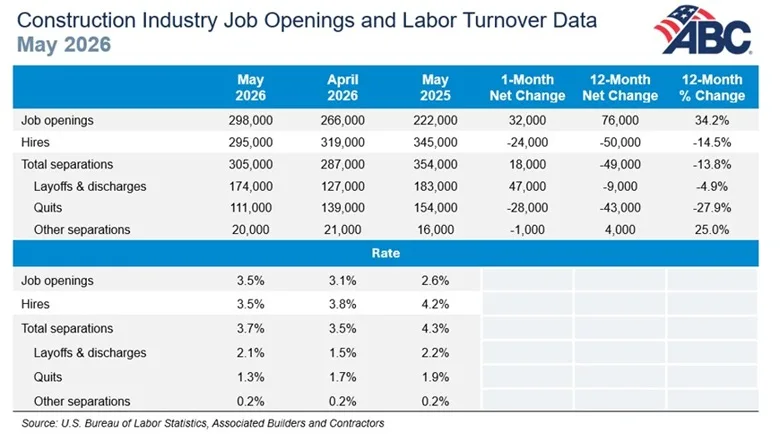
Construction job openings climbed to 298,000 in May, the highest level in 10 months, according to Associated Builders and Contractors' analysis of the latest JOLTS report. On the surface, that sounds like labor demand is heating up again. Not so fast.
ABC Chief Economist Anirban Basu says much of the increase is likely being driven by the surge in data center construction, where specialized trades (particularly electricians) are in exceptionally high demand. That's an important distinction for drywall, framing, ceilings and plaster contractors, whose labor markets don't always move in lockstep with mega-projects.
In fact, the underlying numbers tell a more cautious story.
The industry's hiring rate fell to 3.5 percent, tying the lowest level on record. Layoffs ticked higher, fewer workers voluntarily left their jobs, and overall hiring activity softened. Those are signs that many contractors remain selective about adding people, even as they continue advertising open positions.
For Walls & Ceilings readers, the takeaway is familiar. Finding qualified mechanics, finishers, framers and ceiling installers remains difficult but many firms are balancing workforce needs against uncertain backlogs, shifting project schedules and ongoing pricing pressures. Recruiting hasn't gotten easier, contractors are simply becoming more deliberate about when and where they hire.
The encouraging news is that contractor confidence hasn't disappeared. According to ABC's Construction Confidence Index, firms still expect staffing levels to grow over the next six months, suggesting they're planning for future work even if today's hiring pace remains measured.
The labor shortage hasn't gone away. It's simply evolving into a market where retention, training and productivity matter just as much as recruiting.
What ABC Was Saying a Year Ago
This same report looked very different a year ago. In May 2025, ABC reported 245,000 construction job openings, well below this year's total, and Basu noted that industry labor demand remained **subdued**, with the year's hiring pace tracking at the lowest level since the JOLTS data series began in 2000. At the time, contractors were holding on to existing employees but showed little urgency to expand payrolls.
Fast forward a year, and while job openings have rebounded significantly, hiring itself remains historically slow. The lesson for specialty contractors is clear: more openings don't automatically translate into more hiring, especially when the demand is concentrated in specific market segments rather than across the entire construction industry.
Looking for a reprint of this article?
From high-res PDFs to custom plaques, order your copy today!