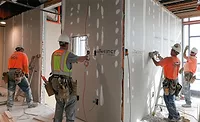
July 2026 Cover Story
Insul-Techs Adapts to Shifting Market Demands
California insulation contractor adapts to price hikes, delays, and energy code demands with SPF expertise.

Key Takeaways
- Insulation contractors are facing growing challenges from material price volatility, procurement delays, and stricter energy codes, requiring more proactive planning and tighter project coordination.
- Demand for spray polyurethane foam insulation remains strong as builders prioritize energy efficiency, airtight building envelopes, and high-performance construction assemblies.
- Proper SPF installation is critical to wall and ceiling performance, making substrate preparation, sequencing, and coordination with other trades essential for maintaining quality and meeting code requiremen.
For insulation contractors working across residential and commercial construction, the past several years have introduced a new level of complexity to jobsite execution. Material volatility, procurement delays, and evolving energy codes have reshaped how building envelope scopes are planned and delivered. For Insul-Techs Inc., a Bay Area, California-based contractor specializing in spray polyurethane foam, adapting to these pressures has required tighter coordination, disciplined workflows, and a continued focus on high-performance assemblies.
“The environment is definitely more demanding than it was a few years ago,” says Luis Ramos, co-owner of Insul-Techs located in Concord. “We’ve had to deal with price increases and occasional material delays, just like everyone else in construction. But we’ve adjusted by planning ahead and staying in constant communication with our suppliers.”
The company’s core work, installation of fiberglass batt systems and SPF insulation, places it directly within the critical path of building enclosure performance. As energy codes become more stringent and owners prioritize lifecycle efficiency, insulation contractors are increasingly responsible for delivering assemblies that meet both thermal and air barrier requirements. That shift has elevated SPF from a niche product to a primary solution in many applications, particularly where air sealing and moisture control are essential.
In the current construction climate, pricing instability has been one of the most immediate challenges. Foam systems, chemical components, and even ancillary materials such as sealants and fasteners have experienced cost fluctuations. For contractors, this introduces estimating risk and complicates bid validity periods. Insul-Techs has responded by tightening preconstruction processes and refining project controls.
“We’ve stayed steady by running tight, organized projects,” Ramos explains. “You can’t control the market, but you can control how you plan and execute. That’s where we’ve focused.”
Necessary Adjustments
Material availability has also required adjustments at the field level. While not constant, intermittent delays in insulation products can disrupt project schedules, particularly when insulation is tied to inspections or the installation of interior finishes such as gypsum board. Missed insulation milestones can cascade into delays for drywall crews, ceiling grid installation, and final close-in. To mitigate this, the company emphasizes early procurement and coordination with general contractors to ensure insulation scopes align with overall project sequencing.
Despite these pressures, demand for insulation services remains strong. The driving factor is the industry-wide push toward energy efficiency and building performance. Modern codes and owner expectations increasingly require continuous insulation, airtight assemblies, and reduced thermal bridging. Spray foam, particularly closed-cell systems, plays a central role in meeting these requirements due to its high R-value per inch, low permeability, and ability to function as both insulation and an air barrier.
“At the same time things have gotten harder, demand has stayed high,” Ramos says. “There’s a bigger push for energy efficiency and better-performing buildings, and that plays directly into what we do.”
Unique Impacts
For wall and ceiling contractors, this trend has direct implications. Assemblies incorporating SPF often alter traditional sequencing and substrate preparation. Ceiling cavities receiving spray foam must be properly prepared to ensure adhesion, uniform thickness, and continuity. Substrate moisture content, temperature conditions, and access all influence installation quality. Improper application can lead to voids, inconsistent coverage or adhesion failure; issues that can compromise both thermal performance and code compliance.
Insul-Techs emphasizes disciplined installation practices to address these risks. Certified crews are trained to monitor lift thickness, substrate conditions, and curing times, ensuring foam is installed within manufacturer specifications. This is particularly important in retrofit environments, where existing conditions may introduce variability not present in new construction.
“High-performance materials only work if they’re installed correctly,” Ramos notes. “That’s where training and accountability come in. Our crews understand that every pass, every lift matters.”
A recent project in Oakland, Calif., highlights these challenges and solutions. The retrofit of a plant nursery facility required the installation of closed-cell SPF across ceiling assemblies to improve environmental control. The design objective centered on creating an airtight, impermeable thermal layer capable of stabilizing interior conditions while reducing energy consumption.
On the Jobsite
From a field execution standpoint, ceiling applications of SPF demand careful attention to spray angle, pass consistency, and ventilation. Over-application can lead to excess material buildup and added cost, while under-application risks failing to meet specified R-values. In retrofit work, ensuring full coverage around existing structural elements (such as joists, beams, and penetrations) is critical to achieving a continuous air barrier.
“Retrofit work always brings surprises,” Ramos says. “You have to be ready to adjust in the field while still maintaining the standard. That’s where experience really shows.”
The use of closed-cell foam in this project also introduced structural and moisture management considerations. Closed-cell SPF adds rigidity and can enhance racking strength, but it also acts as a vapor retarder. Improper placement relative to the dew point can create condensation risks within the assembly. Contractors must understand hygrothermal performance to avoid trapping moisture, particularly in buildings with elevated humidity loads.
Beyond technical execution, labor management remains a key factor in maintaining productivity. Insul-Techs operates with 25 installers supported by eight office personnel, requiring coordinated scheduling and clear communication between field and management teams. In a market where skilled labor is in high demand, retaining trained applicators is essential.
“Building a strong team has been one of our biggest achievements,” Ramos says. “You need people who take pride in the work and understand the responsibility that comes with it.”
Quality control is another area where insulation contractors must remain vigilant. Unlike some other trades, insulation performance is not always immediately visible after installation. Once covered by gypsum board or ceiling systems, deficiencies can go undetected until performance issues arise. This places added responsibility on contractors to verify installation quality during application.
“Doing it right the first time is everything,” Ramos emphasizes. “Once it’s covered up, you don’t get another chance.”
The company’s affiliation with industry organizations, including ICAA and SPFA, supports ongoing training and alignment with best practices. For contractors, these associations provide guidance on installation standards, safety protocols, and emerging technologies as codes evolve.
Those industry relationships extend beyond trade associations. Insul-Techs works closely with manufacturers and distributors including Johns Manville, Owens Corning, Accufoam, Cameron Ashley Building Products, Insulation Distributors Inc. (IDI), CEE and NICE. According to Ramos, maintaining strong connections throughout the supply chain helps the company stay current on product innovations, installation requirements and evolving performance standards while providing more reliable access to materials when project schedules are compressed.
Supply chain relationships have become a competitive differentiator in today's market. Strong partnerships with distributors and manufacturers help ensure consistent material availability, which is critical when project timelines are compressed. Inconsistent supply can halt production, leading to idle crews and potential downstream impacts on other trades.
.jpg)
Photo: Insul-Techs Inc.
A Positive Outlook
Looking ahead, the outlook for insulation contractors remains positive, driven by sustained demand for energy-efficient construction and retrofit upgrades. Backlogs are holding steady, and contractors are seeing continued interest in high-performance envelope systems.
“Our backlog is solid, and we expect steady growth,” Ramos says. “The market has changed, but we’ve adapted with it.”
For wall and ceiling professionals, that adaptation is increasingly interconnected. As insulation systems become more integrated with gypsum assemblies and ceiling systems, coordination between trades is critical to maintaining continuity of the air barrier and overall assembly performance.
In a market defined by tighter margins and higher expectations, insulation contractors are taking on a more central role in delivering building performance. For Insul-Techs, the approach is clear: maintain discipline, invest in people, and execute with precision.
“The goal is simple,” Ramos says. “Deliver consistent quality, stay prepared, and keep improving. That’s how you stay competitive in this environment.”
Looking for a reprint of this article?
From high-res PDFs to custom plaques, order your copy today!